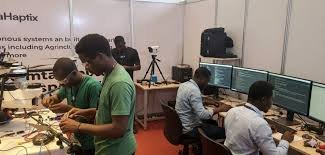
In a breakthrough moment for African tech and security, a Nigerian defence startup has successfully raised $11.75 million in a seed funding round to develop an advanced suite of homegrown defence systems that can monitor and protect critical infrastructure across the continent. This funding, one of the largest early-stage rounds ever achieved by a defence-focused African startup, marks a turning point in how Africa approaches its security challenges and technological independence.
At the heart of this story are two youthful founders, 22-year-old Nathan Nwachuku and 24-year-old Maxwell Maduka, both Nigerian engineers with a shared vision to create sovereign technologies that can help Africa protect its assets from insecurity, terrorism, vandalism and attacks that regularly threaten development efforts and economic stability.
The company, Terra Industries, was founded in 2024 in Abuja, Nigeria’s capital city, and has quickly drawn attention from major global investors. The seed round was led by 8VC, a respected US venture capital firm founded by Palantir co-founder Joe Lonsdale, with participation from heavyweights such as Valour Equity Partners, Lux Capital, SV Angel, Nova Global, and a strong contingent of African investment funds that signal rising local confidence in deep tech ventures, according to a report by Technext.
Investor backing from both sides of the world shows growing belief that Africa is ready not just to adopt foreign technology but to design, build, and deploy its own autonomous defence solutions that are tailored to its geography, operating conditions, and security needs.

Table of Contents
Investing in Africa’s security future with local talent
What makes Terra Industries unusual compared with many tech startups emerging from the continent is its deliberate focus on defence engineering and infrastructure protection, sectors traditionally dominated by Western and Asian defence firms. The founders saw an urgent need to shift this narrative. While Africa is home to some of the world’s fastest-growing economies and a booming young population, insecurity remains a heavy burden that threatens industrialisation, foreign investment and long-term growth.
Nathan Nwachuku and Maxwell Maduka bring complementary experiences to the venture. Nwachuku, who previously built a successful educational technology platform that reached global users, has spent years thinking about how to harness technology for scalable impact. Maduka, who once founded a drone company that was acquired by a larger firm at just 19, also served as an engineer in the Nigerian Navy, where he gained hands-on experience with unmanned aerial systems.
Together, they assembled a multidisciplinary team that includes former military engineers, software developers and defence specialists. According to public reports, about 40 percent of the technical team has prior experience in the Nigerian military, adding valuable operational perspective to the company’s design and deployment strategies.
The addition of Alex Moore, a defence investment expert from 8VC and a board director at Palantir, to Terra’s board further strengthens the startup’s strategic capabilities as it scales. His role is expected to help the company navigate complex defence market dynamics and accelerate its growth across target regions.
Multi-domain defence systems built for African environments
From the outset, Terra’s mission has been clear: build integrated systems that can help governments, infrastructure operators and security agencies detect, monitor and respond to threats across multiple domains — air, land, and maritime — in real time.
At the core of the company’s solutions is proprietary software called ArtemisOS, which aggregates and analyses sensor data from drones, towers, radars and ground units to identify anomalies and trigger alerts. This software platform enables teams on the ground to respond swiftly and intelligently to potential threats, reducing reliance on intelligence sourced from outside Africa.
Terra’s hardware portfolio includes long-range and short-range drones designed for aerial surveillance, ground-based robotic systems and sensor towers for perimeter monitoring, and plans to expand into maritime technology that would protect offshore rigs, underwater pipelines and coastal installations.
In a continent where many countries face security threats ranging from insurgencies in the Sahel to piracy in West African waters and sabotage on vital infrastructure corridors, the company’s approach aims to provide comprehensive and contextually relevant solutions rather than generic technology imports.
Across Nigeria and other African markets where Terra’s systems are already operational, the startup has reported that its technologies are being used to protect critical assets valued at approximately $11 billion. These include hydro power plants, mining infrastructure, and other essential industrial assets whose safety is crucial for economic continuity.
Revenue models currently include the sale of hardware systems as well as annual data processing and analytics fees that ensure sustained support and upgrades for deployed systems. In the commercial sector, Terra already counts private companies among its clients, securing both recurring revenue and proof of concept.

What the new funding means for growth and job creation
The fresh $11.75 million capital injection gives Terra Industries the runway to accelerate expansion and strengthen its technical teams across multiple continents. While the company will keep manufacturing on the African continent, with factories and production hubs anchored in Abuja, it also plans to open software and engineering offices in San Francisco and London to tap into global talent and strategic partnerships.
This approach ensures that core intellectual property development and production remain rooted in Africa while also enabling the startup to leverage global networks and expertise. The founders have made it clear that job creation and skills development for African engineers are central to their strategy, building both capacity and ownership within the local ecosystem.
Analysts see Terra’s funding success as part of a broader shift in Africa’s startup landscape, where deep tech sectors such as hardware, AI, autonomous systems, and defence technology are gaining traction alongside established favourites like fintech and e-commerce. Local venture capital firms participating in the round, such as Tofino Capital, Kaleo Ventures and DFS Lab, demonstrate increasing confidence in long-term technology bets that go beyond purely consumer-focused products.
The company’s ability to generate tens of millions in contracts even before this funding round shows there is real demand for its solutions. Terra has also reported securing its first federal defence contract, although specifics remain undisclosed. This contract milestone signals that local governments are willing to adopt African-built systems to address security gaps.
Shifting the narrative on Africa’s technological independence
For many observers, Terra Industries’ rise reflects a broader narrative of African ingenuity tackling African problems with African solutions. Too often, security infrastructure on the continent has relied on foreign technologies, intelligence and systems, creating dependencies that can delay response times and limit strategic decision-making.
By designing technology with local conditions in mind and placing intellectual property and control squarely in African hands, Terra signals a shift towards self-reliance and technological sovereignty. Its leadership believes that Africa must own its security enablers if it hopes to protect industrial assets, attract investment, and fully realise its potential as a driver of global economic progress.
The founders are outspoken about this mission. As one co-founder has put it, Africa’s industrial future and economic promise could be undermined if insecurity is not countered with systems that are both technically sophisticated and adapted to the diverse terrains and socio-political contexts across African nations.
This emphasis on local talent, local manufacturing, and local intelligence frameworks makes Terra Industries not just a business success story but a potential catalyst for broader shifts in how technology, defence, and economic development intersect on the continent.
As Terra Industries strides forward with its bold plans, its journey highlights the importance of homegrown innovation in securing Africa’s future. In a world where global geopolitics and technology races are intensifying, African-led ventures like this one remind us that solutions born on the continent can be the most effective in strengthening its resilience and prosperity.
Join Our Social Media Channels:
WhatsApp: NaijaEyes
Facebook: NaijaEyes
Twitter: NaijaEyes
Instagram: NaijaEyes
TikTok: NaijaEyes