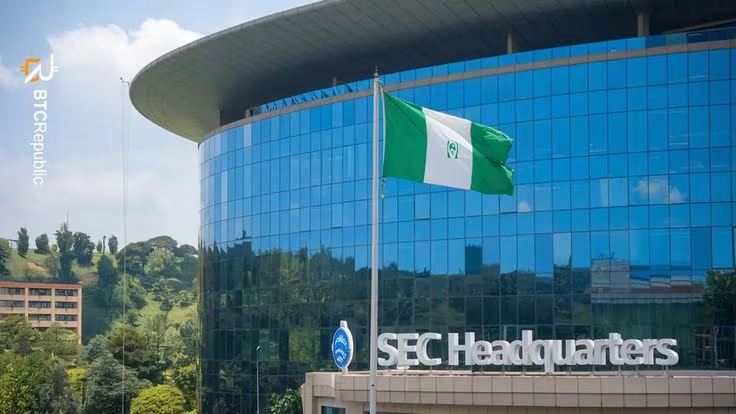
SEC Nigeria 2026 capital market agenda
As we usher in the first few days of 2026, the mood in the Nigerian financial sector is one of cautious optimism and strategic planning. The Securities and Exchange Commission, popularly known as the SEC, has unveiled its road map for the year, and it is a document that carries the weight of our national aspirations. At its core, the commission is shifting its focus toward driving long term capital formation.
This is not just corporate jargon; it is about how we can take the wealth of our nation and put it to work to build the roads, bridges, and power plants that Nigeria so desperately needs. For the professional editor watching the numbers, this move signifies a shift from a market that merely trades to one that actually builds.
Transitioning the capital market to a catalyst for national growth
The SEC has made it clear that the 2026 agenda is built on the philosophy that the capital market must be the engine room of the Nigerian economy.
In the past, many Nigerians viewed the stock market as a place for the elite or a gambling house for the lucky few. However, the new direction aims to change that narrative. The commission is looking to deepen the market by encouraging more companies to list and providing a platform where long term funds can be mobilized.
This is particularly important now that our economy needs a significant lift. By fostering an environment where businesses can access cheap, long term credit, the SEC is effectively giving our local industries the “liver” to compete on a global scale.
Closing the infrastructure gap through innovative funding models
We all know that Nigeria has a massive infrastructure deficit that has been a major “wahala” for business owners and the common man alike. The SEC is stepping up to show that the government cannot do it alone.
The 2026 agenda prioritizes the use of innovative financial instruments like infrastructure bonds and private equity funds to bridge this gap. Instead of relying solely on the federal budget, which is often stretched thin, the commission wants to create a pipeline where private investors can safely put their money into public projects.
This is a win win situation where the investor gets a steady return and the country gets the modern infrastructure needed to drive trade and commerce across our 36 states.
Protecting the Nigerian investor in a digital first economy
In this age where everyone has a smartphone, the SEC is not sleeping on technology. Part of the 2026 agenda is to strengthen the regulatory framework for digital assets and fintech innovations.
But while we embrace the new, the commission is sounding a note of warning about investor protection. The “get rich quick” schemes that have scammed many Nigerians in the past have no place in this new vision.
The SEC is committed to ensuring that every person who puts their hard earned money into the Nigerian capital market is protected by law. They are introducing more robust surveillance systems to catch bad actors before they cause havoc, ensuring that the market remains a safe space for the humble grandmother and the high net worth individual alike.
Building a resilient financial future for the next generation
Ultimately, the goal of the SEC in 2026 is to build a market that our children will be proud of. By focusing on sustainability and long term planning, the commission is ensuring that the Nigerian economy becomes more resilient to global shocks.
The emphasis on capital formation means that we are moving away from being a consumption driven economy to one that is production driven.
As an editor, I see this as a call to action for every Nigerian to take an interest in how our financial systems are run. If we can successfully fund our own growth through the capital market, then we are truly on the path to financial independence as a nation. The journey of a thousand miles has already started with this agenda, and it is up to all of us to ensure it succeeds.
Join Our Social Media Channels: