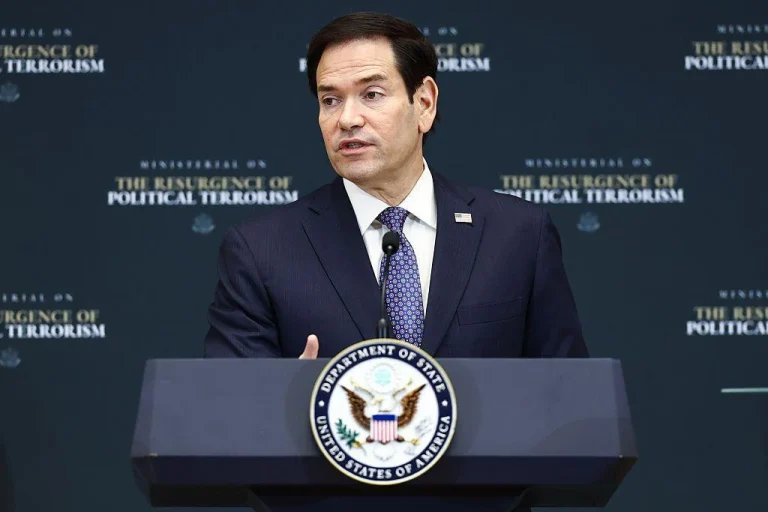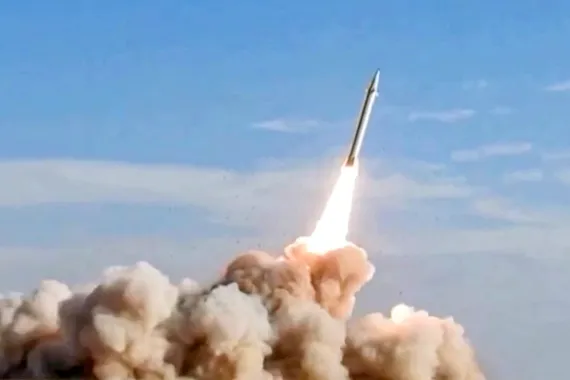

US forces struck Iran for the first time in a month on Sunday. They hit two Iranian launchers on Larak Island in the Strait of Hormuz. Iran responded within hours by firing ballistic missiles at two US air bases in Jordan, but the Jordanian air defenses intercepted eight of them. This recent exchange marks a dangerous escalation in a six-month war that had stalled since late July.
US Central Command spokesperson Captain Tim Hawkins confirmed the strikes. He said American forces observed Islamic Revolutionary Guard Corps (IRGC) personnel preparing to deploy rockets loaded with sea mines into the Strait of Hormuz. The US acted preemptively.
Hawkins said in a statement, “I can confirm that earlier today, US forces struck two Iranian launchers on Larak Island. US forces are monitoring the area closely and remain prepared to protect the free flow of commerce through this essential waterway.”
Larak Island sits approximately 20 miles south of the Iranian mainland. It is a key strategic position in the Strait of Hormuz, the chokepoint through which one-fifth of global oil shipments pass. Iran has concentrated assets there to control the waterway.
The strikes came just days after President Donald Trump announced that the US Navy had cleared all mines from the strait’s main shipping lane. He warned that any vessel attempting to place new mines would be “immediately and systematically destroyed.” The IRGC’s activity on Larak Island appears to have triggered that threat.
Iran’s response was swift and fierce.
The IRGC launched ballistic missiles and drones at King Hussein Air Base and Al-Azraq Air Base in Jordan. The latter is also known as Muwaffaq Salti Air Base. Iranian state media claimed the strikes inflicted “heavy damage” on technical infrastructure and fighter jet positions.
Jordan saw it differently.
Its armed forces announced they had intercepted and destroyed eight missiles that entered the kingdom’s airspace. The military said the projectiles were already neutralized before they could threaten civilians or property. A US official told Fox News that nearly all Iranian missiles in the latest phase had been intercepted.
The human cost of the Larak Island strike remains unclear. Iran’s semi-official Tasnim news agency reported that the US attack killed and wounded several soldiers and civilians. It did not provide an exact death toll of the US attack. IRGC spokesperson Sardar Mohibi called the strikes “a strategic and fatal error.” He warned the US would “pay the consequences of this miscalculation in both the economic and military arenas.“
President Trump added to the confusion with a late-night post on Truth Social. He wrote, “Kharg Island being blown to smithereens!!!” and shared an AI-generated video depicting Iran’s key oil export hub engulfed in flames. It was not immediately clear whether he was implying that Kharg Island had also been attacked. US Central Command did not confirm any strike on the island.
The US-Iran war reached its six-month mark on August 28. A memorandum of understanding that had largely paused hostilities expired on August 17. The Trump administration had recently pivoted to economic pressure rather than military action. Treasury Secretary Scott Bessent unveiled “Operation Economic Outcast” last week, warning foreign governments and companies that continued business with Iran could cost them access to US financial institutions.
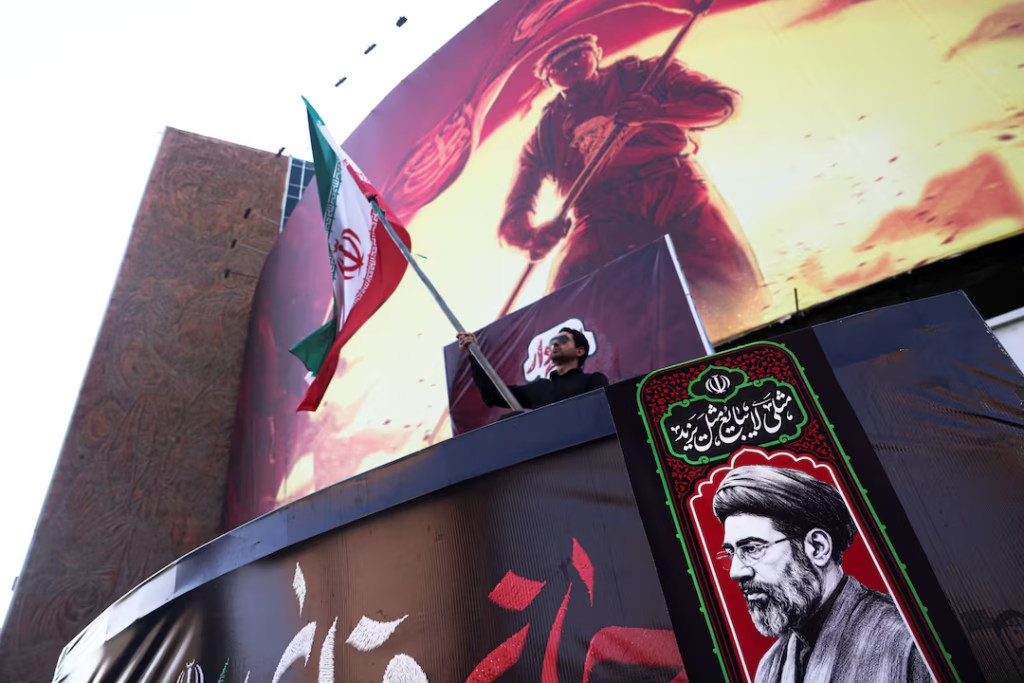
That economic strategy now lies in tatters. Sunday’s strikes and the immediate retaliation suggest both sides have abandoned diplomacy. Dr. Trita Parsi of the Quincy Institute for Responsible Statecraft wrote that Tehran’s strategy is to wait for Trump to return to the MOU, while Trump has barred US officials from engaging with Iran and committed himself to economic warfare.
READ ALSO: US-Iran Conflict: Oil Prices Surge, Stocks Slide as Strikes Resume
The war has already killed thousands and displaced millions of people from their homes. At least 18 US soldiers have died. A Reuters/Ipsos poll published on August 24 showed only 31 percent of Americans approve of the war. Republican support is declining. Trump faces growing pressure to end the conflict rather than escalate it.
The coming days will be critical. Will the US strike again? Or will Iran expand its attacks to other US bases in the region? Will mediators from Pakistan, Qatar, or Oman find a path back to talks? Or is this the start of a new, deadlier phase in a war that has already lasted half a year?
From the Strait to the Brink: How Six Months of War Brought the Middle East to the Edge
The US-Iran war began in February 2026, and the exact trigger of the war remains disputed. What is clear is that Israel launched strikes on Iranian nuclear facilities and the US joined the offensive. Iran retaliated with missile and drone attacks on US embassies and military installations across the Gulf. The conflict spread like wildfire.
NATO found itself drawn in as Iranian drones and missiles were intercepted near Incirlik Air Base in Turkey. Spain, a NATO member, refused to allow US use of its air bases. Trump threatened to cut trade with Madrid; however, the alliance showed cracks under the pressure.
Iran’s strategy has been horizontal escalation and widening the conflict beyond military might. It targeted political and economic pressure points. This was aimed at making the war too costly for the US and Israel to sustain. The Strait of Hormuz became its primary leverage point; relatively few oil and LNG tankers now risk the passage. Global energy markets have felt the squeeze.
The June memorandum of understanding offered a glimmer of hope. It was not a peace deal, but it paused the worst of the fighting. Both sides used the lull to regroup, and then it expired on August 17. Neither side moved to extend it, and the path back to diplomacy closed.
Trump’s “Operation Economic Outcast” was supposed to break the deadlock. It threatened to isolate Iran financially by giving countries a choice: do business with Tehran or with Washington. China, Iran’s biggest trading partner, faced a dilemma. Bessent said he was “giving everyone the opportunity to remedy bad behavior.” He asked, “Why would I want to blow up the global financial system?”
That economic strategy lasted less than a week. The IRGC’s minelaying preparations on Larak Island forced Trump’s hand. He had drawn a red line around the Strait of Hormuz and could not afford to look weak. The strikes followed from the US, and so did the retaliation from Iran
Now the world waits.
Oil prices will spike on Monday morning; Asian markets will open nervously. European leaders will call for restraint. And in Washington, Trump must decide whether to double down or step back. The choice he makes could determine whether this war ends in months or drags on for years.
For Nigerian and African observers, the crisis carries economic weight. Nigeria is an oil exporter. Higher prices benefit the government in the short term. But global instability hurts trade, investment, and growth. African nations import refined petroleum, and they pay more when the Strait of Hormuz closes. The war’s ripple effects reach every corner of the continent.
The Middle East has seen too many wars. It has seen too many red lines crossed. Sunday’s exchange over Larak Island may be forgotten in the grand sweep of history. Or it may be remembered as the moment the US-Iran war reignited with devastating force. Only time will tell.
For now, the missiles have flown, the interceptors have fired, and the world holds its breath.