The Budget “Reset”: Nigeria Shifts to Single Fiscal Cycle in 2026
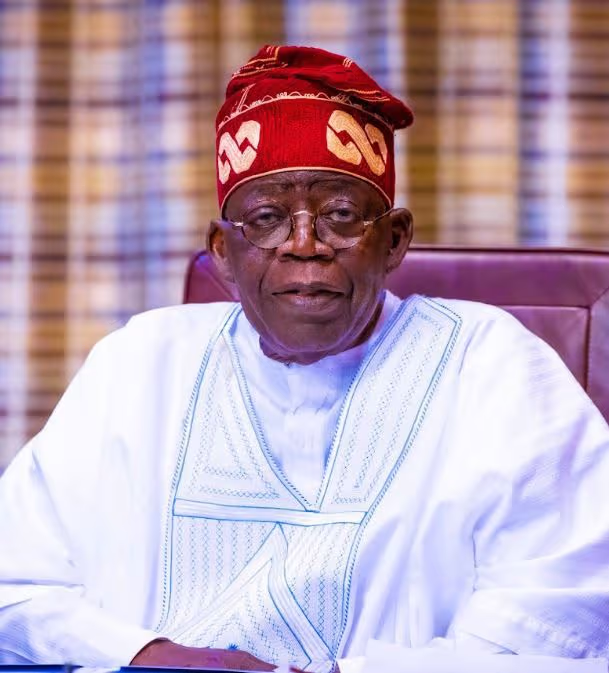
In a major overhaul of Nigeria’s financial management, President Bola Tinubu has announced that the country will officially transition to a single annual budget cycle starting April 1, 2026.1
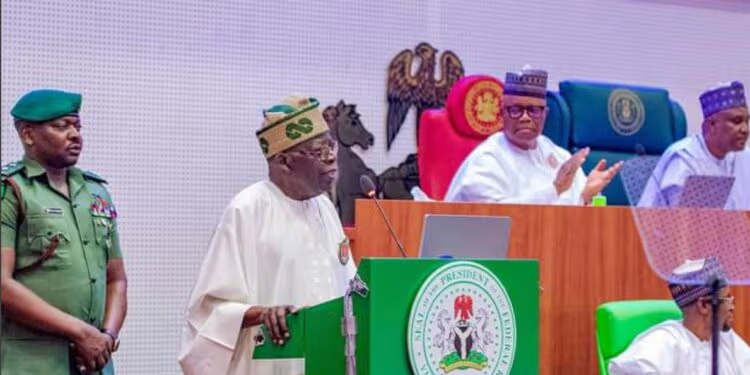
Speaking during the presentation of the ₦58.18 trillion 2026 Appropriation Bill on December 19, 2025, the President described the move as a “hard reset” designed to eliminate the confusing overlap of multiple budgets that has historically slowed down project execution and weakened transparency.2
Table of Contents
The “Single Cycle” Promise: Ending Budget Overlaps
The 2026 “Budget of Consolidation” by the Numbers
Key Sectoral Allocations: Security and Infrastructure Lead
Fiscal Reset: Repealing the 2024/2025 Overlaps
Economic Assumptions: Oil, Naira, and Growth
1. The “Single Cycle” Promise: Ending Budget Overlaps3
For years, Nigeria has struggled with “budget rollovers,” where capital projects from previous years remain unfunded while new budgets are launched.4 President Tinubu’s new directive aims to stop this “habit of running three budgets in one inflow”.5
Deadline for Cleanup: All capital liabilities from previous years must be fully funded and closed by March 31, 2026.6
Effective Date: The new, clean cycle begins April 1, 2026.7
The Goal: A “no overlaps, no excuses” framework backed by a single revenue cycle to ensure every Naira is accounted for and projects are completed on time.8
The 2026 “Budget of Consolidation” by the Numbers
Titled the “Budget of Consolidation, Renewed Resilience and Shared Prosperity,” the 2026 proposal is the largest in Nigeria’s history, focusing on stabilizing the economy after years of reform.9
| Category | Amount | % of Budget |
| Total Expenditure | ₦58.18 Trillion | 100% |
| Capital Expenditure | ₦26.08 Trillion | 44.8% |
| Debt Servicing | ₦15.52 Trillion | 26.7% |
| Recurrent (Non-Debt) | ₦15.25 Trillion | 26.2% |
| Projected Revenue | ₦34.33 Trillion | — |
| Budget Deficit | ₦23.85 Trillion | 4.28% of GDP |
Key Sectoral Allocations: Security and Infrastructure Lead10
The 2026 budget prioritizes the “bedrock of development”—security—while continuing heavy investment in human capital.11
Defence & Security (₦5.41 Trillion):12 Focused on modernizing the armed forces and intelligence-driven policing.13
Infrastructure (₦3.56 Trillion): Prioritizing the completion of ongoing roads, bridges, and power projects.14
Education (₦3.52 Trillion): Includes significant funding for the Nigerian Education Loan Fund (NELFUND), which already supports over 418,000 students.15
Health (₦2.48 Trillion): Aimed at maternal and child health and strengthening the primary healthcare system.16
Fiscal Reset: Repealing the 2024/2025 Overlaps
To prepare for the April 2026 start date, the government is currently “cleaning the books.” President Tinubu has asked the National Assembly to repeal and re-enact the 2024 and 2025 budgets into a unified ₦43.56 trillion framework.17
This legislative move consolidates emergency expenditures and ensures that the 2025 budget implementation officially ends on March 31, 2026, creating a clean slate for the new cycle.18
Economic Assumptions: Oil, Naira, and Growth
The budget is built on several conservative macroeconomic pillars aimed at ensuring fiscal realism.19
Oil Benchmark: $64.85 per barrel.20
Oil Production: 1.84 million barrels per day (mbpd).21
Exchange Rate: ₦1,400 to $1.22
GDP Growth: Projected at 4.68%.23
Inflation: Target of 16.5%.24
Join Our Social Media Channels:
WhatsApp: NaijaEyes
Facebook: NaijaEyes
Twitter: NaijaEyes
Instagram: NaijaEyes
TikTok: NaijaEyes