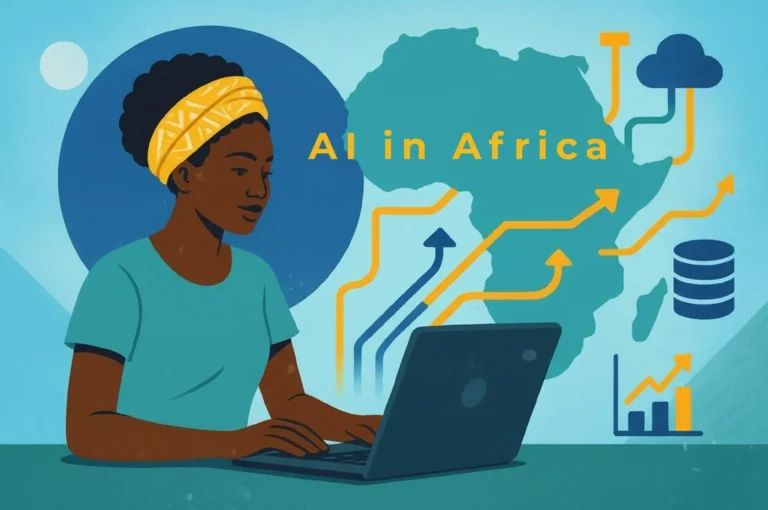

Africa’s technology story is changing quickly. Artificial intelligence, cloud computing, fintech, digital education and data-driven businesses are expanding across the continent, creating opportunities that were difficult to imagine a decade ago.
But beneath this exciting growth is a less glamorous question that could determine whether Africa becomes a major technology producer or remains largely a technology consumer: who owns the infrastructure that makes the digital economy possible?
The issue has become more urgent as global investment in AI infrastructure accelerates. Data centres, fibre networks, cloud platforms, electricity systems and computing facilities are becoming as strategically important as roads, ports and industrial parks were during earlier periods of economic development.
For Africa, building these systems locally and regionally is not simply about technological pride. It is about economic competitiveness, national security, jobs, data protection and the ability to determine how the continent participates in the next industrial revolution.

Africa’s AI ambitions are running into an infrastructure problem
The continent has made considerable progress in connectivity, but the foundation remains uneven. The African Union has identified digital infrastructure, computing capacity, skills and data as important pillars of its artificial intelligence ambitions. In 2025, the AU noted that Africa accounted for only about 1 per cent of global AI compute capacity and called for investment in renewable-powered data centres, regional computing hubs and cross-border digital infrastructure.
The electricity challenge is particularly important.
Artificial intelligence may appear to exist inside a laptop or smartphone, but the systems behind it depend on enormous amounts of physical infrastructure. Data centres need continuous electricity, cooling systems, fibre connections and reliable access to land and water.
The World Economic Forum reported in July 2026 that African data-centre electricity demand could increase from about 0.4 gigawatts to 2.2 gigawatts by 2030. That growth will put additional pressure on already constrained power systems.
This is why Africa cannot treat AI infrastructure as a technology-sector issue alone. Energy policy, telecommunications, education, finance and industrial policy must increasingly work together.
The World Bank’s 2026 assessment of AI readiness makes a similar point, identifying connectivity and reliable electricity, computing infrastructure, quality data and skills as essential foundations for countries hoping to benefit from AI.
Back story: Africa has an opportunity to avoid another dependency
Africa has historically imported much of the infrastructure and technology required for economic development. The digital economy could either repeat that pattern or create a different model in which African countries become active owners, developers and operators of critical technology infrastructure.
There are already signs that governments are beginning to recognise this.
The African Union has been pushing for greater digital sovereignty and continental infrastructure integration. In January 2026, the AU Commission said more than 80 per cent of Africa’s internet traffic was being routed outside the continent, highlighting the need for a stronger continental fibre backbone.
Nigeria is also moving in this direction. In August 2026, the Federal Government launched its National Digital Cloud Policy, with a target of attracting $750 million in private investment over the next 24 months for cloud and digital infrastructure.
Nigeria’s National Information Technology Development Agency has also moved towards a National Sovereign Cloud Initiative, establishing a framework covering cloud providers, data centres, AI infrastructure and government digital assets.
These developments matter beyond Nigeria. Africa’s largest economies can potentially become regional technology hubs, providing computing, cloud and data-hosting services to neighbouring countries rather than every country attempting to build everything independently.
The opportunity is therefore not necessarily for every African nation to build a massive hyperscale data centre. It is for the continent to develop interconnected infrastructure that strengthens African capacity as a whole.
What Africa needs to build before the next industrial revolution
The first priority should be reliable and affordable electricity. AI infrastructure cannot operate consistently where businesses and data centres are forced to depend on expensive backup power. Africa therefore needs to connect digital infrastructure planning with renewable energy, gas, grid expansion, storage and regional electricity markets.
The second priority is local and regional data-centre capacity. Africa currently has less than 1 per cent of global data-centre capacity despite being home to nearly one-fifth of the world’s population, according to CNBC Africa’s July 2026 report.
Third, the continent needs stronger fibre networks and internet exchanges. Keeping more internet traffic within Africa could improve resilience, reduce dependence on external infrastructure and support faster digital services.
Fourth, African universities, researchers and startups need access to affordable computing resources. It is difficult to build globally competitive AI companies when researchers cannot access the computing power required to train, test and deploy advanced systems.
Finally, infrastructure investment must be connected to human capital.
Africa’s greatest advantage may not be its minerals or even its growing digital markets. It is the people who will build, operate and adapt the technologies of the future. Governments need to invest in computer science, engineering, data science, vocational training and research while creating opportunities for skilled Africans to build companies at home.
The World Bank’s 2026 World Development Report argues that developing countries do not necessarily need to build trillion-dollar AI models to benefit from the technology. However, they do need reliable electricity, internet access, computing infrastructure, skills and systems that allow AI to be adapted to local languages, institutions and development needs.
That should be the central lesson for Africa.
The next industrial revolution will not be won simply by having the best AI applications. It will be shaped by whoever controls the infrastructure underneath them.
Africa has the entrepreneurs, young population, natural resources and growing digital markets to become a serious technology power. What remains is the harder task of building the electricity systems, data centres, fibre networks, cloud platforms, computing capacity and skills needed to support that ambition.
If African countries act now, the continent can move from simply using technologies developed elsewhere to helping determine what the next era of technology looks like.