
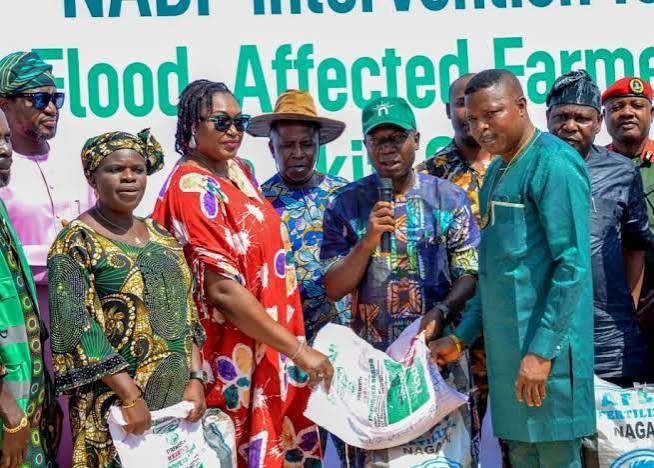

The Federal Government, acting through the National Agricultural Development Fund (NADF), has launched an emergency recovery initiative to support close to 22,000 smallholder farmers affected by flooding across six states.
Covering Ekiti, Akwa Ibom, Kogi, Benue, Bayelsa, and Ogun states, the intervention will provide beneficiaries—whose crops, farmlands, and productive assets were destroyed during the 2026 rainy season—with improved seeds, fertilizers, and crop protection products to help restore agricultural production.
Speaking on behalf of NADF Executive Secretary Mohammed Ibrahim at the flag-off ceremony in Ekiti, Adebanke Fajana, Head of Strategy and Planning, Monitoring, Evaluation, and Learning, explained that the program was designed to ensure flood-induced losses do not undermine farmers’ livelihoods or their preparations for the next planting season.
“The consequences go beyond lost crops. Farm inputs and infrastructure have been damaged, productive land affected and household incomes threatened.
For many farmers, these losses could affect not just this season but their ability to prepare for the next,” Ibrahim said.
He noted that the intervention builds upon NADF’s previous emergency efforts, including the ginger recovery program for growers in Kaduna, Plateau, and the Federal Capital Territory following the ginger blight outbreak, as well as relief provided to flood-hit onion farmers in Sokoto, Kebbi, Borno, and Yobe states.
Spanning six states across three geopolitical zones, the latest initiative will support rice farmers in Bayelsa, Akwa Ibom, Benue, and Kogi, while also assisting farmers in Ekiti and Ogun with rice and maize cultivation.
According to Ibrahim, beneficiaries were selected through joint assessments and data verification conducted alongside state governments, adding that the rollout will be completed within seven weeks.
Backstory…
The intervention comes amid recurring flooding across Nigeria, which has continued to destroy farmlands, damage crops and threaten the livelihoods of farming communities.
During the 2026 rainy season, flooding affected several states, leaving thousands of farmers with significant agricultural losses and raising concerns about its impact on food production.
The problem is part of a wider challenge facing Nigeria’s agricultural sector, where climate-related disasters, insecurity and rising production costs have continued to undermine farmers’ output.
In 2024, flooding destroyed an estimated 1.4 million hectares of farmland, while the 2025 floods affected more than 400,000 people across 25 states, according to the UN Office for the Coordination of Humanitarian Affairs.
Read Also: NiMet Issues Flood Alert for 27 States as Peak Rainfall Begins