
Artificial intelligence is moving rapidly beyond text and images into the world of video, and OpenAI appears ready to take a major step in that direction. The company is reportedly planning to integrate its advanced video generation system, Sora, directly into ChatGPT. If the move goes ahead, users of the popular chatbot could soon create AI-generated videos within the same interface where they currently write prompts, generate images and carry out complex conversations with the system.
The development represents another phase in the evolution of multimodal AI. Over the past few years, AI tools have steadily expanded from simple text responses to images, voice and now high-quality video generation. Bringing Sora into ChatGPT could significantly expand the platform’s creative possibilities while also intensifying debates around misinformation, copyright and digital ethics.
For millions of users across the world, including many in Nigeria and across Africa who rely on ChatGPT for learning, productivity and experimentation, the integration could transform the way content is created online.
Sora and the Rise of AI-Generated Video
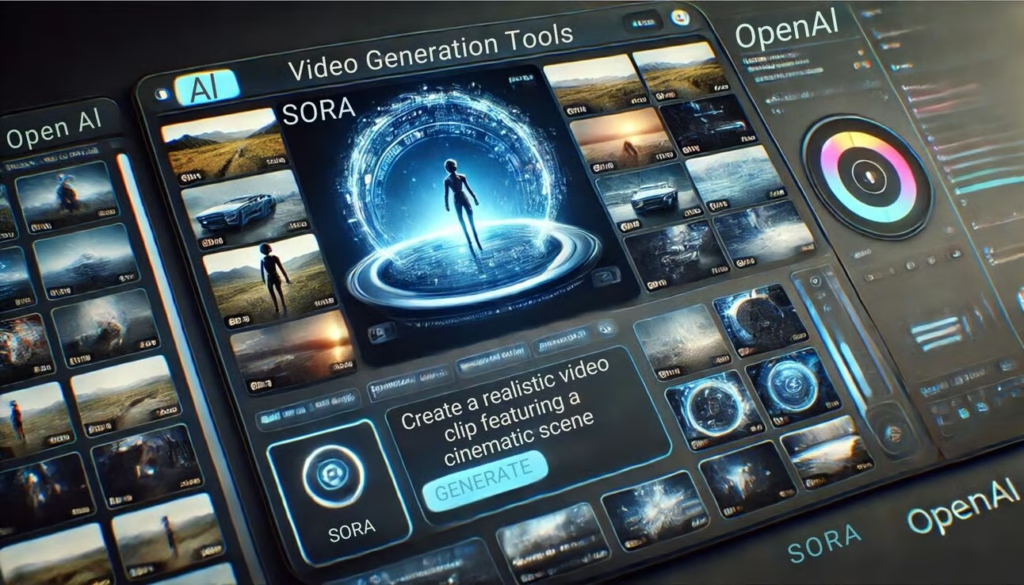
Sora is OpenAI’s text-to-video model designed to generate realistic short videos from simple written prompts or images. Users can describe a scene in natural language, and the system produces a video that attempts to simulate real-world motion, lighting and visual detail.
The model first gained attention after OpenAI released preview demonstrations showing complex scenes such as busy streets, animals moving through landscapes and cinematic shots generated entirely by artificial intelligence. Later versions introduced improved realism, audio synchronisation and more control over visual elements.
Unlike earlier generative tools that focused on still images, Sora attempts to simulate the physics of motion and spatial relationships across frames. The result is a system capable of producing short narrative style clips, animated sequences and experimental visual content.
Initially, OpenAI released Sora as a standalone application with social media-style sharing features. Users could generate videos and distribute them online in a similar fashion to short video platforms.
However, despite the excitement surrounding its launch, the dedicated Sora app has reportedly struggled to maintain the same level of popularity enjoyed by ChatGPT. Reports indicate that downloads and usage dropped sharply after the initial surge in interest.
Integrating the technology directly into ChatGPT may therefore be a strategic attempt by OpenAI to bring the tool to a much larger audience.
Why OpenAI Wants Sora Inside ChatGPT
ChatGPT remains one of the most widely used AI platforms in the world. By embedding Sora directly into the chatbot environment, OpenAI could expose its video generation technology to hundreds of millions of users without requiring them to install a separate application.
Industry observers believe the move could also help boost engagement and encourage users to upgrade to paid subscription plans that offer enhanced capabilities.
Within ChatGPT, users might be able to type a prompt such as “create a short cinematic clip of Lagos traffic at sunset” or “generate an animated science demonstration explaining photosynthesis”. The system would then produce a short video clip based on that description.
This type of capability would significantly expand the range of content that can be created using AI tools. Educators could produce visual learning materials, marketers could generate quick promotional clips, and filmmakers could prototype scenes without expensive equipment.
The integration also aligns with OpenAI’s broader strategy of building a fully multimodal AI platform. ChatGPT has already evolved from a simple conversational chatbot into a tool that can analyse images, generate artwork and assist with programming tasks.
Adding video generation would bring the platform closer to becoming an all-in-one creative and productivity system.
Opportunities and Risks of AI Video Generation
While the potential benefits of AI-generated video are significant, the technology also raises serious concerns.
One of the biggest challenges is the risk of misinformation and deepfake content. Because Sora can generate realistic footage, there is the possibility that fabricated scenes could circulate online and be mistaken for genuine events.
To reduce this risk, OpenAI has implemented safeguards such as visible watermarks in generated videos. These markers are intended to signal that the footage was produced by artificial intelligence rather than captured by a camera.
However, researchers and critics have warned that determined users may still attempt to remove or manipulate such safeguards.
Another major issue involves copyright and intellectual property. AI models are trained on vast datasets that may include copyrighted materials. When these systems generate videos or images, questions arise about whether they are reproducing protected creative work.
In some cases, AI-generated videos have already used visual styles or characters that resemble existing intellectual property. This has sparked legal debates about how creative rights should be handled in the age of generative AI.
For content creators, filmmakers and media companies, the emergence of tools like Sora presents both opportunities and threats. On one hand, the technology could democratise video production by making it accessible to anyone with an internet connection. On the other hand, it could disrupt traditional creative industries.
Competition in the Global AI Race
The integration of Sora into ChatGPT also reflects the intense competition currently shaping the artificial intelligence sector.
Major technology companies and AI research labs are racing to develop systems capable of generating text, images, audio and video with increasing realism. Each breakthrough quickly triggers responses from competitors seeking to keep pace.
OpenAI faces growing competition from firms such as Anthropic, Google and Meta, all of which are investing heavily in multimodal AI systems. Some rival platforms are experimenting with their own video generation technologies and advanced creative tools.
At the same time, public debate around the governance of AI continues to intensify. Governments around the world are considering new regulations to address risks such as misinformation, privacy violations and the potential misuse of powerful generative models.
Against this backdrop, OpenAI’s decision to expand Sora’s reach through ChatGPT may be both a technological and strategic move. It allows the company to showcase its capabilities while reinforcing the central role of ChatGPT in the rapidly evolving AI ecosystem.
What the Integration Could Mean for Users
If Sora becomes fully integrated into ChatGPT, everyday users could gain access to a powerful new creative capability.
Students might use it to generate visual explanations for school projects. Entrepreneurs could quickly produce marketing videos for social media campaigns. Journalists and researchers could visualise complex ideas in ways that are easier for audiences to understand.
In Nigeria and across Africa, where access to professional video production tools can be limited by cost, AI-generated video could open new doors for digital storytelling and online education.
At the same time, responsible use of the technology will remain critical. As AI-generated media becomes more convincing, digital literacy and verification practices will become increasingly important.
For OpenAI, the success of the integration will depend not only on technological performance but also on public trust. Users will want reassurance that safeguards are in place to prevent misuse while still allowing creativity to flourish.
Artificial intelligence is steadily reshaping how information and media are produced. The potential arrival of Sora inside ChatGPT may mark another milestone in that transformation, signalling a future where generating a video could be as simple as typing a sentence.
Join Our Social Media Channels:
WhatsApp: NaijaEyes
Facebook: NaijaEyes
Twitter: NaijaEyes
Instagram: NaijaEyes
TikTok: NaijaEyes