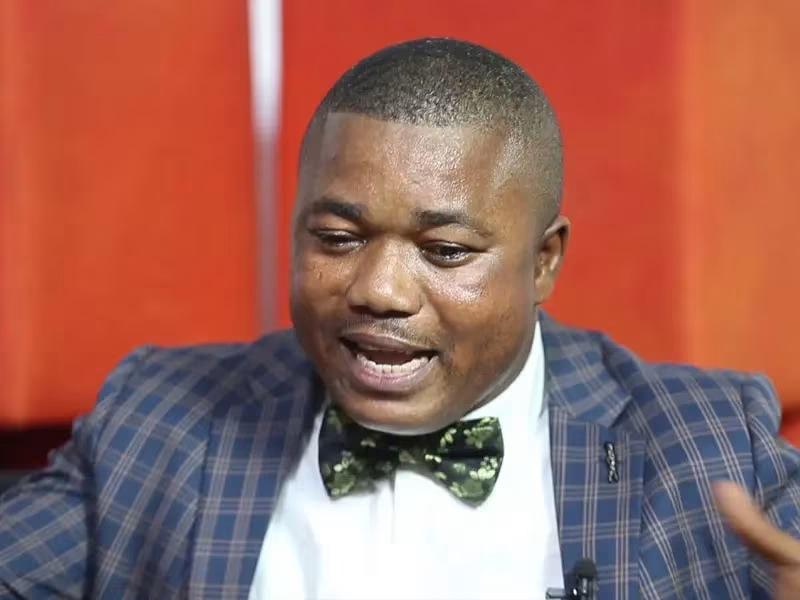

Human rights lawyer and lead counsel to the Indigenous People of Biafra (IPOB), Ifeanyi Ejiofor, has criticised Primate Elijah Ayodele over what he described as increasingly political-style prophecies that, according to him, blur the line between spiritual guidance and political commentary in Nigeria.
Ejiofor, who is also a social crusader and public affairs analyst, expressed his views in a statement issued on Saturday, where he questioned the growing trend of religious leaders making frequent political predictions.
He argued that what is traditionally expected of the pulpit has shifted over time, with prophecy now appearing to overlap with election forecasts, political analysis, and partisan speculation.
According to him, clerics are primarily called to guide people spiritually and uphold moral values rather than engage in continuous commentary on political outcomes.
Ejiofor said: “Ordinarily, men clothed in cassocks are expected to be fishers of men, custodians of faith, guardians of morality, and ambassadors of the Kingdom of God.
“Their divine mandate is neither ambiguous nor negotiable. They are called to reconcile humanity to God, not to become perpetual commentators on the ever-changing fortunes of politicians and political parties.
“One is tempted to wonder whether Heaven now convenes daily political strategy meetings from which he alone receives exclusive briefings.”
Ejiofor further noted that the frequency of such prophecies has made some members of the public treat them like political forecasts, comparing the anticipation to that of election results or opinion polls.
He said it has become increasingly difficult at times to distinguish between spiritual messages and political analysis when such declarations are made consistently.
The lawyer stressed that his concern was not personal or denominational, but about the broader implications for democracy and public discourse, noting that freedom of expression remains constitutionally protected.
He, however, cautioned that repeated political prophecies could heighten tension and uncertainty, especially during sensitive political periods.
“Democracy thrives on institutions, reasoned debate, electoral participation, and the sovereign will of the people,” he said, warning that constant prophetic predictions of political outcomes could distort public perception and fuel anxiety.
Ejiofor also questioned the balance between spiritual duties and political commentary, suggesting that greater focus on evangelism and moral teaching could yield more meaningful societal impact.
He added that while religious leaders are free to express opinions on governance, there is a clear distinction between occasional moral guidance and sustained political forecasting, which, in his view, risks positioning the pulpit as part of the political space.
BACKSTORY…
The comments come amid ongoing debates in Nigeria over the increasing involvement of some religious leaders in political commentary, particularly through prophecies that touch on elections, governance, and national leadership outcomes.
In recent years, Primate Elijah Ayodele has become widely known for releasing frequent predictions on political events and electoral outcomes in Nigeria and beyond. These declarations often attract public attention and generate mixed reactions, with supporters describing them as spiritual insight, while critics argue they resemble political forecasting.
Against this backdrop, human rights lawyer and IPOB lead counsel, Ifeanyi Ejiofor, raised concerns about what he described as the growing overlap between religious messaging and political speculation. He argued that such trends risk blurring the traditional role of the pulpit and could influence public perception during sensitive political periods.
His remarks reflect a broader conversation within Nigerian society about the role of religion in politics, and whether constant prophetic declarations about elections and leadership could affect democratic discourse or heighten political tension.

Chinenye Ubunama
Chinenye Ubunama is a content writer and storyteller with a background in Biological Science. She specializes in crafting engaging, well-structured, and SEO-optimized content that simplifies complex ideas for everyday readers. With a focus on audience-centered writing, she consistently delivers value-driven content that informs, connects, and drives visibility across digital platforms.