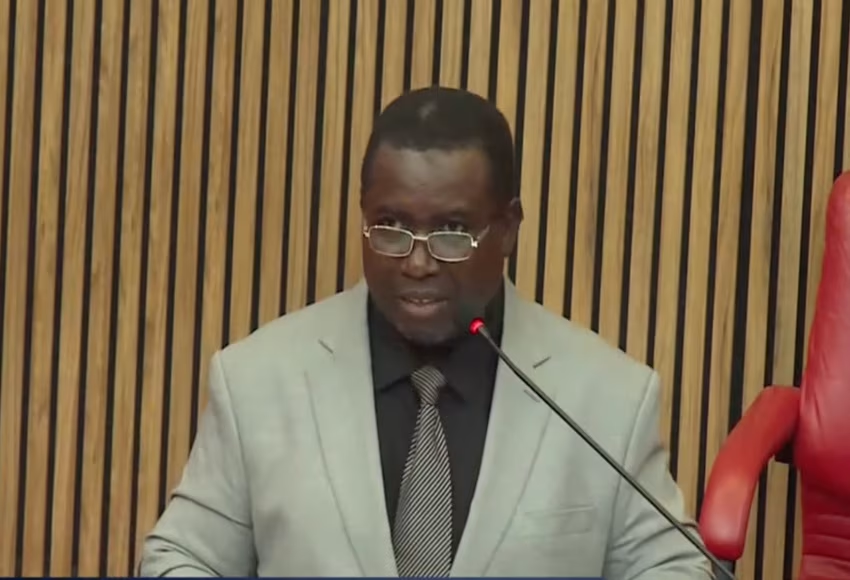

As Nigeria inches closer to the 2027 general election, one institution is once again under the spotlight—the Independent National Electoral Commission (INEC).
Every election cycle, the commission promises free, fair and credible elections. Every election cycle, Nigerians hope those promises translate into reality. Yet after the controversies that followed the 2023 presidential election, many citizens are asking whether INEC has done enough to rebuild public confidence ahead of 2027.
The question is no longer simply whether INEC can conduct an election. The bigger question is whether Nigerians will believe the electoral processes and outcome.
The Perception Problem
Democracy depends as much on public confidence as it does on legal procedures. Even before the first ballot is cast, many Nigerians have already begun debating the neutrality of the electoral umpire.
Part of that debate centres on the process through which INEC’s chairman is appointed.
Under Nigeria’s Constitution, the President nominates the Chairman of INEC, subject to confirmation by the Senate. The arrangement is legal and has existed since the return to democratic rule in 1999.
Yet critics argue that the process inevitably creates a perception challenge. Can an electoral commission headed by someone nominated by an incumbent president convince opposition parties and millions of voters that it is completely independent?
In April 2026, Senior Fellow at the Centre for Democracy and Development, Jibrin Ibrahim, accused the Chairman of the Independent National Electoral Commission (INEC), Joash Amupitan, of displaying partisanship.
He further alleged that Amupitan’s actions, particularly his involvement in matters affecting the main opposition party without what he described as a solid legal basis, point to political partiality
The Shadow of 2023
The 2023 presidential election fundamentally changed how many Nigerians view INEC.
Before the polls, the commission introduced the Bimodal Voter Accreditation System (BVAS) and promised timely electronic transmission of results through the INEC Result Viewing Portal (IReV).
Many voters believed these innovations would make the election the most transparent in Nigeria’s history.
Instead, technical challenges and delays in uploading presidential election results generated widespread criticism.
Although the Supreme Court eventually upheld the election outcome, legal victory did not automatically restore public confidence.
For many Nigerians, unanswered questions remained. Has INEC addressed those concerns? Will similar problems occur in the 2027 general election?
The Chairman- Amupitan’s Burden
Professor Joash Ojo Amupitan now carries perhaps one of the most difficult responsibilities in Nigerian public life.
Regardless of what INEC does over the next two years, every decision is likely to be interpreted through a political lens.
Similarly, the African Democratic Congress (ADC) caucus in the House of Representatives previously called for the removal and prosecution of Joash Amupitan.
According to the caucus, Amupitan has engaged in actions and made statements that are inconsistent with the expectations of an impartial electoral umpire.
If the commission introduces new reforms, supporters may applaud them while opponents question the timing. If it retains existing procedures, critics may argue that nothing has changed.
In many ways, the chairman is not simply managing elections—he is managing public trust.
Read Also: 2027 Election-INEC Announces Mock Presidential Poll
The Questions That Remain
As the 2027 general election approaches, Nigerians may find themselves asking difficult but important questions.
Will INEC demonstrate enough transparency to convince sceptical voters?
Can the commission remain completely independent despite the political pressures that accompany every election?
Should Nigeria rethink the constitutional process for appointing electoral commissioners to reduce perceptions of political influence?
Or is the bigger problem not the appointment process itself, but whether institutions and individuals faithfully uphold the law after taking office?
These questions do not yet have definitive answers.