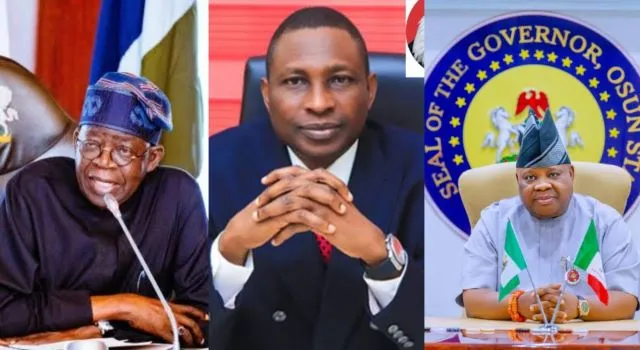

President Bola Ahmed Tinubu has reportedly directed the Economic and Financial Crimes Commission, EFCC, to lift restrictions placed on bank accounts belonging to the Osun State Government, a move that is expected to restore the state’s access to public funds and ease administrative operations.
The development comes after days of uncertainty surrounding the reported freezing of the accounts, which had sparked political debate and concerns over the impact on governance, salary payments and the delivery of essential public services.
Although details surrounding the directive are still emerging, the decision is being viewed as an effort to ensure that legitimate government activities are not disrupted while any investigations or legal processes continue through the appropriate channels.
The reported intervention has also renewed discussions about the balance between anti-corruption enforcement and the uninterrupted running of state institutions. Analysts say while anti-graft agencies must be allowed to carry out investigations without interference, actions that affect the financial operations of a state government should be carefully managed to avoid unintended consequences for citizens.
For residents and civil servants in Osun, the restoration of access to government accounts is expected to provide relief, particularly if it prevents delays in salary payments, project execution and other statutory obligations.
Also Read: BREAKING: EFCC Freezes Osun State Account 10 Days Before Governorship Election
Reactions Trail the Presidency’s Decision
The reported directive has generated mixed reactions from political observers and stakeholders across the country.
Supporters of the decision argue that governance should not be paralysed because of ongoing investigations, especially where there has been no final judicial determination. They believe government institutions must continue to function while due process takes its course.
Others, however, insist that anti-corruption agencies should be allowed to carry out their constitutional responsibilities independently, warning against any action that could create the impression of political interference.
Legal experts have also noted that disputes involving the freezing of government accounts often require a careful interpretation of existing laws, constitutional provisions and court orders. They maintain that transparency and adherence to due process remain essential in preserving public confidence in both law enforcement agencies and democratic institutions.
As of the time of reporting, neither the Presidency nor the EFCC had released detailed public information explaining the circumstances surrounding the reported directive beyond what has been circulated in media reports.
Back Story
The controversy follows earlier allegations relating to payroll irregularities and claims of ghost worker payments in Osun State. Members of the All Progressives Congress, APC, had previously urged the EFCC to investigate the alleged diversion of public funds and to freeze accounts they believed were connected to the matter.
Those allegations became a major talking point in the political atmosphere ahead of the Osun governorship election, with opposition figures calling for a thorough investigation. The state government, on its part, has consistently defended its administration while political exchanges between rival parties have continued over financial management and accountability.
Also Read: EFCC Declares Aisha Achimugu Wanted for Money Laundering!
What Happens Next
Attention is now shifting to the next steps that will be taken by the EFCC and other relevant authorities. If the reported directive is fully implemented, the Osun State Government is expected to regain unrestricted access to its accounts, allowing normal financial operations to continue.
Observers say the episode highlights the need for stronger institutional coordination whenever investigations involve public finances, particularly where government services could be affected.
The coming days are expected to provide greater clarity on the legal and administrative implications of the decision, as Nigerians continue to monitor developments closely. Whatever the eventual outcome, the situation underscores the delicate balance between fighting corruption and ensuring that governance remains effective and uninterrupted.