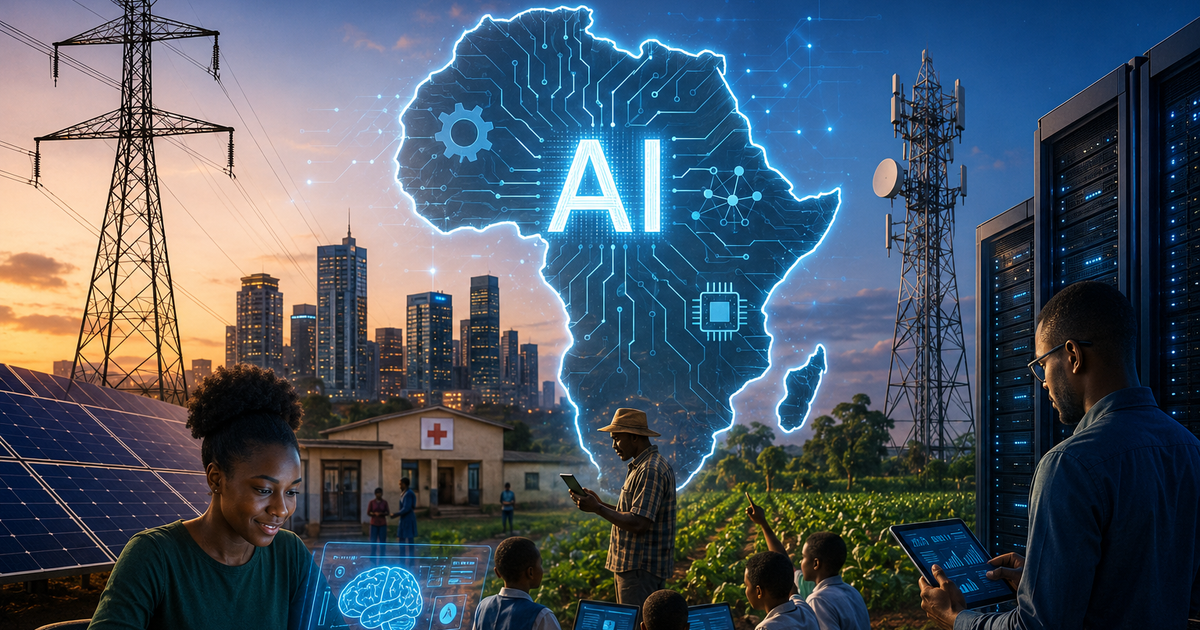

Africa is entering the artificial intelligence era at a difficult point in its development. Across the continent, businesses, governments, schools and young people are increasingly turning to AI for productivity, education, research and business opportunities. But behind every AI tool is an infrastructure requirement that is easy to overlook: electricity.
This creates a difficult question for Africa. How can countries that are still struggling to provide reliable electricity to homes and businesses support the enormous computing infrastructure required for the next generation of AI?
The issue is becoming more important as data centres expand globally. The International Energy Agency estimates that electricity consumption from data centres worldwide could more than double from about 415 terawatt-hours in 2024 to around 945 terawatt-hours by 2030. Electricity demand from AI-focused accelerated servers is expected to grow particularly quickly.
For Africa, the challenge is not simply producing more electricity. It is producing enough reliable power, transmitting it efficiently and making it available where digital infrastructure is being built.
Africa’s AI Ambition Meets an Old Power Problem
The continent has no shortage of AI ambition. Countries including Nigeria, Kenya, South Africa, Egypt and Rwanda are developing policies, businesses and innovation ecosystems around artificial intelligence. Young Africans are also becoming some of the most enthusiastic users of emerging digital tools.
But AI adoption cannot be separated from the infrastructure underneath it.
A person using an AI chatbot on a smartphone may not think about electricity beyond charging the device. A company building a large AI platform has a completely different requirement. Behind such services are servers, cooling systems, storage facilities, networks and data centres that must operate continuously.
That is where Africa’s electricity challenge becomes a technology challenge.
The African Data Centre Association reported in 2026 that the continent accounted for only about 0.6% of global data centre capacity, with power availability emerging as the industry’s leading constraint. More capacity is being built, but the availability of dependable electricity remains a major factor determining where these facilities can operate.
This matters for countries such as Nigeria because unreliable electricity already increases the cost of running businesses. Adding energy-intensive digital infrastructure without expanding generation and transmission could make the problem more complicated.
Back Story: Why AI Is Changing the Energy Conversation
The relationship between artificial intelligence and electricity has become one of the defining infrastructure questions of the technology boom.
Gartner estimates that global data centre electricity consumption will reach 565 terawatt-hours in 2026, representing a 26% increase from the previous year. The research firm also expects AI-optimised servers to account for about 31% of data centre electricity consumption this year.
Africa is starting from a much smaller base, which means its absolute demand remains modest compared with major technology markets. The IEA estimates that Africa’s data centre electricity consumption was below 1 kilowatt-hour per person in 2024 and could approach 2 kilowatt-hours per person by 2030. South Africa is expected to remain significantly above the continental average.
Yet the low starting point should not create false comfort.
Africa’s digital economy is expanding, while demand for cloud services, fintech, streaming, online education and AI applications continues to increase. New data centres could therefore become important economic infrastructure, but they will need dependable electricity to function.
There is also an opportunity hidden inside the problem. Industry stakeholders at Enlit Africa 2026 argued that AI and data centre growth could encourage investment in renewable energy, transmission networks and new electricity markets across the continent.
Africa Cannot Build AI Without Building Power
The answer should not be to slow down Africa’s AI ambitions. Instead, the continent needs to recognise that digital infrastructure and energy infrastructure must be developed together.
Governments need to think beyond simply increasing installed generation capacity. Transmission networks, distribution systems, renewable energy projects, battery storage and reliable connections for industrial users will all become increasingly important.
This is particularly relevant for Nigeria, where the conversation around artificial intelligence often focuses on skills, startups and digital policy. Those areas matter, but they cannot carry the entire ecosystem. A talented developer still needs electricity to work. A technology company still needs reliable connectivity and power. A data centre needs even more.
There is also a case for locating new digital infrastructure around abundant and dependable energy resources rather than treating electricity as an afterthought.
AI itself could eventually help improve the situation. The IEA notes that artificial intelligence can be used to optimise energy systems, improve forecasting, manage demand and make electricity networks more efficient.
That creates a potential cycle in which better energy systems support AI, while AI helps make those energy systems more efficient.
But Africa has little room for infrastructure planning that treats these issues separately. The continent missed opportunities during earlier technology revolutions because basic infrastructure was often not developed at the required scale.
This time, the lesson is clear. Africa’s AI future will depend not only on how many people learn to use artificial intelligence, but also on whether the continent can build the electricity systems capable of supporting them.
The AI race is therefore becoming an energy race too. For Africa, solving the power problem may be one of the most important technology investments of the coming decade.