
The University of Nigeria, Nsukka (UNN), is taking a more practical approach to artificial intelligence by training academics and postgraduate students to use AI tools in research, teaching, supervision and other areas of university administration.
The initiative was carried out through a two-day Train-the-Trainers Workshop on “Artificial Intelligence for Academia Productivity” organised by the Faculty of the Social Sciences in partnership with the Design Thinking Center and The Beaconsmith Collective.
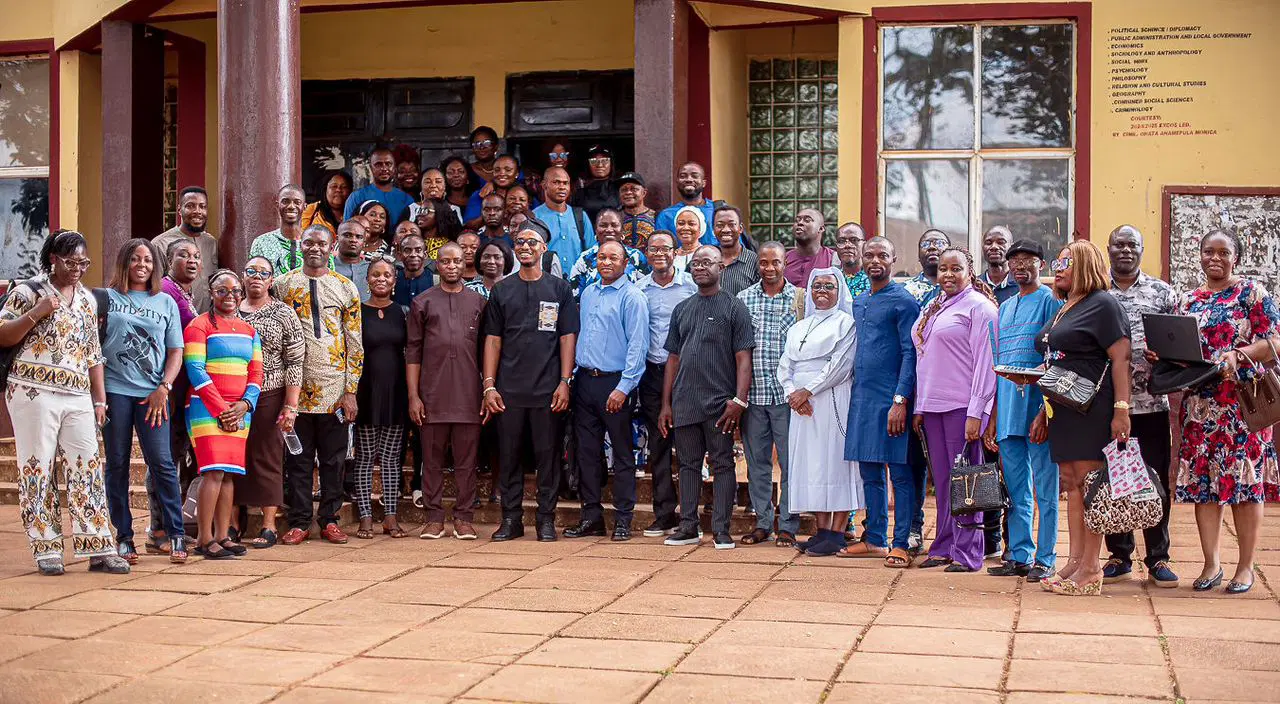
Held from August 26 to 27, 2026, at the Faculty of the Social Sciences Lecture Hall, the programme brought together more than 100 academic and senior staff members alongside postgraduate students. According to Vanguard’s report on the training, participants were introduced to practical ways of applying artificial intelligence to everyday academic responsibilities.
Rather than presenting AI as a replacement for lecturers or researchers, the training focused on how academics can use the technology as an assistance tool while retaining responsibility for the quality and accuracy of their work.
UNN Focuses on Practical AI Skills for Academia
The training covered several areas that are becoming increasingly important as generative AI changes the way information is discovered, processed and produced.
Participants explored the use of AI for literature discovery, research development, academic writing, teaching and assessment, postgraduate supervision and administrative work.
This is particularly significant for Nigerian universities, where academics are under pressure to conduct research, publish, teach students, supervise postgraduate work and manage administrative responsibilities, often with limited time and resources.
The workshop also placed considerable emphasis on verification. Participants were encouraged to question AI-generated responses, check information against reliable sources and improve machine-generated outputs instead of accepting them automatically.
That approach matters because artificial intelligence can produce convincing but inaccurate information. In an academic environment, an unchecked error can affect a research paper, lecture material, student assessment or postgraduate thesis.
The organisers therefore stressed academic integrity, privacy, responsible use of AI and the continued importance of human judgement.
The Faculty of the Social Sciences Dean, Prof. Chukwuedozie Ajaero, described the changing academic environment as one where the question is no longer whether academics will encounter AI, but how prepared they are to use it effectively.
Participants were also given a 30-day action plan designed to help them move beyond the workshop and incorporate the skills into their regular academic activities.
Also Read: OAUSTECH Opens 2026/2027 Postgraduate Admission Application
AI Is Becoming Part of Nigeria’s University Conversation
UNN’s latest training reflects a wider shift taking place across Nigerian higher education. Artificial intelligence is no longer being discussed only as a subject for computer science departments. Universities are increasingly considering how it can affect teaching, research, assessment, curriculum development and the skills students need after graduation.
UNN already has several AI-related initiatives. Its e-learning platform offers an Artificial Intelligence course covering areas such as machine learning, Python programming, deep learning and AI applications.
The university has also established an Innovation, Vocational and Entrepreneurship Training Hub at its Enugu Campus, where AI and machine learning are among the available training areas.
The institution’s Computer Science Department is also preparing for the 2026 International Conference on Data-Driven Innovations and Applications, with the theme focused on advancing data systems and ethical practices in a generative AI era. UNN’s conference information shows that researchers and practitioners are being invited to examine how AI is reshaping different sectors.
This growing activity suggests that Nigerian universities are beginning to move from simply discussing AI to developing the capacity to use it responsibly.
Back Story: Why AI Training Matters for Nigerian Universities
The rapid spread of generative AI has created both opportunities and difficult questions for higher education.
Students can now use AI systems to summarise information, generate ideas, analyse text and assist with writing. Academics can similarly use the technology to support research, lesson preparation and administrative work. However, universities must also deal with concerns about plagiarism, inaccurate information, overdependence on AI and the weakening of independent thinking.
UNN’s own academic community has been examining these issues. A 2026 study involving UNN researchers investigated the influence of AI technologies on students’ academic performance and specifically examined concerns around AI dependency and declining reading culture. The study published by UNN researchers highlights why AI adoption in education requires more than simply giving people access to new tools.
For Nigerian universities, the bigger challenge may therefore be finding the right balance. AI can make research and teaching more efficient, but academic institutions still need people who can think critically, verify evidence and produce original knowledge.
UNN’s latest training points in that direction. The goal is not simply to teach academics how to use artificial intelligence, but to help them understand where the technology fits into academic work and where human judgement must remain firmly in control.
Also Read: Calls and Data to Increase by 60% – Dr. Bosun Tijani