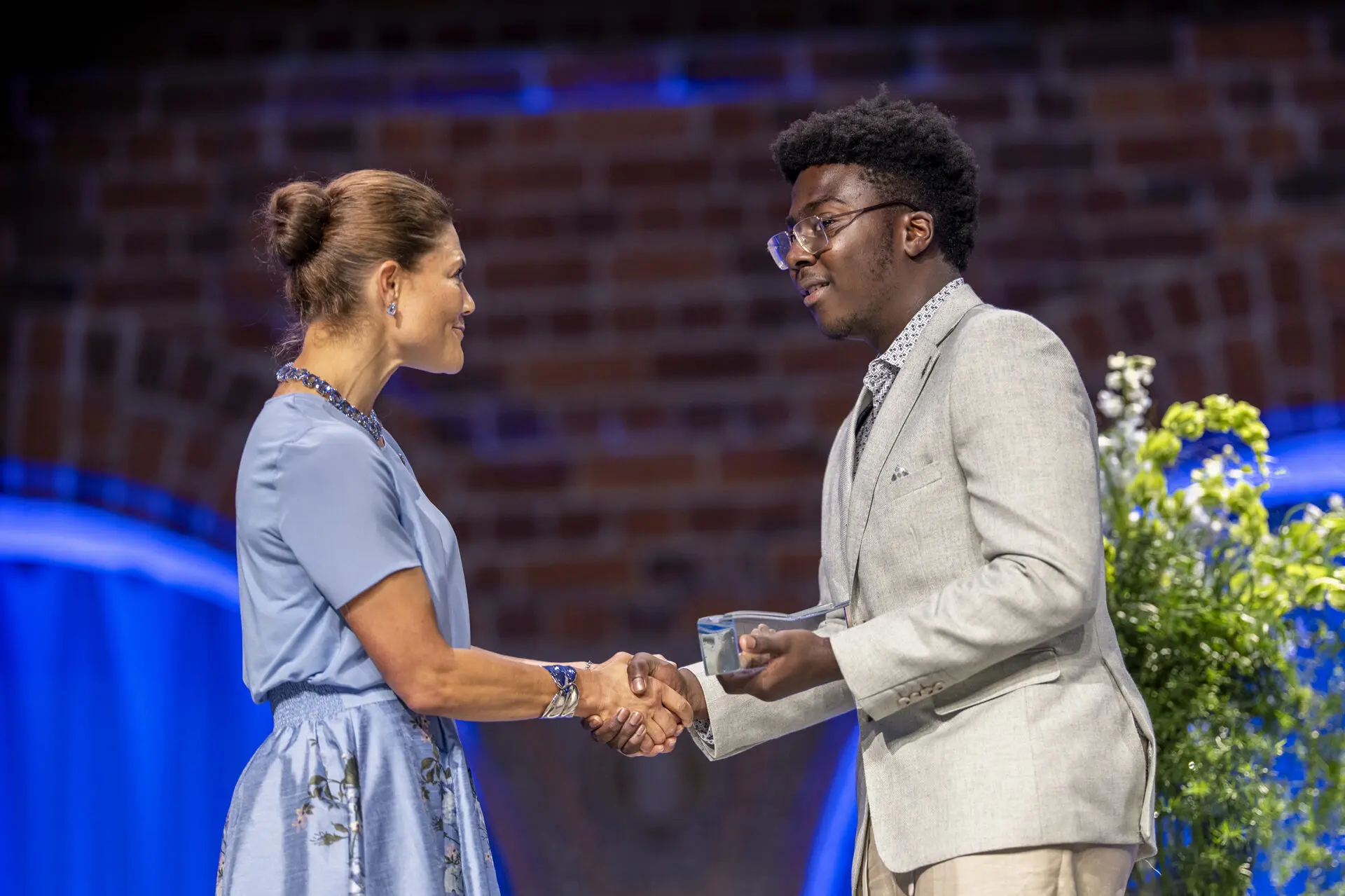

Young Nigerian Moroti Adegboyega has emerged as the winner of the 2026 Stockholm Junior Water Prize after developing an artificial intelligence-powered robotic system designed to remove plastic pollution from water while reducing the risk of harming aquatic life.
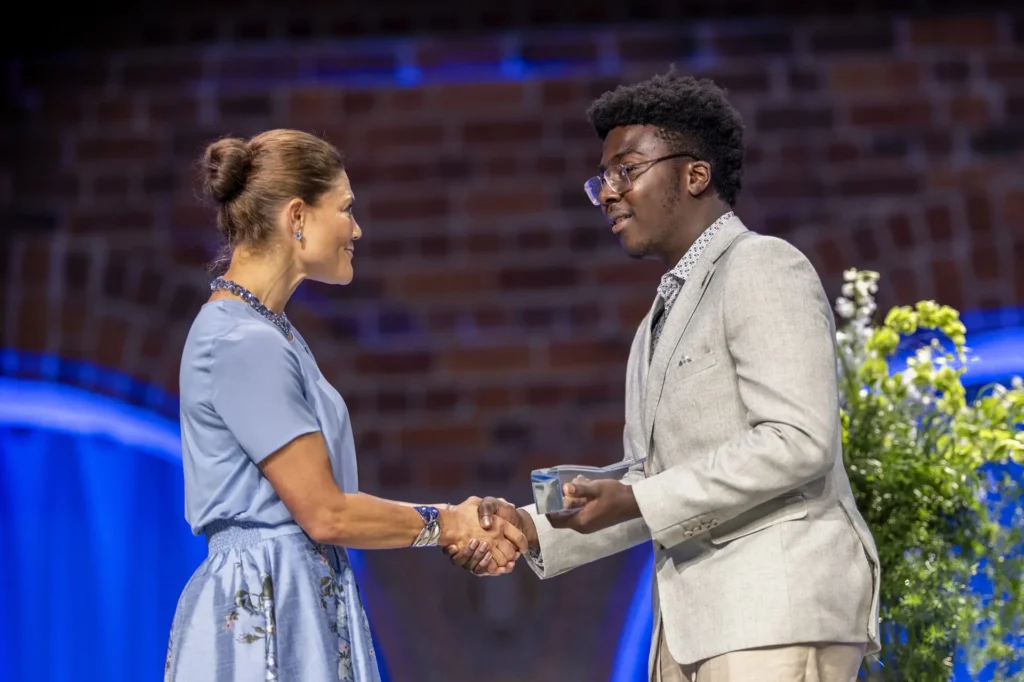
Adegboyega, who is based in St. John’s, Newfoundland and Labrador, represented Canada at the international competition and was announced as the overall winner on August 25, 2026, during a ceremony at Stockholm City Hall in Sweden. The award was presented by Sweden’s Crown Princess Victoria as part of World Water Week.
His winning project, called Ecoferroquatics, combines artificial intelligence, robotics, computer vision, magnets and a biodegradable ferrofluid to identify and collect plastic waste from water.
The achievement has also attracted attention in Nigeria after the Nigerians in Diaspora Commission (NiDCOM) congratulated Adegboyega and described him as a young Nigerian who has brought recognition to the country through his achievement.
There is an important distinction, however. While Nigerian authorities have celebrated his Nigerian identity and achievement, the Stockholm Water Foundation officially lists Adegboyega as the 2026 winner representing Canada.
The project is particularly significant because plastic pollution is becoming a major threat to aquatic ecosystems. Plastic waste can break down into smaller particles, be consumed by aquatic organisms and potentially carry harmful chemicals through the food chain.
Rather than relying entirely on conventional nets, filters or manual collection, Adegboyega’s idea attempts to make the cleanup process more selective and automated.
How Ecoferroquatics Uses AI and Magnets to Remove Plastic From Water
At the centre of Adegboyega’s innovation is an autonomous robotic platform that can identify plastic in water and help collect it using a magnetic system.
According to the Stockholm Water Foundation, the project uses an AI-guided system with a specially developed ferrofluid and magnetic drum. The AI component was trained using a handmade dataset to help the system identify plastic debris.
The use of ferrofluid is one of the more unusual aspects of the project. Ferrofluids contain magnetic particles and can respond to magnetic fields. Adegboyega incorporated this principle into his system to create a method for selectively targeting plastic waste.
The idea addresses a weakness in some conventional approaches to water cleanup. Large debris can be relatively easy to collect, but smaller pieces of plastic, including microplastic-sized particles, can pass through coarse screening systems.
Testing of the Ecoferroquatics prototype produced promising results. After nine trials, the robot recorded a 51.85 per cent removal efficiency and collected approximately 1.73 pieces of plastic per minute. The project also outperformed a preliminary sieve-based system when dealing with microplastic-scale particles.
The results do not mean the technology is already ready for large-scale deployment. The project’s own documentation acknowledges limitations that will require further development. However, it demonstrates the potential of combining AI, robotics and environmental engineering to address water pollution.
For a student project, that is a notable achievement.
Why the Achievement Is Important to Nigeria and Africa
Adegboyega’s success comes at a time when African countries are looking for practical ways to tackle environmental challenges while also preparing young people for a technology-driven economy.
Nigeria, in particular, continues to face challenges associated with plastic waste, blocked drainage systems, polluted waterways and inadequate waste management. A technology capable of identifying and removing plastic from water could therefore have relevance beyond the laboratory.
The bigger lesson, however, may be about education.
Adegboyega’s project demonstrates how students can move beyond learning technology as an academic subject and begin applying it to problems they can see around them. Artificial intelligence, coding and robotics are increasingly becoming tools for solving practical problems rather than simply areas of study.
The Stockholm Junior Water Prize, which has been held annually since 1997, provides an international platform for young innovators working on water-related challenges. The 2026 competition brought together national winners from more than 40 countries.
That international platform makes Adegboyega’s achievement even more significant. He was not simply recognised for producing a working prototype. His project was selected from a global field of young innovators working on some of the world’s most pressing water challenges.
Interestingly, the 2026 competition also recognised young innovators from other countries. Hungary’s Laura Ivanka received the Diploma of Excellence, while Egypt’s Basmala Diab won the People’s Choice Award for a project that converts agricultural waste into activated carbon for cleaner water and energy.
Back Story: From a Student Innovation to a Global Water Prize
Adegboyega’s story is also a reminder that major scientific ideas can begin with young people experimenting with problems that interest them.
His official profile describes him as an engineer interested in solving real-world problems through unconventional solutions. He is also involved in TecNurtur, a nonprofit focused on innovation and technology.
The Ecoferroquatics project brings together several disciplines that students often study separately: artificial intelligence, robotics, environmental science, materials science and water management.
That combination is perhaps what makes the project particularly interesting.
The global conversation around AI is often dominated by chatbots, automation and workplace applications. Adegboyega’s project offers a different perspective. It shows how AI can be connected to physical systems and used to address environmental problems in the real world.
For Nigeria and Africa, the achievement should also encourage greater investment in science, technology, engineering and mathematics education. Young people need opportunities to experiment, fail, improve their ideas and eventually present those ideas to the world.
Adegboyega has now done exactly that on one of the world’s biggest stages for young water innovators.
His Stockholm Junior Water Prize victory may have been achieved while representing Canada, but the recognition from Nigeria’s diaspora authorities shows that his success also carries significance for Nigerians watching from home and abroad.
More importantly, his project sends a straightforward message: some of the solutions to Africa’s environmental problems may already be sitting in the hands of its young innovators.