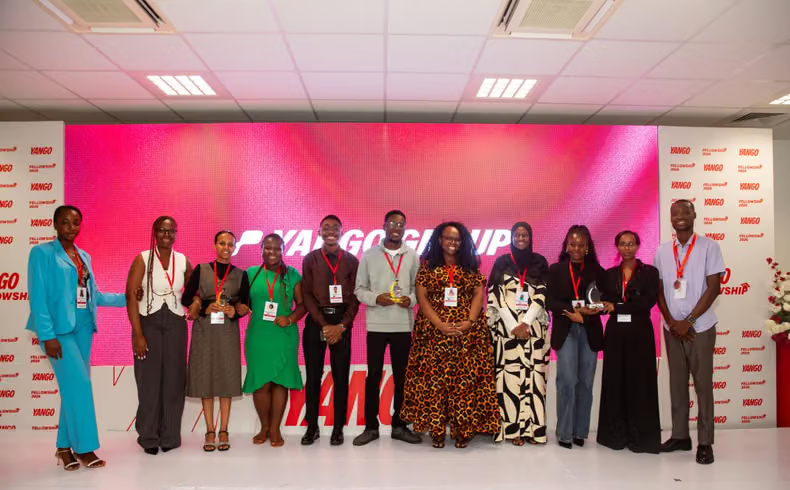

Twenty-four young technology innovators from six African countries are being positioned to develop businesses and digital solutions capable of addressing some of the continent’s most pressing problems.
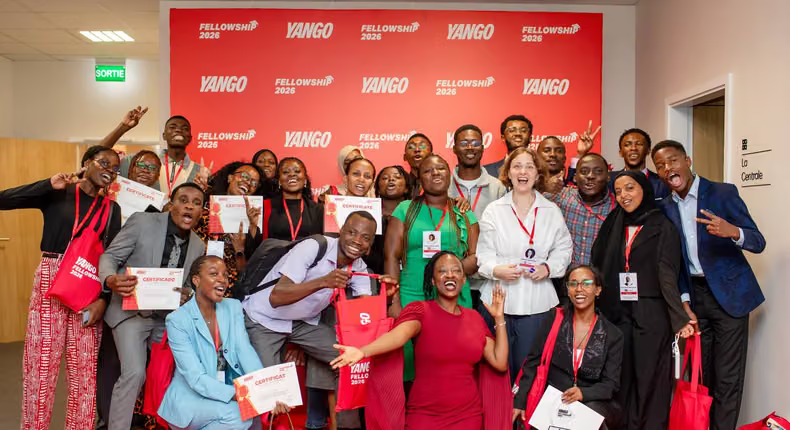
The innovators were selected for the 2026 Yango Fellowship after more than 600 applications were received from across Africa. The programme brought together participants from Ghana, Zambia, Senegal, Ethiopia, Mozambique and Côte d’Ivoire, with the initiative expanding significantly from its earlier country-level focus.
According to Business Insider Africa’s report, Yango is using the fellowship as part of a broader effort to identify and support technology talent outside Africa’s traditional startup centres.
For a continent where countries such as Nigeria, Kenya, Egypt and South Africa have historically attracted significant attention from technology investors, the programme is also highlighting the opportunities emerging in less frequently discussed markets.
Also Read: World Bank Opens 2027 Africa Fellowship Applications for Nigerian Scholars
Yango wants Africa’s next big technology companies to come from overlooked markets
The scale of interest in the fellowship is significant. More than 600 people applied for only 24 places, meaning that the programme had to select a small fraction of the applicants.
Shashi Singh, Yango’s Director of Operations for MEA and Asia, told Business Insider Africa that the company wants to see technology companies capable of reaching billion-dollar valuations emerge from what are often described as frontier markets.
Singh said Yango hopes to see a couple of unicorns emerge from the fellowship within the next three to five years across Ghana, Zambia, Senegal, Ethiopia, Mozambique and Côte d’Ivoire. His comments reflect the company’s belief that Africa’s technology opportunity is not limited to the continent’s established startup hubs.
The fellowship itself lasted 12 weeks and moved participants through problem identification, research, product development, business modelling, prototyping and pitching.
The approach is important because the participants were not simply being encouraged to develop technology for technology’s sake. Their projects were tied to practical challenges affecting people and businesses across African communities.
Back story: From a Zambia programme to a Pan-African technology fellowship
The Yango Fellowship did not begin as a continent-wide programme.
Yango started the initiative in Zambia in 2024, initially supporting students through financial assistance, mentorship and practical exposure to technology and innovation. The programme has since expanded to six African countries.
In April 2026, Yango announced that its latest cohort would bring together 24 participants from more than 600 applicants. African Media Agency’s report said the fellows would spend 12 weeks developing science and technology projects before presenting their work in Abidjan.
Yango’s own impact information also places the fellowship within its wider efforts to support technology and innovation among young people in Africa.
The 2026 expansion comes at a time when African economies are looking beyond simply producing technology users and are increasingly interested in building products, companies and technical talent on the continent.
For young innovators, access to mentorship, networks and the opportunity to test an idea with real users can be as important as access to funding.
From cashless transport to AI-powered employment platforms
The projects developed during the fellowship covered several areas with direct relevance to African consumers and businesses.
Among them were solutions for cashless payments in informal public transport, digital financial identity for informal merchants, medicine supply visibility for community health workers, cross-border employment, smart waste collection and recycling, as well as affordable water-quality testing.
At the final Pitch Day in Abidjan, six teams presented their projects before judges from the technology, investment and business sectors.
Africoded emerged with the top team prize of $4,500 for an AI-assisted platform designed to connect African job seekers with cross-border employment, remote work and career development opportunities. Harambee came second with a smart waste collection and recycling platform, while Bloom placed third with a cashless payment solution for informal public transport.
Individual recognition also went to Zambia’s Fredrick Mwepu, whose RoboCore Zambia project aims to make practical robotics and STEM education more accessible to young people.
Ghanaian innovator Meshack Kwame Nartey received an individual runner-up award for Shuttle Smart Ghana, a platform designed to give university students real-time information about campus shuttle movements.
Oulimata Rose Dia was recognised for Smart Bin Collection, a solar-powered system that monitors waste-bin levels and uses 2G connectivity to improve collection efficiency.
Ghanaian Times reported on the final Pitch Day that the programme distributed $12,000 in total prizes across its strongest team and individual projects.
The bigger story, however, may be what happens after the fellowship.
Yango is not simply looking for impressive presentations. The company is building a pipeline of young African technology talent that could eventually produce startups capable of operating across multiple countries.
Whether these projects eventually become major companies remains to be seen. For now, the fellowship offers a useful reminder that some of Africa’s next technology businesses may emerge from markets that have received far less international attention.
And with more than 600 people competing for 24 places, the demand for opportunities to build those businesses is already very clear.
Also Read: NCC Calls for More Homegrown Technology as Hackathon Awards N6m to Innovators