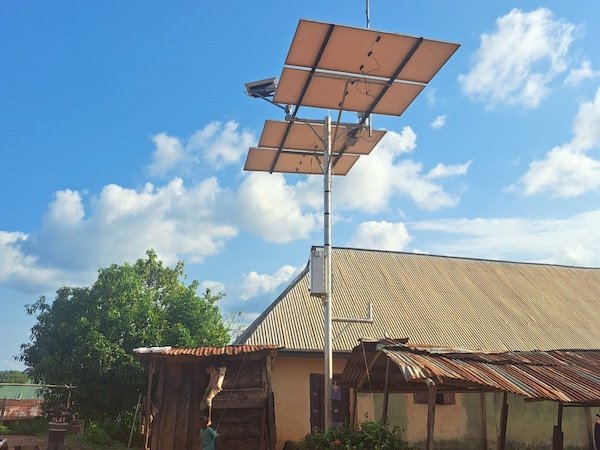

A computer centre at Race Course Model Primary School in Kano is drawing attention to an issue that can easily be overlooked when schools discuss digital transformation: electricity. ABUMET donated 24 desktop computers, solar-powered electricity infrastructure and new classroom furniture to the school, which has about 600 pupils across 14 classrooms. The intervention is intended to give children practical exposure to computers and strengthen digital literacy. The Abuja Inquirer reported that the company plans to return within a year to assess progress and the impact of the centre.
At first glance, the story is about computers. But the more revealing part may be the solar system that keeps them usable. A computer laboratory cannot deliver much when power interruptions repeatedly stop lessons or discourage regular use.
For pupils at Race Course, the centre is being integrated into practical lessons rather than treated as a room opened only on special occasions. The school says pupils are organised into smaller groups so more learners can have hands-on time with the machines. They are being introduced to applications such as Microsoft Office, as well as typing, calculations, record keeping and information management.
The project also reflects a wider shift in how Nigerian education authorities are approaching technology. In July, the Federal Ministry of Education urged states and schools to make better use of digital learning platforms. The ministry highlighted the Nigerian Learning Passport and other digital initiatives, while UBEC officials pointed to digital learning resource centres equipped with computers, smart boards and solar power.
Also Read: Africa’s AI Future Hinges on Power Supply More Than Smart Algorithms, IMF Warns
Why Reliable Electricity Matters to Digital Learning
Nigeria’s digital education challenge is not simply about buying devices. It involves making sure those devices can be powered, maintained and used consistently by teachers and pupils.
UNICEF Nigeria said in February 2025 that only 36 per cent of the population was using the internet, while 78 per cent of young people lacked digital literacy skills. The agency also identified limited and unaffordable electricity and broadband access as barriers to expanding digital learning. These figures help explain why a school can have a computer laboratory and still struggle to make digital education part of classroom life.
That is where solar power becomes particularly relevant. A solar installation gives a school an alternative source of electricity for essential equipment, reducing dependence on grid supply or generators. It does not solve every problem, because batteries, inverters, maintenance and security still matter, but it can help make a computer laboratory more available for planned lessons.
The World Bank’s 2025 AGILE school survey also shows that solar power is already present in a notable share of sampled schools in the programme. Of 209 valid responses in the school dataset, 85 reported solar power as their main source of electricity, compared with 105 for the national grid and 19 for generators. The World Bank cautions that these figures are from the survey sample and should not be treated as national statistics.

Also Read: 600 Kano Pupils Gain Digital Learning Access as ABUMET Opens ICT Centre
Back Story: Nigeria’s Digital School Push
The Kano project is part of a larger conversation about access to digital skills. In 2026, the Federal Government has continued promoting digital learning platforms, while states and development programmes have been investing in infrastructure that allows pupils to use computers and other learning technologies.
The scale of the challenge is clear. According to the education minister, the Nigeria Learning Passport had about 2.3 million users in July 2026, compared with an estimated 67 million learners across primary and secondary education. He also said UBEC was constructing digital learning resource centres with computers, smart boards and solar systems.
Similar thinking is appearing in school interventions. In July 2026, fellows of the Lateef Jakande Leadership Academy delivered a solar-powered ICT centre to Alapere Community Senior High School in Lagos, with laptops, offline CBT software and teacher training. The project was designed to support digital learning while reducing dependence on unreliable power.
The lesson from these developments is straightforward. The computer remains the tool, but electricity is part of the infrastructure that makes the tool useful. For Nigeria, where schools still contend with unstable power and uneven digital access, solar energy may increasingly be treated not as an optional extra, but as a practical part of building a functional digital school.