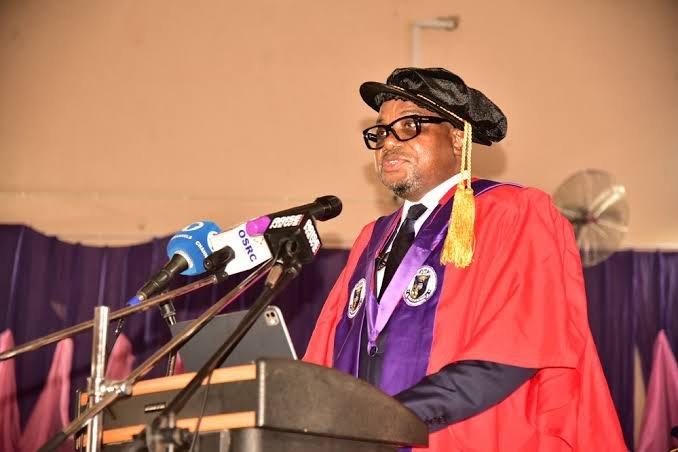

Innocent Ike, Group Managing Director and Chief Executive Officer of Access Holdings Plc, has urged Nigerian graduates to acquire artificial intelligence (AI) and digital skills, saying qualifications alone may not keep them competitive as technology changes the workplace.
He spoke at the 37th convocation lecture of the Federal University of Technology, Akure (FUTA), on Friday, November 20, 2026. The lecture, titled “From Akure to the World: The Next Chapter Is Yours to Write,” challenged graduates to treat university education as the beginning of continuous learning.
“Master artificial intelligence and digital tools in whatever field you choose,” Ike advised. He also urged graduates to develop creativity, communication, sound judgement, teamwork and integrity, arguing that technical knowledge must be matched with human skills.
AI now affects work beyond software development. Graduates need not become programmers, but must apply it appropriately in their fields, verify outputs and recognise when professional judgement should take priority.
Nigerian employers expect demand for digital skills to grow
The World Economic Forum’s Future of Jobs Report 2025 provides a measure of the shift. Its Nigeria profile says 80 per cent of surveyed employers expect AI and big data skills to be used more by 2030. The figure is 87 per cent for networks and cybersecurity and 67 per cent for systems thinking. reports.weforum.org
These are employer expectations about skills, not predictions that equivalent percentages of jobs will be created. The distinction matters: knowing how to use an AI application is only one part of preparing for work that increasingly involves data, digital security and complex problem-solving.
The report identifies labour-market skills gaps as a barrier to business transformation for 65 per cent of surveyed Nigerian organisations. It also says 73 per cent see greater funding and provision for reskilling and upskilling as ways to improve talent availability. Graduates cannot close this gap without institutional support. reports.weforum.org
Also Read: AI Skills Nigerian Graduates Need in 2027 to Improve Their Employment Prospects
Universities and employers must turn advice into training
Ike’s advice raises a practical question for universities: are students learning to apply digital tools in their chosen professions? AI education need not mean teaching every student to code. It can include data literacy, responsible use of AI, practical projects and training to verify machine-generated information.
Employers can contribute through internships and workplace training. A World Bank review of Nigeria’s digital skills also examines whether schools have the infrastructure needed to develop them, highlighting that training depends on access as well as individual motivation.
FUTA Vice-Chancellor, Professor Adenike Oladiji, urged graduates to become innovative thinkers and problem-solvers who contribute to their communities and the country.
Back Story: Thousands of graduates entering the job market
FUTA said 3,039 students were expected to receive first degrees at its 37th convocation, including 256 first-class graduates. The numbers illustrate the scale of the transition from university into employment and entrepreneurship.
A degree remains important, but graduates must increasingly demonstrate how they can apply their knowledge. Ike’s call to acquire AI skills is part of a wider demand for adaptable professionals who combine digital competence with judgement, communication and problem-solving.
Also Read: Why AI Skills Are Becoming Essential Across Every Profession