
The Federal Government has ordered the dredging of the sand-filled Kuramo Lagoon in Lagos as part of efforts to address persistent flooding in parts of the state, insisting that the ongoing Lagos-Calabar Coastal Highway project is not responsible for the flooding experienced in nearby communities.
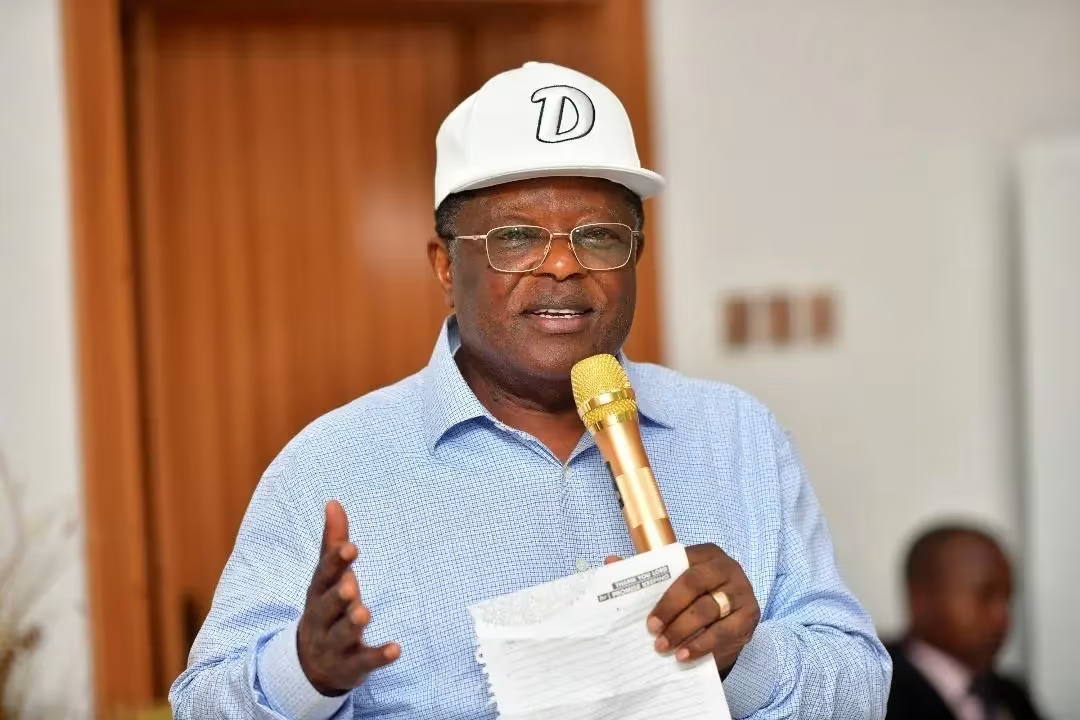
Minister of Works, David Umahi, disclosed this on Monday while inspecting the Lagos-Calabar Coastal Highway project.
Umahi said investigations showed that Kuramo Lagoon, identified in the Lagos State drainage master plan as a major flood retention area, had been illegally reclaimed with sand by residents, preventing it from performing its intended drainage function.
He revealed that the Surveyor-General of the Federation has erected a warning sign at the site to deter further encroachment, while the Federal Government has directed that the lagoon be dredged to remove the sand deposits and restore the natural flow of water.
Responding to claims that the coastal highway project caused the recent flooding in surrounding communities, the minister dismissed the allegations, insisting that the road construction had no connection to the flooding.
According to him, the lagoon was originally designed to receive floodwaters from adjoining areas, but its drainage capacity was compromised after residents blocked its natural water channels.
“You cannot block the channel and be crying about flooding,” Umahi said.
He maintained that, rather than causing flooding, the Lagos-Calabar Coastal Highway has improved drainage by incorporating infrastructure designed to channel floodwater away from vulnerable communities.
Addressing complaints from residents around Alpha Beach, Umahi said flooding in the area predated the highway project.
“This Alpha Beach flooding is not caused by us,” he stated.
The minister attributed the recurring floods to poor planning and development of the estate, adding that long-term solutions would require the construction of additional drainage systems, a service lane and, where necessary, the removal of structures obstructing natural waterways.
“Some buildings must have to go,” he added.
Umahi also noted that flooding remains a nationwide challenge, citing similar incidents in Adamawa, Bauchi, Niger and Taraba states, as well as Summit Junction in Asaba, Delta State.
He described the problem as a broader infrastructure issue that requires coordinated action by relevant government agencies.
To improve maintenance along the highway corridor, the minister directed the Federal Controller of Works in Lagos to deploy 40 personnel on rotational shifts—20 during the day and 20 at night—to monitor culverts and manholes and prevent indiscriminate refuse disposal.
“We cannot be manning every manhole; there must be discipline in this country along this corridor,” Umahi said.
Lagos has experienced recurrent flooding over the years, particularly during the rainy season, with low-lying communities often affected by heavy rainfall, blocked drainage channels and rapid urban development. The issue has sparked concerns over the adequacy of drainage infrastructure and the impact of human activities such as illegal land reclamation and indiscriminate waste disposal on the state’s flood management system.