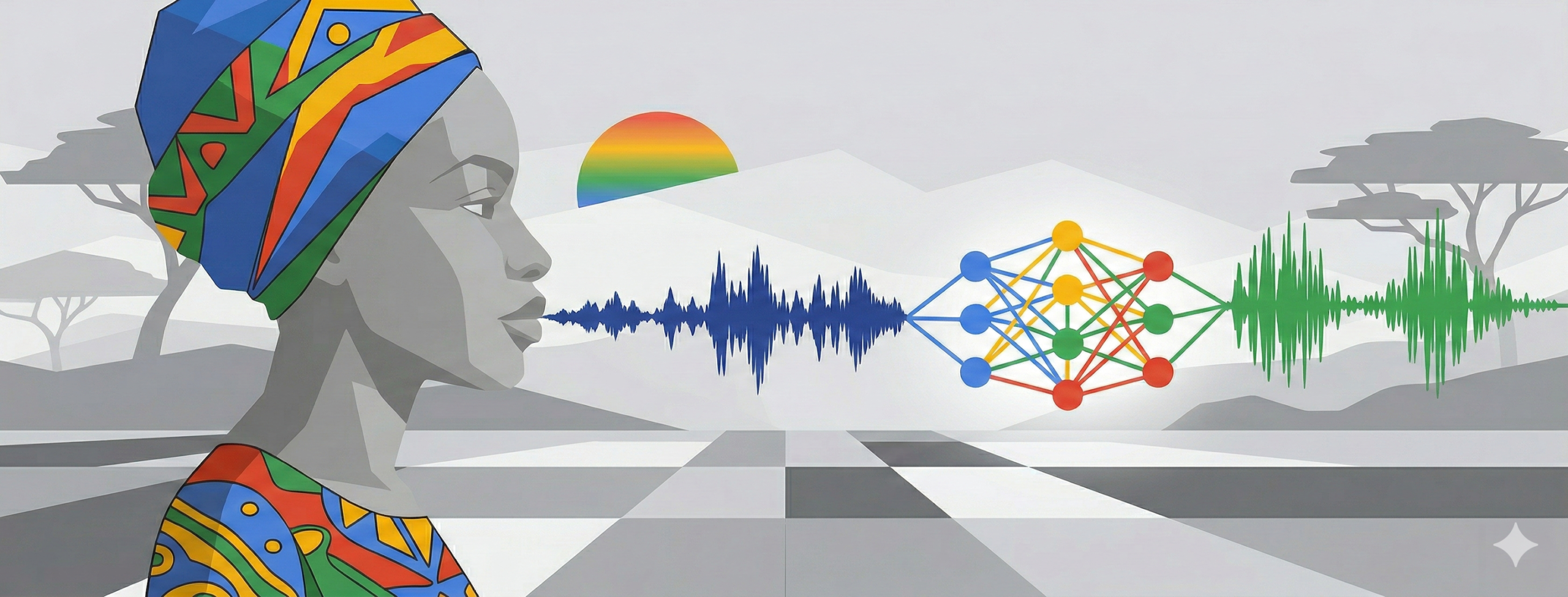

Google is pushing deeper into African language technology as researchers and developers work to improve artificial intelligence systems that can understand spoken Lingala and Shona.
The work is part of the Google Research WAXAL initiative, an open speech data project created to address one of the biggest barriers facing voice technology in Africa: not enough quality training data. In its latest announcement, Google said the WAXAL speech recognition challenge attracted 1,462 innovators from 100 countries, including participants from 42 African countries. They submitted 8,837 solutions and spent more than 24,000 hours working on the problem.
The results point to a growing role for African developers in shaping how the continent builds voice AI. Google described WAXAL as an effort to bring speech technology closer to languages millions of Africans use every day. The shift could make ordinary digital interactions more accessible.
Also Read: Intron Launches Africa-Wide Challenge to Help Voice AI Understand How Africans Really Speak
African developers make their mark in speech AI
The final challenge produced a notable showing from African participants. Team Pasketti, made up of Roman Solovyev and enes3774 from Kazakhstan and Canada, took first place.
Burkina Faso machine learning engineer Alban Nyantudre finished second and was recognised as the Best African Participant. His approach drew on multiple readings of the same audio before selecting the transcription considered most reliable. Nyantudre has worked on speech and machine translation models for Mooré, his mother tongue.
Niger-based AI engineering student Abdourahamane Ide Salifou placed third. Google said his approach considered how words flow together in Lingala, while using surrounding context to improve predictions for Shona.
Their performances matter because African language speech recognition has a particular technical challenge. Models trained heavily on English and other high-resource languages cannot simply be expected to understand pronunciation patterns, vocabulary and conversational structures across African languages.
The Zindi challenge description says the competition focused on Lingala, Shona and Luganda and required systems to perform well on previously unseen speech. It also used Word Error Rate and Character Error Rate to assess performance.
Back Story
Google introduced WAXAL in February 2026 as an open dataset intended to tackle the shortage of African speech data. Its first announcement listed 21 languages, including Hausa, Igbo, Lingala, Shona, Swahili and Yoruba. A later Google Research update described WAXAL as covering 27 African languages, while the September winners announcement said the collection had reached 32 languages.
The project was developed with African academic and community organisations and made available as an open resource for researchers and developers. Google says the goal is not only better speech recognition, but also technology that can represent how people communicate.
That foundation is important because speech data is a key ingredient needed to train automatic speech recognition systems. Without representative recordings, AI can struggle with pronunciation, spelling, word boundaries and differences between speakers.
Google has also said it is trying to move beyond traditional translation by building systems that can understand audio more directly, including tone, context and conversational cues. Its wider language programme has a stated goal of supporting the world’s 1,000 most spoken languages.
Also Read: Intron Sahara v2.5 Expands African Voice AI With 31 African Languages
What the development means for Africa
The WAXAL challenge is significant because it shifts part of the language technology conversation from importing finished AI products to developing tools around African linguistic realities.
For countries such as Nigeria, where people frequently move between English, Pidgin and indigenous languages, stronger speech recognition could eventually support voice interfaces, education tools, transcription services, customer support and digital public services.
It also creates room for African developers to contribute datasets, models and technical methods rather than serving only as end users of technologies designed elsewhere.
There is still a long road ahead. Winning a speech recognition challenge does not automatically mean that a commercial voice assistant will understand every speaker in real-world conditions. Performance can vary because of background noise, accents, code-switching, recording quality and limited data.
However, the latest WAXAL results show that the technical community around African languages is becoming more active. With open datasets, local expertise, and continued research, speech AI is moving closer to a future where speaking an African language is less likely to be a barrier to using digital technology.