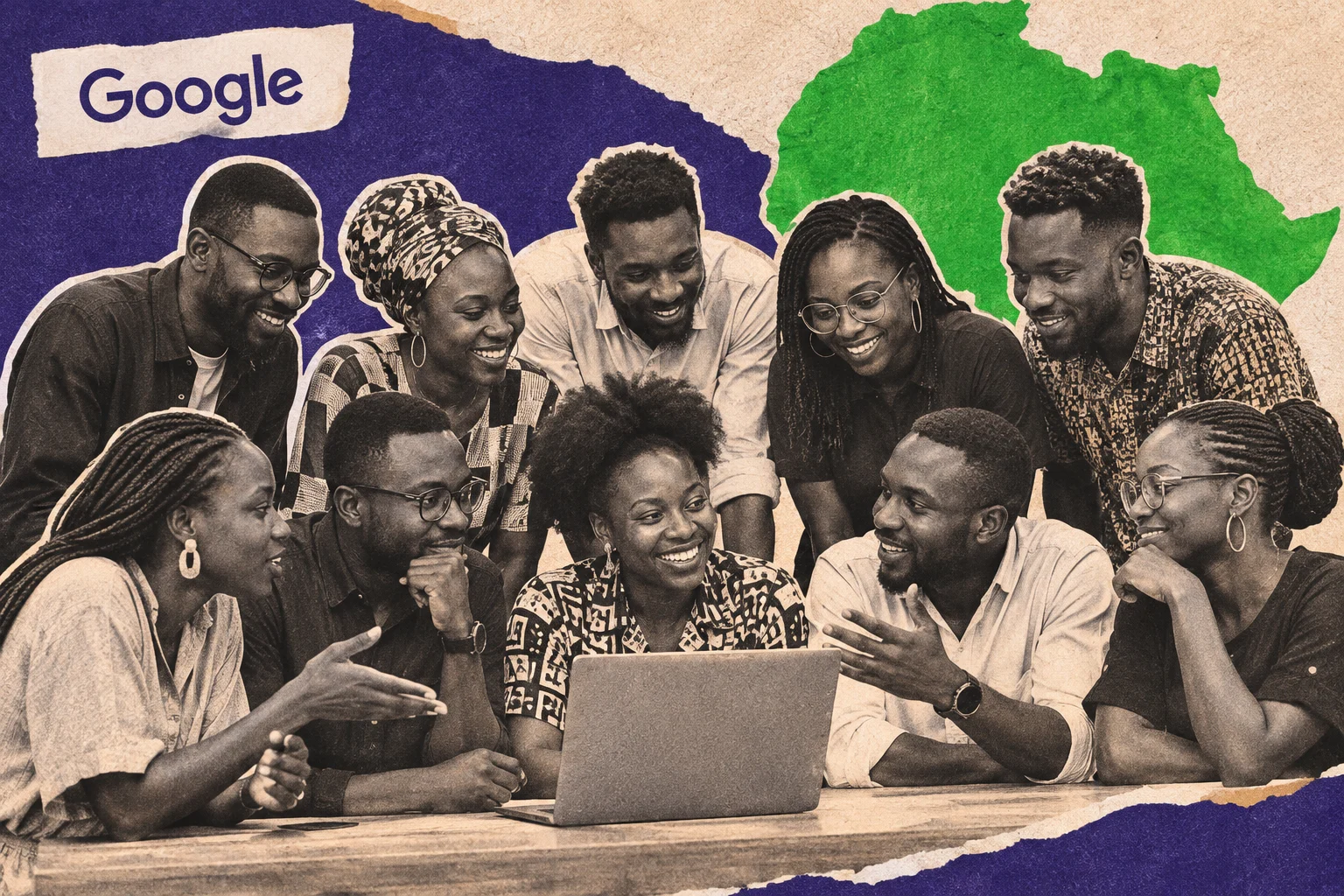

Google has selected 10 African startups for its inaugural Africa Applied AI Lab, bringing Nigerian technology companies into a programme designed to turn artificial intelligence research into products for real-world use.
Announced on November 11, 2026, the selection includes Nigeria’s Intron, Termii and Vendy. The other participants operate in Uganda, Kenya, Senegal and across multiple African markets. They are developing products covering speech recognition, financial services, healthcare, agriculture, identity verification and access to information.
Google received thousands of applications from startups across more than 45 African countries before selecting the inaugural cohort. The initiative is managed by the Google AI Futures Fund alongside Google Research.
Nigeria’s Three Selected Companies Address Different Technology Gaps
The Nigerian companies are developing solutions in three distinct areas of the digital economy.
Intron focuses on clinical and enterprise speech recognition, with technology designed to understand African accents and conversations involving multiple languages. This addresses an important limitation in voice technology, where systems trained predominantly on standardised speech can struggle with different accents and code-switching.
Termii provides communication infrastructure for businesses, including customer verification, messaging and operational alerts. Its inclusion brings attention to the role of reliable communication systems in financial services and other businesses operating across digital channels.
Vendy takes a different approach by enabling businesses to establish storefronts and accept payments directly through WhatsApp.
The three companies illustrate different commercial applications of technology: improving communication between people and machines, supporting business operations and making online commerce more accessible. Their selection does not mean their products have been developed entirely through Google’s AI models, but participation requires meaningful use of Google’s AI technology.
Also Read: Google Gives Nigerian Students Free AI for One Year Across 27 African Countries
What the Other Seven Startups Are Building
The remaining participants reveal the range of problems African founders are attempting to address with AI.
Uganda’s Crane AI Labs develops offline AI tools for healthcare workers and schools using affordable phones. Senegal’s Tolbi combines satellite imagery with voice guidance to help smallholder farmers improve agricultural yields.
Kenya’s Satlyt is developing connected computing nodes that allow satellites to process data in orbit, while Smile ID uses computer vision for identity verification and customer onboarding.
The other participants include AethexAI, which develops voice agents for banks and telecommunications companies; Agrails, which is building AI-powered insurance infrastructure for farmers and other underserved borrowers; and Viamo, which provides generative AI access through ordinary telephone calls in local languages.
These applications are significant because they extend AI development beyond chatbots and conventional software products. They target practical challenges involving access to healthcare, agricultural information, financial services and digital communication.
Google Offers Technical Support, Not Guaranteed Investment
Participating companies will receive early access to Google’s AI models, including Gemini and Gemma, alongside technical mentorship from Google engineers, research scientists and product specialists.
The programme also involves four venture capital firms: 4DX Ventures, Norrsken22, Novastar Ventures and Ventures Platform. Their role includes providing guidance on commercialisation, market entry and potential investment.
However, participation does not guarantee that a startup will receive funding. Google’s programme information explains that selected companies may be eligible for investment through the AI Futures Fund and its venture capital partners.
Founders also do not automatically surrender equity simply by participating. The programme is not an exclusivity arrangement, meaning companies can continue using other AI technologies alongside Google’s models.
Back Story: Google’s Growing AI Presence in Africa
Google introduced the Africa Applied AI Lab in July 2026, with the Accra AI Community Centre in Ghana serving as its base. Applications opened on July 1 and closed on August 31. The initial co-development period runs from mid-September to early December, with a demonstration event scheduled for December.
The initiative builds on Google’s broader investment in African AI research, infrastructure and skills development. One relevant example is WAXAL, an African-language speech dataset launched in February 2026 with research partners to support speech technology development across 21 sub-Saharan African languages.
For the selected companies, the immediate opportunity is access to technical expertise and tools that could accelerate product development. The longer-term test will be whether these products can attract customers, remain affordable and scale beyond their initial markets.
Google’s first cohort therefore offers a useful indication of where African AI entrepreneurship is heading: towards applications designed around the continent’s specific economic, linguistic and infrastructure conditions.
Also Read: Google Advances AI Speech Technology for Lingala and Shona Through African Developer Challenge