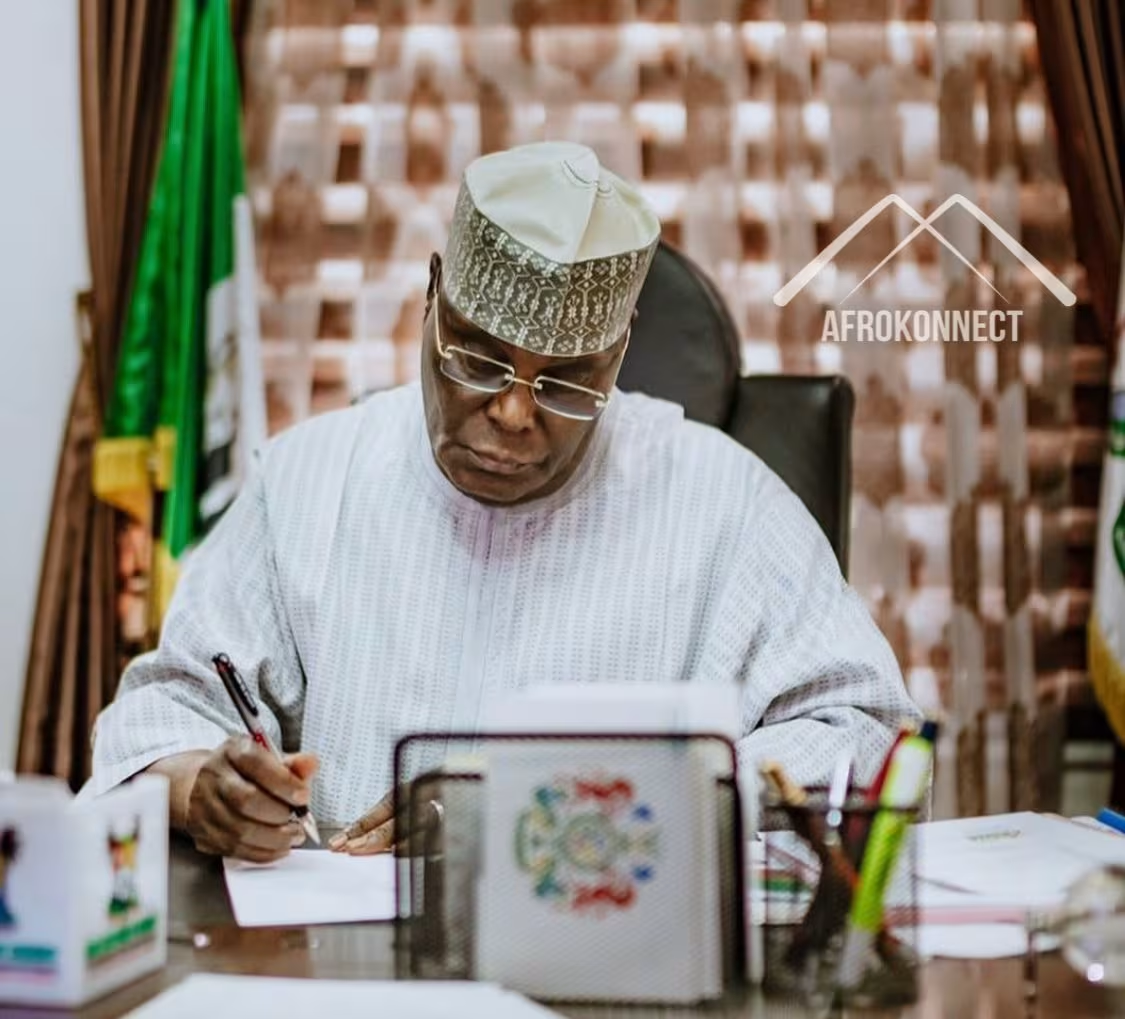

Former Vice President Atiku Abubakar has urged President Bola Tinubu to increase the national minimum wage, stating that the current N70,000 baseline is inadequate to cover basic living expenses amid rising inflation.
Atiku, the presidential candidate of the African Democratic Congress (ADC), endorsed calls from organized labor for a substantial wage revision, prompting the Federal Government to implement a pay increase that aligns with current economic conditions.
In a statement issued on Sunday by Phrank Shaibu, Director of Strategic Communications for the ADC Presidential Campaign Council, Atiku accused the administration of intensifying economic hardship for workers through the removal of the petrol subsidy.
Cost of petrol gulps 70,000 minimum wage
The former vice president claims that the policy had increased the cost of food, fuel, transportation and other essential goods without providing adequate protection for working families.
Atiku compared workers’ purchasing power under the previous and current minimum wages. He said N30,000 could buy nearly 118 litres of petrol at the national average price of N254.06 per litre in April 2023, while N70,000 could buy about 50 litres at N1,400 per litre.
According to Atiku, increasing the minimum wage from N30,000 to N70,000 had not restored workers’ purchasing power.
His comments come amid rising fuel prices and a broader increase in the cost of living.
He said, “The government pulled away the floor, offered workers a flimsy umbrella and now applauds itself while the rain beats down on them,” Atiku said.
“Fuel, transport, food and rent have devoured their earnings. This is a callous way to govern people who work hard and ask only for the means to live.”
“At ₦1,400 a litre, the entire ₦70,000 monthly minimum wage buys just 50 litres of petrol,” he said.
“What does the worker take home to feed the children? What pays the rent? What gets that worker back to work on Monday?”
Also Read: NLC agitated says 70k minimum wage hardly sufficient, demand 250k
Nigeria’s wage against other African nations
Atiku contrasted Nigeria’s minimum wage with those of other African and oil-producing nations, highlighting that Libya, Algeria, Equatorial Guinea, and Gabon maintain significantly higher wage baselines.
Based on exchange rates from July 2026, he noted that the monthly minimum wage stood at approximately N213,000 in Libya, N245,000 in Algeria, N302,000 in Equatorial Guinea, and N351,000 in Gabon.
He added that neighbor Benin Republic also maintains a higher minimum wage floor than Nigeria based on those conversion rates.
While acknowledging variations in living costs and national wage structures, Atiku maintained that the N70,000 monthly baseline remains insufficient for Nigerian workers given prevailing economic conditions.
Backstory…
Recall that the Federal Government increased the minimum wage from N30,000 to N70,000 in July 2024 following negotiations with organised labour.
The Tinubu administration has previously defended its economic and wage policies, saying negotiations with organised labour and other stakeholders led to the agreement on the N70,000 minimum wage.
The Presidency also promised to review the wage after three years and said at the time of the agreement that the increase would provide immediate relief to workers.
Meanwhile, Atiku’s call for an increase in wage is not the first of it’s kind. Several public figures, activists and bodies have also previously demanded similar request.
In July of 2026, the Federal Workers Forum (FWF) called on the federal government to address issues impacting correctional facilities across the country, adopt a minimum wage of ₦300,000, and pay unpaid workers’ entitlements.
Read Also: #TakeItBack Movement Stages Protests in Lagos and Abuja, Demand 500k Minimum Wage