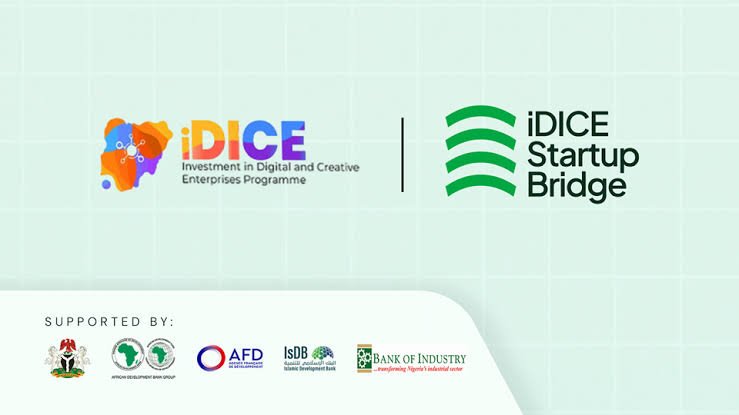

Eight Nigerian startups have been selected for equity investment through the Federal Government-backed iDICE Startup Bridge Growth Lab, for a package worth about $800,000, or ₦1.07 billion. But this is equity, not grant funding.
The companies are GoDash (last-mile logistics), Telios (energy), Vantrace (regulatory technology), KrosAI (artificial intelligence), Leaflet (agritech), Lenol (mobility), 360gadgetsafrica (e-commerce) and SavvyBee (fintech). Their published regional labels cover the Northwest, North Central, Southeast, Southwest and South-South, but not the Northeast.
Each company is expected to access $100,000, approximately ₦134 million. The package also includes a 12-week accelerator and mentoring.
Also Read: Nigeria’s $618m iDICE Programme: What Tech and Creative Businesses Can Access
The money comes with an equity cost
Equity investment means a company gives an investor part-ownership in exchange for capital. The Growth Lab’s published FAQ states that its standard offer is $100,000 for 7.5 per cent equity. This differs from a grant, which does not normally require founders to surrender shares.
The programme’s funding page describes the primary investment as up to $100,000, paid in naira at the prevailing exchange rate, and says final terms are shared with selected founders. Its FAQ sets out the $100,000-for-7.5 per cent offer. The signed documents will determine each founder’s precise terms; the headline amount is not proof that funds have already been transferred.
Outstanding participants may qualify for up to $250,000 in additional growth capital, but only if they meet programme conditions and secure matching funds from qualified investors or partners. This follow-on money is not guaranteed.
Why the selection number matters
The programme’s July 15 application announcement said Growth Lab would select 12 startups. Its current FAQ repeats that target, while the November 19 announcement names eight companies. The public information reviewed does not explain the difference.
This does not prove that the programme has failed or that money has been withheld. It leaves a question for organisers: were four places left unfilled after due diligence, postponed to another cohort or removed for another reason? Explaining the change would help applicants and the public understand how the selection worked.
Back Story: What iDICE was created to do
The Investment in Digital and Creative Enterprises programme was launched in Abuja on March 14, 2023. The Federal Government initiative aims to address barriers facing technology and creative businesses, including limited access to finance and gaps in business capacity. It is implemented through the Bank of Industry and co-financed by the African Development Bank, Agence Française de Développement and the Islamic Development Bank.
Growth Lab is the Startup Bridge’s accelerator for companies with a working product and evidence of market traction. Its support covers product development, customer growth, financial planning, governance, operations and fundraising preparation.
The programme’s success should be judged by more than the launch figure. The public should be able to track whether participating companies grow revenue, create sustainable jobs and attract investment. Publishing those outcomes, alongside an explanation of the eight-versus-12 selection difference, would show whether government-backed startup finance is delivering lasting value.
Also Read: Google Selects 10 African Startups for Applied AI Lab, With Three From Nigeria