A Nigerian student studying Robotics Engineering in Ghana is showing how emerging technologies can be applied to some of Africa’s most persistent agricultural challenges.
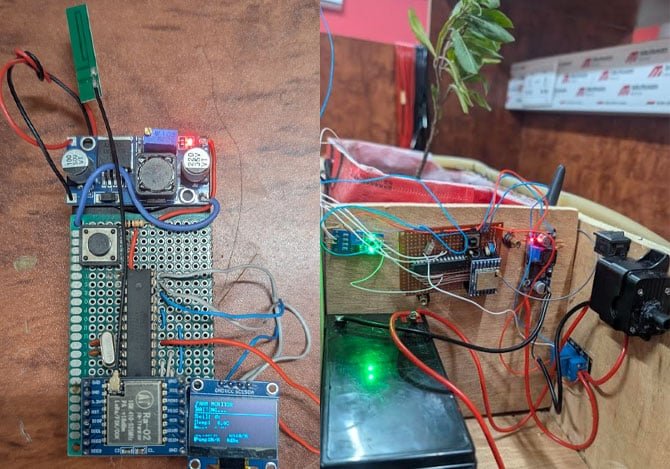
Ikechukwu Alfred, a Level 300 Robotics Engineering student at Academic City University in Accra, Ghana, developed a precision agriculture system capable of collecting environmental and agricultural information from farmland and transmitting the data over distances of more than five kilometres.
The project, developed as part of his Embedded Systems course, reflects a growing interest among African students in using robotics, sensors and connected technologies to address practical problems rather than limiting robotics to conventional applications.
For farmers managing large areas of land, regularly checking conditions across a farm can be demanding. Alfred’s system is designed to reduce that burden by allowing agricultural information to be gathered remotely and transmitted to users, potentially helping farmers make quicker decisions without having to physically inspect every part of their farms.
The project is particularly significant because precision agriculture depends heavily on timely information. Technologies involving sensors, connectivity, data analysis and automation can help farmers understand changing conditions and use resources more efficiently.
A 2026 study on precision agriculture in Ghana similarly identified technologies such as sensors, drones, artificial intelligence and data analytics as important tools for improving farm productivity, resource efficiency and climate resilience.
Alfred’s project therefore sits within a much wider movement towards digital agriculture across Africa.
Also Read: The Rise of Robotics Laboratories in African Universities Is Shaping the Continent’s Future
From Robotics to Real-World Agricultural Innovation
What makes Alfred’s story stand out is not simply the technology behind his project, but the thinking that led to it.
According to his profile published by Academic City University, Alfred developed an interest in how machines work from a young age. He was particularly fascinated by electronics, mechanics and programming, eventually deciding that Robotics Engineering would allow him to bring those interests together.
His educational journey could have taken him outside Africa. He had initially considered studying in Germany before encountering Academic City University and its Robotics Engineering programme during his final year of secondary school.
That encounter ultimately changed his plans.
Rather than viewing robotics as an abstract engineering discipline, Alfred began looking at how it could be adapted to African realities. His precision agriculture project became one expression of that approach.
The system uses a transmitter and receiver arrangement to gather and communicate agricultural and environmental information across a farm. The central idea is straightforward: instead of requiring a farmer to constantly move around a large farm to observe conditions, relevant information can be communicated remotely.
That kind of approach could become increasingly valuable as African agriculture faces pressure from climate variability, labour challenges, rising production costs and the need to increase food production.

Back Story: A Nigerian Student Building His Future in Ghana
Alfred’s agricultural technology project is only one part of his experience as a Nigerian student in Ghana.
Originally from Delta State, Nigeria, he moved to Accra to study Robotics Engineering. Academic City University describes him as a student who has combined his academic work with leadership, volunteering and creative activities.
Beyond his engineering studies, Alfred has participated in student media and outreach activities and has held several leadership responsibilities. He has served as General Secretary of the Robotics Club, founded the Creative Collective and worked in media and publicity roles.
He also became involved in stage productions and later served as the Public Relations and Communication Officer of the Academic City Student Council.
His experience offers an interesting perspective on the movement of Nigerian students across African borders in search of specialised education.
It also challenges the assumption that international educational opportunities must always mean Europe, North America or other Western destinations. For students interested in fields such as robotics, artificial intelligence, engineering and technology, institutions within Africa are increasingly becoming part of the conversation.
Academic City University says Alfred’s experience has been shaped by practical learning, mentorship, collaboration and opportunities to work beyond the classroom.
Also Read: Nigeria’s Agriculture Education Reform Targets More Practical Training in Polytechnics
Why the Project Matters for African Agriculture
The significance of Alfred’s innovation extends beyond one university project.
Agriculture remains central to livelihoods across Africa, yet many farmers still have limited access to technologies that can provide timely information about their farms. Precision agriculture offers a possible pathway towards changing this by combining field data with digital tools to improve decision-making.
Research on African agricultural robotics has highlighted applications including precision navigation, computer vision, sensors, machine learning and robotic systems for tasks such as planting, monitoring and applying farm inputs.
There is also growing evidence of African engineers and students developing locally relevant agricultural technologies. In Ghana, for example, robotics company 3Farmate has developed autonomous farming technology designed to perform agricultural operations with minimal human intervention.
For Nigeria and other African countries, the emergence of young innovators such as Alfred points to a potentially important shift. The next generation of African engineers may not simply consume imported technology. They may increasingly design systems around the realities of African farms, communities and businesses.
Alfred’s five-kilometre agricultural data transmission system is still a student project, and it should not be mistaken for a complete commercial farming solution. However, it demonstrates an important principle: robotics education becomes more meaningful when students can connect engineering knowledge to problems people actually face.
For African agriculture, that connection could be where some of the continent’s most useful innovations begin.