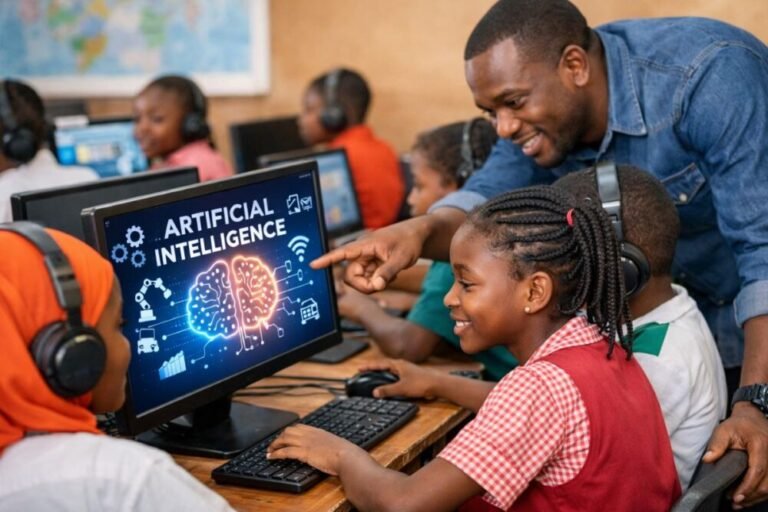

Six African innovators are using artificial intelligence (AI) to address educational challenges, from helping students understand difficult subjects to finding scholarships and preparing for technology-driven careers. Their work highlights how homegrown solutions can make learning more accessible, personalised and relevant to African students.
As education systems across the continent grapple with unequal access to learning resources, limited individual attention in classrooms and the cost of digital tools, these entrepreneurs are exploring practical ways to close existing gaps.
According to a report published by Punch Newspapers on October 29, 2026, the innovators are applying AI to different stages of the educational journey, including academic tutoring, curriculum-based learning, admissions guidance and digital skills development.
Six Innovators Applying AI to African Education
South African entrepreneur Dacod Magagula co-founded FoondaMate, an AI-powered study assistant that operates through messaging platforms such as WhatsApp and Messenger. The service enables students to ask academic questions and receive explanations without necessarily downloading a specialised learning application. According to Meta, the platform has handled more than 100 million student questions, demonstrating the potential of familiar communication tools to support learning.
Shabnam Aggarwal, an education technology leader at Rising Academies, has helped advance Rori, an AI mathematics tutor available through WhatsApp. Its approach focuses on guided practice and feedback rather than simply providing answers. An eight-month evaluation involving approximately 1,000 students in 11 Ghanaian schools found that pupils using Rori alongside regular classroom instruction achieved better mathematics results than those in the comparison group. A larger trial across 100 public schools is also underway.
In Nigeria, Ahmed Ogundimu founded NGScholars, an education platform that has provided information about admissions, scholarships, examinations and academic opportunities since 2013. He is now extending the platform’s capabilities with AI-assisted tools intended to help students discover relevant opportunities, organise applications and navigate admission requirements. This addresses a significant challenge for students who may qualify for opportunities but struggle to find reliable information about them.
Claire Mongeau, founder of Kenya-based M-Shule, has pursued a different approach to educational access. The platform uses AI to personalise learning content delivered through SMS, allowing students to receive educational support using basic mobile phones. By reducing dependence on smartphones and broadband internet, the model offers an alternative for learners in communities with limited digital infrastructure.
Nigerian entrepreneur Isaac Oladipupo, co-founder of Afrilearn, is using technology to support curriculum-based education. The platform combines video lessons, class notes, examination preparation, quizzes and AI-assisted learning features. Afrilearn reports reaching more than four million learners, with resources designed to help students practise subjects and prepare for examinations within African education systems.
Meanwhile, Adewale Yusuf, co-founder and chief executive of AltSchool Africa, is focusing on the skills people need to participate in an AI-driven economy. Through its AI for 10M Africans initiative, the organisation aims to expand practical AI knowledge across the continent. The effort reflects the growing importance of teaching people how to use AI tools effectively, assess their outputs and apply them responsibly in education and employment.
Back Story: Why AI Education Matters in Africa
The growth of AI-powered education reflects longstanding challenges facing learners across Africa. In many communities, students have limited access to qualified teachers, affordable learning materials, reliable internet connections and personalised academic support.
Nigeria faces similar concerns, particularly where students must prepare for competitive examinations while dealing with financial constraints or limited access to extra lessons. Finding scholarships and understanding admission requirements can also determine whether a student progresses to higher education.
AI offers potential solutions by providing additional explanations, adapting exercises to individual performance and helping learners navigate educational information. However, technology alone cannot resolve problems caused by inadequate school infrastructure, unreliable electricity or the high cost of internet access.
Research and practical experience also make it important to assess whether these tools improve learning outcomes rather than merely attract users. The evaluation of Rori in Ghana offers an example of how educational AI can be examined through measurable academic performance.
For African developers, building solutions around familiar platforms, local curricula and existing infrastructure may be just as important as the sophistication of the underlying technology.
Opportunities and Challenges Ahead
The work of these six innovators demonstrates that AI can support education in several ways, from classroom learning to career preparation. Their approaches also show why solutions developed with African students’ circumstances in mind may be more useful than products designed without local needs in consideration.
Nevertheless, questions remain about data privacy, the accuracy of AI-generated information, affordability and the risk of students becoming overly dependent on automated assistance. Schools and education authorities will need to consider these issues as adoption grows.
For Nigeria and the wider continent, the opportunity lies in combining technology with effective teaching, relevant learning materials and responsible implementation. If developers can demonstrate lasting improvements in educational outcomes, AI-powered platforms could become valuable additions to conventional learning and help more young Africans prepare for future opportunities.