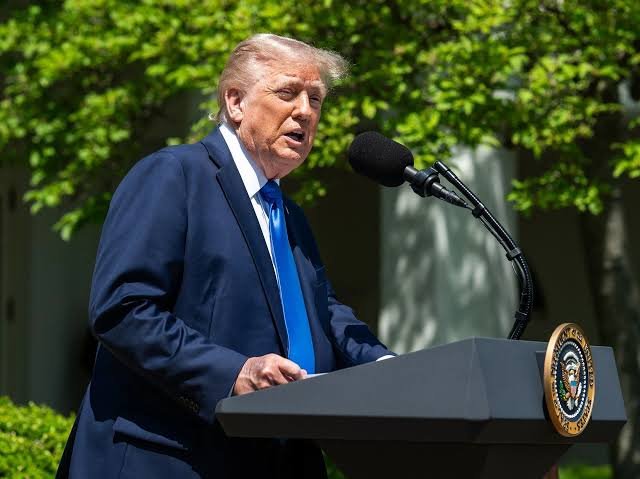

In a bid to help the U.S. artificial intelligence sector compete against Chinese rivals, President Donald Trump announced on Friday that the United States will penalize American companies that build data centres overseas.
Trump delivered the remarks during a press conference where he also discussed the 2026 APEC Summit in Shenzhen, China, and his historic trilateral meeting with Presidents Xi Jinping and Vladimir Putin.
The president argued that the expansion of certain U.S.-based tech firms abroad has undermined America’s technological dominance and global competitiveness.
He maintained that these facilities should be allowed to operate anywhere across the country, warning that companies defying his directive would face “tremendous” financial penalties.
Rather than blocking or shutting down data centres projects, however, Trump encouraged local towns and state governments to negotiate with developers, “take advantage” of the investments, and “make them pay” their communities.
Read Also: China, US, Russia Sign ‘Peace Declaration’ Following Historic Summit
Data centres
According to Reuters, data centers play a vital role in the artificial intelligence boom by delivering the computing power needed to train and operate increasingly complex AI models—meaning new penalties could complicate the global AI infrastructure rollout.
Major U.S.-based data center operators, including Equinix and Digital Realty, actively construct and manage such facilities outside the United States.
Reuters further notes that developers routinely position these facilities close to end users to minimize latency for time-sensitive operations like payment processing, as transmitting massive volumes of data across long distances can generate substantial costs.
Trump has strongly backed the construction of data centres inside the United States, a position that has met public pushback due to worries over power consumption, rising utility bills, and other local impacts.
Trump also noted that he and Xi discussed establishing cooperative safeguards for superintelligence, reiterating that “whoever wins SI, wins.”
While the president raised the issue of denuclearisation with his Russian and Chinese counterparts, there was no indication that the three leaders reached an agreement to reduce their nuclear arsenals.
Roughly 90% of the world’s estimated 12,000 nuclear warheads are possessed by the United States and Russia, with China holding about 600.