
By the time Eid al-Fitr arrived, many residents across Niger State were already anticipating the worst as electricity supply had become increasingly unreliable.

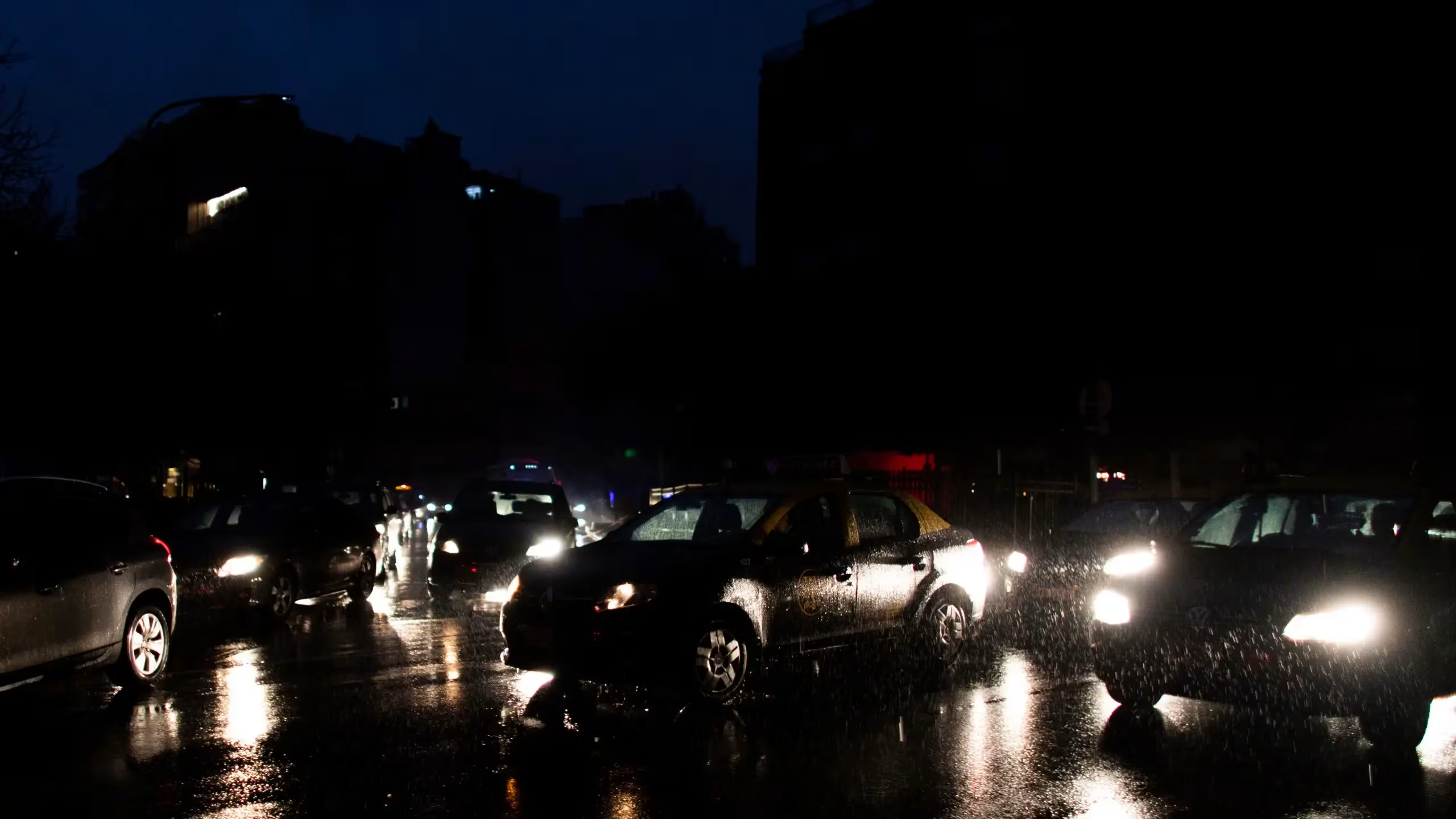
Several neighbourhoods experienced prolonged outages lasting days. Then, during one of the most significant religious celebrations of the year, power supply dropped drastically, with barely two hours of electricity available daily.
Fans went off, water systems broke down, and businesses were forced to close earlier than usual.
“We planned for Sallah, but there was no light. With this heat, it was just unbearable,” a resident of Chanchaga said.
For many, the blackout marked more than a disruption, it was a breaking point.
A Controversial Message
As the frustration grew, Governor Umaru Bago of Niger, speaking during a media briefing on February 28, 2026, urged residents to consider solar power as an alternative.
The reaction was immediate as across Minna and surrounding communities, residents described the advice as unrealistic.
“How do you tell people to go solar when they can barely afford food? The government is migrating, and citizens are left to suffer. Why not support people to make life easier?” Garba, a trader at the Minna central market said.
Some residents said that even with Easter approaching, they do not expect any improvement in electricity supply.
“We don’t expect anything different,” Mrs. Martha said. adding: “if anything, it may even get worse.”
Government Turns Inward
During the same February 28 briefing, Governor Bago said Niger State Government was reducing its dependence on the national grid.
He disclosed that the Government House, where he resides, has already been disconnected from the Abuja Electricity Distribution Company, alongside several other government institutions.
The Niger governor, who did not disclose how much was invested in the transition, said more than 180 communities, including Lambata in Gurara Local Government Area have been disconnected from the grid and now rely on mini solar systems.
He also revealed that efforts are underway to migrate the state water board to solar power to improve water supply, as residents grapple with shortages.
The administration says the shift to solar is part of a broader strategy to reduce pressure on the grid.
However, residents say the transition has not eased their struggles.
While government facilities move toward independent power, many communities continue to endure prolonged outages and unreliable supply.
A State That Generates — But Does Not Receive
Niger State hosts major hydropower facilities, including Kainji, Jebba, and Shiroro dams, yet local supply remains unreliable.
Electricity generated in the state is transmitted through the national grid and distributed by companies such as AEDC, but system losses and infrastructure constraints reduce what ultimately reaches consumers.
Niger State Governor Bago noted that although the state hosts some of the country’s major dams, it does not own them, as the electricity generated is fed into the national grid for nationwide distribution.
He added that the state is now exploring independent power generation options to reduce its reliance on the national grid and improve supply to residents, a move that reflects a broader shift toward self-sustained energy solutions amid persistent grid challenges.
The Aso Rock Solar Shift
At the federal level, a similar transition is underway.
The Aso Rock Presidential Villa is expected to fully disconnect from the national grid by March 2026 following the completion of its solar power project.
Niger State House Permanent Secretary, Temitope Fashedemi disclosed this while defending the State House 2026 budget before the Senate Committee on Special Duties.
He said the system has been tested and is already operational in parts of the complex.
He noted that the State House Medical Centre has operated without generator power since its own solar installation.
A total of N17 billion has been committed to the project, with N10 billion allocated in 2025 and an additional N7 billion provided in the 2026 budget.
The development has intensified debate over equity, as government institutions move toward energy independence while many citizens remain dependent on an unstable grid.
Energy Experts Raise Concerns
An energy expert based in Minna Niger, Dr. Musa Bulus, said the national grid continues to struggle despite decades of investment.
“Decentralised energy like solar is part of the future.
“But presenting it as a replacement rather than a supplement raises serious equity concerns,” he said.
A Broader Power Crisis
Nigeria’s electricity sector continues to face structural challenges despite installed capacity. Actual generation remains far below demand due to transmission constraints and infrastructure limitations.
For households and small businesses, the impact is immediate, with perishable goods spoiling, water systems failing, and generators becoming a costly necessity.
“Everything now depends on fuel, and fuel is not cheap,” another resident Kalgo said.
Accusations Against AEDC
Governor Bago of Niger State has also pointed to issues around payment compliance, referencing claims that some residents are not paying for electricity supplied.
However, residents strongly dispute this, insisting that supply itself is unreliable.
Many accuse the system of uneven distribution and lack of transparency, while others say they remain on estimated billing despite repeated requests for prepaid meters.
“You cannot expect people to pay for what they don’t get,” one resident said.
Parliamentary Scrutiny
The House of Representatives Ad-hoc Committee investigating power sector reforms has criticised what it described as a discriminatory distribution pattern by AEDC.
During an oversight visit in February 2026, lawmakers raised concerns that about 80 percent of electricity supply is directed to the Federal Capital Territory, leaving Niger, Kogi, and Nasarawa State with the remainder.
Committee Chairman Mustapha Ibrahim Aliyu said the arrangement is unfair saying, “Electricity supply should not be determined solely by revenue considerations”.
AEDC Response
AEDC’s Managing Director, Chijioke Okwuokenye, had earlier addressed lawmakers during the February oversight visit, stating that distribution is influenced by operational and commercial realities.
He cited factors such as revenue performance, infrastructure limitations, energy theft, and non-payment as key challenges.
According to him, areas with stronger revenue recovery, particularly the Federal Capital Territory tend to receive more stable supply.
He added that the company is working to expand metering and improve service delivery across its franchise areas.
However, efforts to obtain a fresh comment from AEDC for this report were unsuccessful, as calls and messages were not returned.
Voices from Minna
Spoke to residents of Tunga, Maitumbi, Kpakungu, Maitunbi and Bosso, where electricity supply remains a daily struggle.
In Tunga, Abubakar Sani said:
“We don’t sleep well because of the heat. There is no light, no water. Even charging phones is now a problem.”
In Maitumbi, Hauwa Yusuf said:
“I sell cold drinks, but without electricity, I am losing customers. Sometimes I buy fuel to run a generator, but it is not sustainable.”
In Bosso, Ibrahim Musa said:
“The heat is unbearable. When there is no light, everything stops.”
Amina Sani added, “At first we thought it was temporary, but now it feels like a normal situation. You can go days without power.”
Usman Aliyu said, “Solar is good, but it is expensive. Many of us cannot afford it.”
Beyond Minna
Reports from other parts of the state suggest the situation is widespread.
In Lambata, where solar systems have been introduced, residents say supply remains inconsistent.
“It works during the day but stops at 8:30 pm in the night until the next day,” one resident said.
In Kontagora, a source, Mohammed Kabiru, told DAILY POST that the town experienced up to eight hours of electricity daily during Ramadan.
He alleged that the improved supply was linked to a political figure believed to be preparing for the next general election, though he did not name the individual.
While the claim could not be independently verified, it reflects growing public suspicion over how electricity is distributed.
A Wider Divide
While government institutions move toward energy independence, many citizens say they remain trapped in darkness.
For many, the contrast highlights a widening gap between policy and reality.
Residents continue to ration fuel, wait for brief power supply, and endure long hours without electricity.
For many, the demand is simple- Not solar panels; not policy debates. Just power.
“We are in the state that produces electricity; yet, we are the ones living in darkness,” one resident added.