
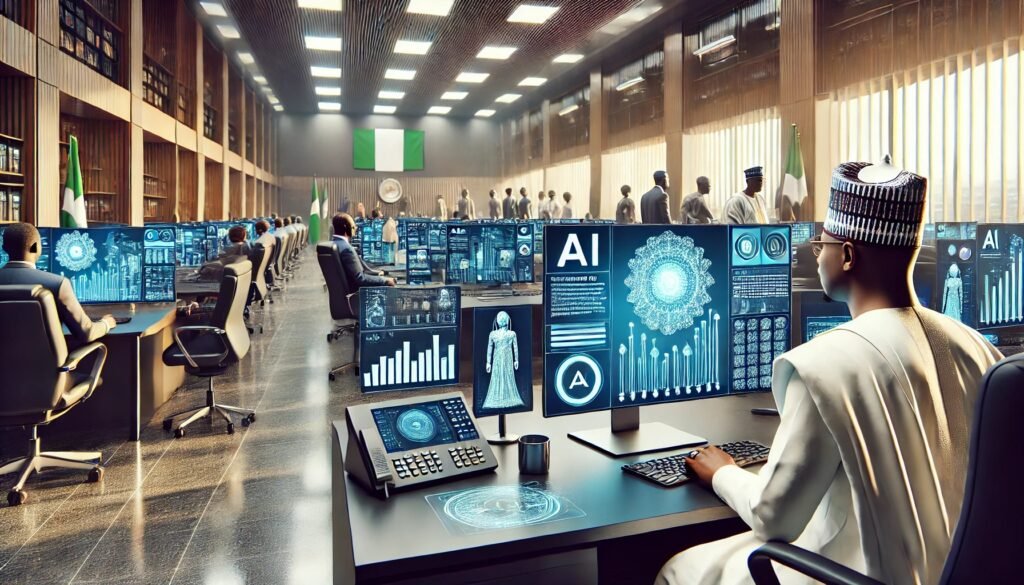
Nigeria’s ambition to build a homegrown alternative to ChatGPT is no longer a futuristic idea. It is a serious national conversation shaped by policy, investment, talent, and hard economic realities. Across government, startups, and academia, the question is shifting from “if” to “how” and, more importantly “how soon”.
In 2026, the country stands at a critical point. There is growing confidence that Nigeria can develop its own large language models tailored to local needs. At the same time, deep structural challenges continue to slow progress. This article explores what is possible, what is already happening, and what still stands in the way.

Nigeria’s AI Ambition Gains Momentum
Nigeria’s push into artificial intelligence is no accident. It is part of a broader strategy to reduce dependence on imported technologies and build systems that reflect local realities. Policymakers and tech leaders are increasingly aligned on one key idea: foreign AI tools do not always understand Nigeria.
Recent policy direction has reinforced this stance. Authorities have openly prioritised local AI development, with a strong emphasis on data sovereignty and control over digital infrastructure.
At the same time, the federal government has begun investing in homegrown research. Through national AI initiatives, grants have been provided to dozens of startups and researchers working on local solutions. These efforts are aimed at building foundational capabilities rather than simply consuming global tools.
The urgency is also practical. Nigerian businesses are already benefiting from AI. Startups report improved productivity and reduced operational costs through AI adoption, with some saving hundreds of thousands of naira monthly by automating routine tasks. This growing dependence on AI tools has made local alternatives not just desirable but necessary.
The Real Barriers to Building a Nigerian ChatGPT
Despite the ambition, building a ChatGPT-level system is not something that happens overnight. It requires massive computing power, high-quality data, and sustained funding. These are areas where Nigeria still faces significant limitations.
One of the biggest challenges is infrastructure. Training large language models requires advanced data centres and specialised hardware. While Nigeria is preparing to launch AI-focused data centres, the ecosystem is still in its early stages. Without sufficient computing capacity, local developers remain dependent on foreign cloud services.
Another major issue is data. Nigeria is one of the most linguistically diverse countries in the world, with over 500 languages. However, only a small fraction of these languages have enough digital data to train AI systems effectively. Research shows that most existing models perform poorly on many Nigerian languages due to limited datasets.
Funding also remains a constraint. Building a large language model costs millions of dollars. For many Nigerian startups, access to such capital is limited. Even in sectors like banking, studies show that high implementation costs slow down AI adoption.
There is also the issue of talent. While Nigeria has a growing pool of developers, there is still a shortage of highly specialised AI researchers needed to build systems on a global scale.
Local Innovation Is Already Taking Shape
Even with these challenges, Nigeria is not starting from zero. Local innovation is already happening, often in ways that are more practical than headline-grabbing.
Developers are building smaller, domain-specific AI tools rather than trying to replicate ChatGPT directly. These include chatbots for healthcare, finance, education, and customer service. In some cases, these tools are already making real impact by solving local problems more effectively than global alternatives.
For example, AI-powered platforms are being used in areas like mental health support, offering accessible and affordable assistance where traditional services are limited. While not perfect, these solutions highlight how local AI can address gaps that global systems overlook.
There is also a growing ecosystem of AI development companies and startups working on language models, automation tools, and enterprise solutions. Many of these companies are focusing on adapting existing technologies rather than building from scratch, which is a more realistic path in the short term.
Importantly, experts are calling for contextual AI development. This means building systems that understand Nigerian culture, languages, and economic conditions rather than copying foreign models.
What the Future Holds for Nigeria’s AI Dream
The question is no longer whether Nigeria can build its own ChatGPT. The more realistic question is what form that system will take.
In the short term, Nigeria is likely to develop hybrid solutions. These will combine global AI models with local data and customisation layers. This approach allows developers to deliver value quickly without the enormous cost of building everything from scratch.
In the medium term, investments in infrastructure such as AI data centres could begin to close the gap. As computing power becomes more accessible locally, the possibility of training large-scale models within Nigeria becomes more realistic.
In the long term, the real opportunity may not be in copying ChatGPT exactly. Instead, Nigeria could lead in building specialised AI systems designed for African contexts. These could include models trained on local languages, business environments, and social realities.
There is also a broader opportunity across the AI value chain. From data labelling to hardware assembly and data centre management, Nigeria can build capacity in multiple areas, not just software development.
However, success will depend on consistency. Policy support, funding, education, and private sector investment must all align. Without this, the ambition risks remaining just that, an ambition.
Back Story: How Nigeria Entered the AI Conversation
Nigeria’s journey into artificial intelligence did not begin in 2026. It has been building over several years through a mix of global exposure and local necessity.
The widespread adoption of tools like ChatGPT introduced many Nigerians to the power of AI. Businesses quickly realised its potential for productivity, while individuals began using it for learning, writing, and problem-solving.
At the same time, gaps in sectors such as healthcare, education, and public services created a strong demand for scalable digital solutions. AI emerged as a natural fit for addressing these challenges.
Government interest followed. National strategies were developed to support AI research and innovation, with a focus on local capacity building.
Culturally, AI has also entered mainstream awareness. From tech hubs in Lagos to university research labs and even creative industries, the conversation around AI is growing rapidly.
This combination of demand, exposure, and policy has brought Nigeria to its current moment. The country is no longer just consuming AI technology. It is actively trying to shape it.
Join Our Social Media Channels:
WhatsApp: NaijaEyes
Facebook: NaijaEyes
Twitter: NaijaEyes
Instagram: NaijaEyes
TikTok: NaijaEyes