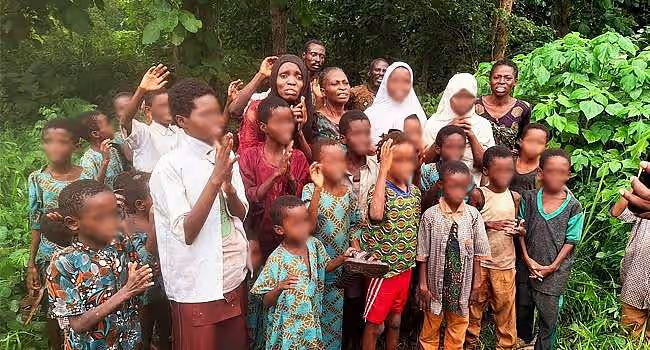

For years, Nigeria has battled two crises simultaneously: insecurity and distrust. While one threatens lives, the other threatens confidence in institutions. The Oyo kidnap incident and subsequent rescue of the school principal and other victims has once again brought both issues into sharp focus.
Ordinarily, the successful rescue of the Oyo kidnap victims should have been celebrated as another victory in the fight against insecurity. Instead, the operation has become the subject of intense public scrutiny, with conflicting accounts raising more questions than answers.
On one hand is the Federal Government’s account of a daring rescue operation. On the other is the testimony attributed to one of the rescued victims, whose account circulating online appears to differ from the official version of events. Between these two narratives lies a growing public debate that has refused to die.
The question many Nigerians are asking is simple: Who should the public believe?
Two Narratives, One Incident
According to government officials, security forces carried out a coordinated operation that led to the victims’ rescue after an exchange of gunfire with the kidnappers. The operation was presented as another example of the military’s commitment to combating kidnapping and restoring security.
Then came another account.
Accounts from a rescued survivor sparked widespread speculation online, leading many social media users to challenge the official narrative released by authorities.
Within hours, digital platforms filled with commentary, video clips, and breakdown posts, as commentators openly questioned if official channels were withholding key details of the incident.
None of those claims has been independently verified. Yet their rapid spread reflects something deeper than curiosity—it reflects a widening trust deficit between the government and many Nigerians.
Read Also: Senate Approves ₦50 Million for Families of Oyo School Attack Victims
The Questions That Refuse to Go Away
The controversy is not driven solely by rumours. It is fuelled by questions that remain unanswered.
If reports that soldiers lost their lives during the rescue operation are accurate, who were they?
What military formation did they belong to? Were their families formally notified? Were they buried with military honours?
Why has there been no comprehensive public account detailing the operation from start to finish?
Military casualties are not ordinary statistics. Behind every fallen soldier is a grieving family, colleagues and a nation that owes them recognition. If lives were indeed lost during the rescue, many Nigerians believe those sacrifices deserve to be acknowledged publicly rather than reduced to passing references.
Information Gaps Fueling Conspiracies
Whenever official communication leaves significant questions unanswered, alternative narratives quickly emerge to fill the gap. Some are reasonable. Others are wildly speculative.
The Oyo incident has become a textbook example.
Across Facebook, X, TikTok and WhatsApp, countless theories now compete with the official narrative. Some users have gone as far as alleging that the entire incident was staged, while others insist the government is withholding key facts about the rescue.
There is currently no publicly available evidence proving those claims.
Read Also: FG Arraigns Three Over Alleged Kidnap of Oyo Schoolchildren, Teachers
Nigeria Deserves Clarity
If the official account is accurate, Nigerians deserve a detailed chronology of what transpired.
If soldiers made the ultimate sacrifice during the rescue operation, they deserve to be identified and honoured publicly.
If conflicting testimonies exist, they should be explained rather than ignored.
The questions surrounding the Oyo kidnap may eventually be answered. Or they may join the long list of national controversies that gradually fade from public attention without full clarification.
Every national controversy reaches a point where silence becomes part of the story. The Oyo kidnap may have reached that point. The longer authorities fail to address the inconsistencies, the more Nigerians will continue to ask whether they witnessed a heroic rescue, an incomplete story, or something else entirely. In a country where public trust is already fragile, unanswered questions are often more damaging than uncomfortable answers.