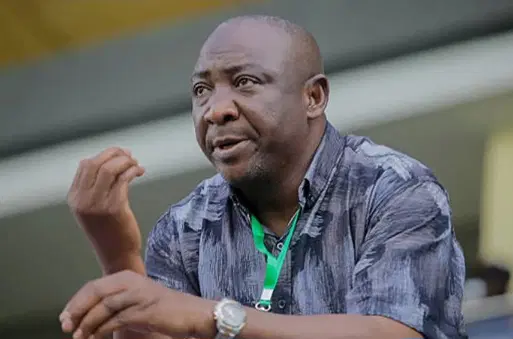

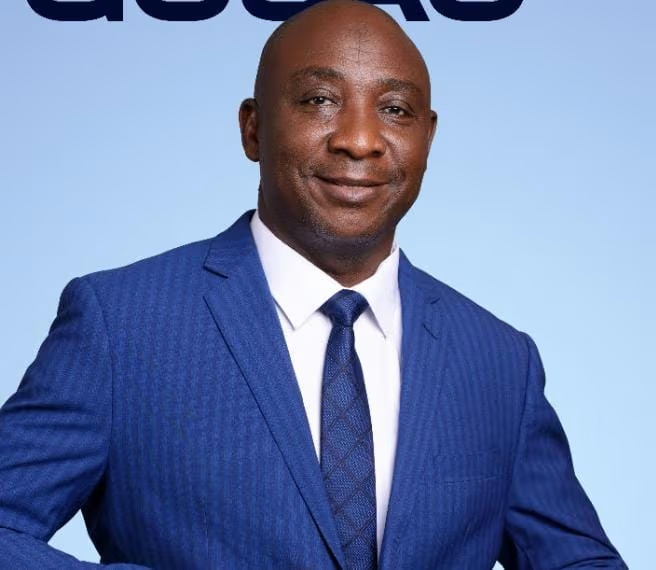
Ibrahim Gusau has quit!
The Nigeria Football Federation (NFF) president handed in his resignation on Wednesday morning. Also, several board members followed him out the door. This mass exodus comes after months of public anger and a security probe into billions of naira missing.
Nigerian football is experiencing its worst crisis in decades.
Eight of thirteen board members have resigned, as reported by Vanguard. The football federation now barely functions, as key decisions cannot be made, and several contracts hang in limbo. The September 27 board elections in Lafia, Nasarawa State, now look dead in the water.
A lot of this pressure came as the Super Falcons failed to qualify for the 2027 Women’s World Cup in Brazil. They lost to Cameroon and South Africa, and for the first time since 1991, Nigeria will not send a women’s team to the global tournament.
The Super Eagles added to the misery as they missed the 2026 World Cup in the United States, Mexico, and Canada. The men’s team that once dominated Africa now cannot even qualify for the biggest stage. The fall from grace is staggering and painful for most Nigerian football fans.
Gusau took over in 2022, when he promised reform and transparency and claimed to restore Nigeria’s football glory. The results never matched his words. The Falcons and Eagles crumbled in front of everyone. The youth teams faded from the spotlight, and every level of the national setup underperformed.
The federal government approved a 17 billion naira intervention fund in 2024. The money was meant for player wages and bonuses. It was meant to clear debts that had festered for years with the NFF, as players had threatened to boycott important matches and tournaments. Most coaches had quit over unpaid salaries. The intervention fund was supposed to fix all of that.
The Department of State Services (DSS) opened a probe, and the Economic and Financial Crimes Commission (EFCC) began asking questions. The 17 billion naira vanished into a black hole of bureaucracy and questionable accounting.
FIFA will be watching closely, as the world governing body does not tolerate government interference in football administration. If Nigerian authorities install a new board without following proper electoral procedures, FIFA could suspend the country. That would mean no international matches. No continental competitions. Without funding, Nigerian football would grind to a halt.
The September 27 elections will not happen as planned. The federation must first stabilize and find enough board members to form a quorum. It must negotiate with FIFA and convince the world that Nigerian football can govern itself. That is a tall order for a federation in ruins.
From Glory to Ash: How Nigeria’s Football Lost Its Way
There was a time when Nigerian football inspired a continent as the 1994 Super Eagles were magical with Rashidi Yekini, Jay-Jay Okocha, and Daniel Amokachi. They all played with swagger and reached the Round of 16 at the World Cup. They won the Africa Cup of Nations, and the world took notice of Nigeria.
The 1996 Olympic gold in Atlanta topped it all. Kanu Nwankwo scored the winning goal against Brazil in the semifinal. He scored again in the final against Argentina. Nigeria became the first African nation to win Olympic football gold. The streets of Lagos erupted. The continent celebrated.
The women’s team carried the torch too. The Super Falcons dominated African football for decades. They won the African Women’s Championship eleven times and reached the World Cup quarterfinals in 1999. Stars like Mercy Akide, Perpetua Nkwocha, and Asisat Oshoala were the standard-bearers.
READ ALSO: Bruno Fernandes Wins 2026 PFA Players’ Player of the Year Award
The 17 billion naira intervention fund was supposed to be different. It was a lifeline from a government that finally recognized the crisis, and the money could have cleared debts and funded youth programs. It could have hired qualified coaches. Instead, it vanished into the same abyss that swallowed every other NFF allocation.
The road back is long. It requires more than new elections; it requires structural reform and independent oversight of NFF finances. A domestic league that pays players on time and requires youth academies that actually develop talent and finally, a culture change at every level.
Nigeria has the players and will always have. The streets of Lagos produce more raw talent than most European countries. But raw talent needs structure, coaching, and opportunity. The NFF has failed to provide any of these for too long.
The fans deserve better. The players deserve better. The country deserves better. “Deserve” means nothing in Nigeria football. Only action matters. And right now, there is nobody left to act.