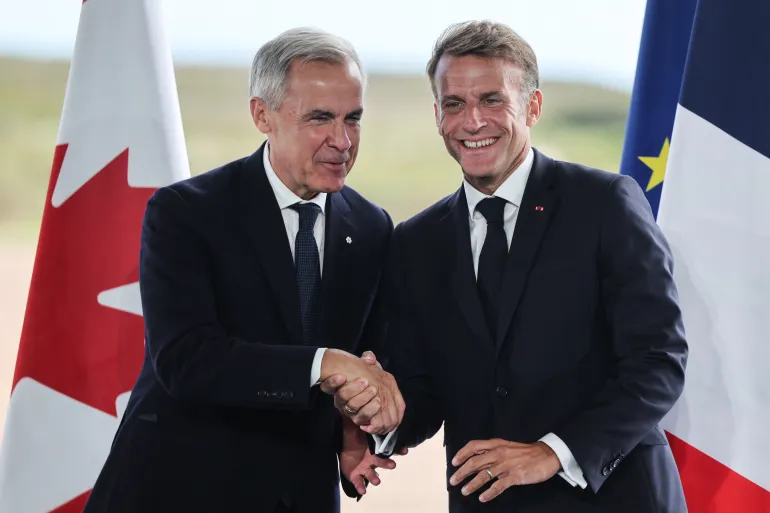

The leaders of France and Canada have pledged to strengthen France-Canada ties to tackle growing geopolitical threats, climate change and what they described as the erosion of democratic values.
The two leaders met in Saint-Pierre and Miquelon, a French territory off Canada’s Atlantic coast. The visit marked the first trip to the islands by a Canadian prime minister and the first by a French president since 2014.
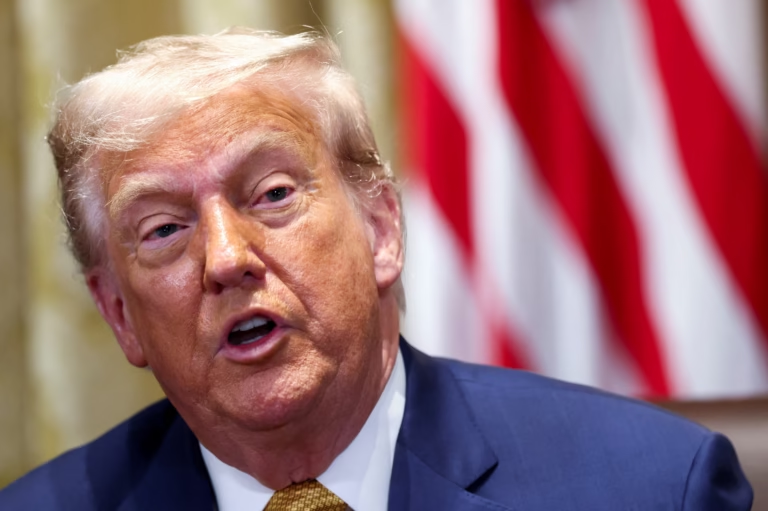
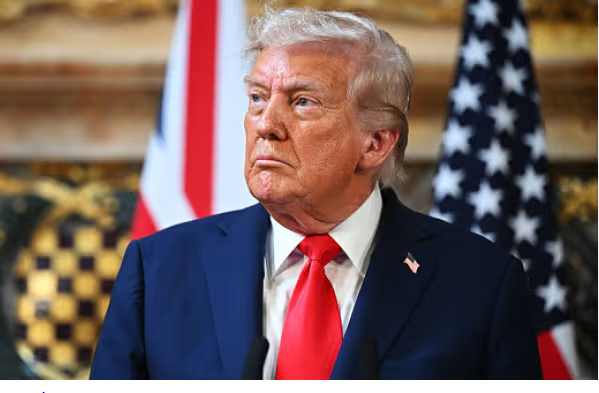
The meeting came weeks after Donald Trump shared a picture showing the islands, along with Canada and other North American countries, under the US flag.
Ottawa has been strengthening ties with the European Union as its trade dispute with the United States intensifies.
Canada’s Mark Carney said in a statement alongside France’s Emmanuel Macron on Sunday, “Our societies are being shaken by new storms: the upheavals, caused by climate change, the erosion of democratic norms, and new threats to our sovereignty, the time has come to strengthen our ties.”
Macron added that the two ally nations agreed to deepen their partnership across several sectors, including climate, space, and energy.
Following Trump’s social media post, diplomats noted that Macron’s visit—timed with his attendance at the annual UN General Assembly meeting of global leaders—carried significant symbolic weight.
Trump shared an image displaying the text “United States of America” alongside the US flag positioned over a map encompassing the US, Canada, Greenland, Iceland, Mexico, Central America, and the Caribbean, which also incorporated Saint-Pierre and Miquelon as well as French Caribbean territories.
Saint-Pierre and Miquelon
Responding to questions about Trump’s remarks, Macron rejected the suggestion that the territories could not remain French. He said he did not need to repeat France’s position every day because “people have strange ideas or say strange things.”
Saint-Pierre and Miquelon holds strategic importance for France because of its proximity to the US and the Arctic.
The territory also plays an important role in France’s cooperation with Canada, particularly in the energy sector.
Macron said the negotiations had created an opportunity for bilateral discussions aimed at reaching concrete agreements. His government is also facing increased domestic pressure as fuel prices continue to rise.
Paris hopes Canada will broaden its exports of liquefied natural gas to Europe rather than primarily to Asia.
“Canadian liquefied natural gas projects can help. They are important for Europe,” Macron said.
Backstory…
The latest France-Canada ties comes as Ottawa looks to deepen its European relationships at a time when its traditionally close relationship with the United States has become increasingly difficult under President Donald Trump.
For decades, the US has been by far Canada’s dominant economic partner, but Trump’s tariffs and repeated pressure on Canada have encouraged Prime Minister Mark Carney’s government to look for alternative markets and stronger partnerships.
Just recently, in early September, the White House announced that the US will ban Canadian dairy products, most alcoholic beverages and motorcycles.
The ban will take effect in three weeks, following Canada’s retaliatory tariffs on $20 billion worth of US goods earlier on Tuesday.
Read Also: US-Canada Trade War- US Bans Canadian Dairy, Alcohol and Bikes