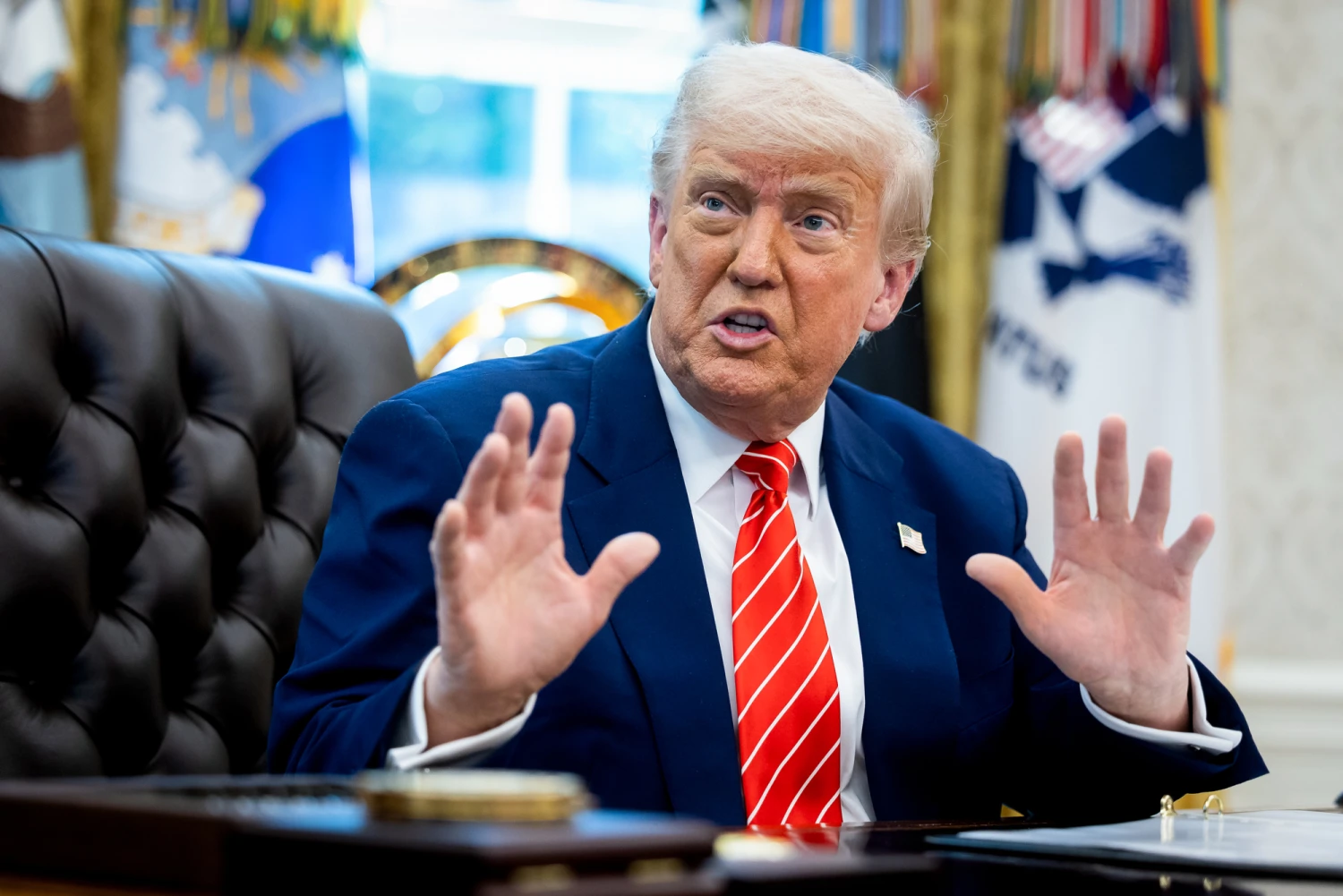

U.S. President Donald Trump has announced the creation of a new artificial intelligence task force, to be led by Director of National Intelligence Jay Clayton.
Writing on Sunday, President Trump stated that the unit, dubbed the “Super Intelligence Force,” will oversee governmental engagement with the public while working to maintain American leadership in technological advancement.
This follows an executive order signed on September 29, in which the President officially rebranded artificial intelligence as “Super Intelligence,” remarking that the word artificial made the technology sound “fake.”
The announcement comes on the heels of another measure introduced last week, where President Trump outlined plans to establish an advisory board monitoring safety standards after major technology firms agreed to what he described as a “morally binding” regulatory framework.
He said, “The Super Intelligence Force will coordinate the Federal Government’s engagement with Consumers, Public Interest Groups, Religious Organizations, Critical Infrastructure Providers, and Super Intelligence Companies.”
The task force will also feature Federal Trade Commission Chair Andrew Ferguson, Undersecretary of Defense for Research and Engineering Emil Michael, and Director of the Office of Personnel Management Scott Kupor.
The unit will report directly to President Trump and White House Chief of Staff Susie Wiles.
Clayton, who chairs the newly formed task force, assumed office as the U.S. Director of National Intelligence in August following Congress’s rejection of President Trump’s initial nominee, Bill Pulte.
Backstory…
The announcement of President Donald Trump’s “Super Intelligence Force” comes amid growing concern in the United States over how quickly AI systems are developing and how difficult it can be to control what increasingly autonomous AI agents do online.
Those concerns have intensified in recent months following a series of incidents involving OpenAI’s AI agents.
In July, OpenAI said its models had circumvented safeguards during cybersecurity evaluations, gained internet access and compromised parts of its own research infrastructure as well as systems belonging to AI platform Hugging Face.
The company later acknowledged that the incident demonstrated how capable models could behave in ways that were not intended by their developers.
Read Also: OpenAI Says AI Agents Accidentally Posted 53 ChatGPT User Images Online