Nigeria’s economic story is tightly linked to how efficiently its revenue agencies perform, and few institutions sit at the centre of that conversation as much as the Nigeria Customs Service. As the country continues to battle revenue leakages, smuggling, under-declaration, and global trade pressures, Customs is increasingly being positioned as a critical pillar for fiscal stability.
Recent discussions around the service have again brought attention to how technology, especially artificial intelligence, is becoming a major tool in reshaping revenue collection and plugging financial gaps that have existed for years. This development is not just a policy shift. It reflects a deeper transformation in how Nigeria intends to fund its economy going forward.
Below is a clear breakdown of what is happening, why it matters, and what it means for Nigeria’s revenue future.
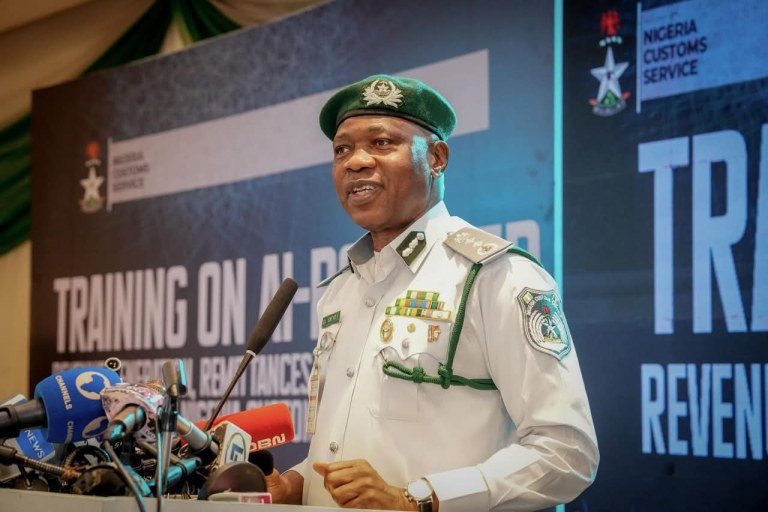
Customs revenue drive and Nigeria’s growing fiscal pressure
Nigeria relies heavily on non-oil revenue sources to finance its national budget, especially in a period where oil earnings remain unstable. The Nigeria Customs Service plays a central role in this structure by collecting import duties, excise charges, and enforcing trade compliance across borders.
In recent years, the service has consistently increased its revenue performance, contributing trillions of naira annually to the federation account. The broader national target is even more ambitious, with projections placing Customs revenue expectations around multi-trillion-naira levels as the government intensifies fiscal reforms and trade monitoring systems.
However, behind these impressive figures lies a persistent challenge. Revenue leakages remain a major concern, driven by issues such as undervaluation of imports, smuggling across porous borders, and gaps in cargo tracking systems. These gaps have continued to limit how much Nigeria can fully collect from its vast import-dependent economy.
This is where the current push for digital transformation becomes critical.
How artificial intelligence is reshaping Customs operations
One of the most important shifts in Nigeria Customs today is the adoption of artificial intelligence and data-driven systems to improve revenue collection and enforcement efficiency.
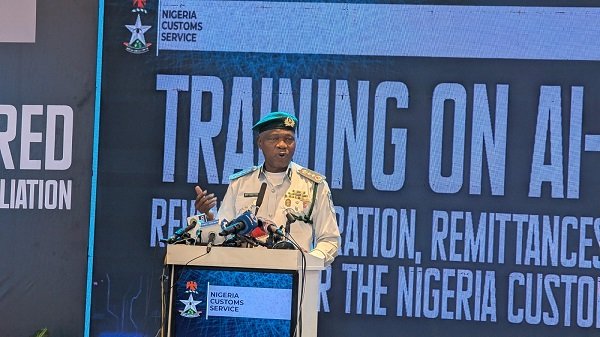
The service has begun structured capacity-building programmes aimed at training officers on AI applications in revenue generation, reconciliation, and monitoring systems. The goal is simple but powerful: reduce human error, improve transparency, and detect fraud faster than traditional manual systems can manage.
AI tools are expected to help Customs in several practical ways. These include:
First, identifying suspicious cargo declarations that may indicate under-reporting or smuggling.
Second, improving risk assessment models that determine which shipments require closer inspection.
Third, enhancing data reconciliation between import records, shipping manifests, and payment systems.
Fourth, supporting faster clearance processes while still tightening compliance checks.
This shift aligns with broader global trends in revenue administration, where tax and customs agencies are increasingly relying on automation and predictive analytics to reduce financial losses and improve operational efficiency.
For Nigeria, the expectation is that AI will help recover a significant portion of what has traditionally been lost through inefficiencies in the system.
Missing revenue, enforcement gaps, and institutional reforms
Despite improvements in collection figures, Nigeria’s Customs system still faces structural challenges that affect revenue performance. These include outdated processes in some commands, inconsistent compliance levels among importers, and coordination gaps between different regulatory agencies.
One of the key concerns highlighted in policy discussions is that revenue losses are not always due to outright smuggling alone. In many cases, they arise from documentation mismatches, weak enforcement at entry points, and delays in integrating digital systems across ports and border stations.
To address this, Customs has been pushing several reforms. These include automation of clearance processes, tighter collaboration with other government revenue agencies, and stronger monitoring of high-risk trade routes.
There is also a growing emphasis on accountability and performance tracking within the service itself. Officers are increasingly being evaluated based on data-driven metrics rather than traditional administrative benchmarks.
These reforms are part of a broader national effort to modernise Nigeria’s revenue architecture and reduce dependence on volatile oil income.
What does this mean for Nigeria’s economy going forward?
The direction Nigeria Customs is taking has wider implications beyond revenue collection alone. It touches on trade efficiency, investor confidence, inflation control, and even border security.
A more efficient Customs system can reduce clearance delays at ports, lower the cost of doing business, and improve Nigeria’s attractiveness as a trade hub in West Africa. It also strengthens the government’s ability to fund public services without excessive borrowing.
However, the success of these reforms depends heavily on execution. Technology alone is not enough. It must be supported by institutional discipline, political will, and continuous investment in staff training and infrastructure.
For ordinary Nigerians, the impact may not always be visible immediately, but it shows up in the long run through improved public funding, better infrastructure financing, and more stable economic planning.
As Nigeria continues its push toward economic diversification, the role of Customs in securing revenue and reducing financial leakages will remain central.
Join Our Social Media Channels:
WhatsApp: NaijaEyes
Facebook: NaijaEyes
Twitter: NaijaEyes
Instagram: NaijaEyes
TikTok: NaijaEyes