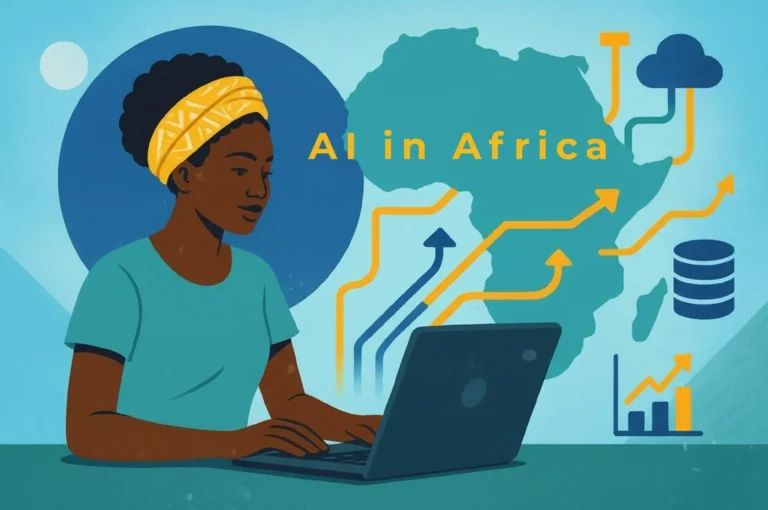

FATE Foundation, in partnership with the African Institute for Mathematical Sciences (AIMS) and with support from Google.org, has launched a major advanced artificial intelligence programme designed to strengthen AI education in Nigerian universities and other higher institutions across Africa.
The Africa AI Upskilling Programme was officially launched at the University of Lagos on August 10, 2026, marking a move towards taking advanced artificial intelligence education beyond online courses and placing it directly inside university classrooms. FATE Foundation says the programme is designed to strengthen institutional capacity, train educators and help universities prepare students for a technology-driven labour market.
The programme covers Nigeria, Ghana, Kenya and South Africa, with a target of supporting 30 higher education institutions and reaching more than 30,900 students over three years. It will use a train-the-trainer model, allowing lecturers to acquire the technical and teaching skills needed to deliver advanced AI courses to students within their institutions.
Also Read: DeepSeek: The AI Revolution Challenging OpenAI
Programme brings advanced AI curriculum into universities
At the heart of the initiative is Google DeepMind’s AI Research Foundations curriculum, which was developed with academic and education experts and adapted for African contexts in collaboration with AIMS.
Unlike introductory AI programmes that focus mainly on teaching people how to use existing AI tools, the curriculum goes considerably deeper. Students can learn about generative AI models, transformer networks, language models and model development, giving them a stronger technical foundation for future work and research.
Google DeepMind said the curriculum gives learners practical experience with building and fine-tuning language models, while also introducing responsible innovation principles. The courses are available at no cost through Google Skills and can be taken independently or incorporated into structured university courses.
The African adaptation is particularly significant. Google DeepMind said only about 1.8 per cent of global AI research contributions come from Africa, despite the continent being home to roughly one in five people globally. The programme therefore aims to increase African participation in AI research and ensure that future technologies can better reflect African realities and needs.
For Nigeria, that could have implications beyond the classroom. A stronger pipeline of AI-trained graduates could support local startups, research institutions, financial technology companies, healthcare organisations, government agencies and other sectors increasingly looking towards AI for practical solutions.

Google.org funding supports wider AI skills development
The funding behind the programme is also broader than the $1.1 million figure reported in some accounts.
According to Google DeepMind, Google.org provided $4 million to FATE Foundation to support the rollout of the AI Research Foundations curriculum in African classrooms. The funding will support lecturer training and the development of instructional toolkits needed to take the online curriculum into universities.
Separately, Google announced a $2.1 million commitment to Nigeria to support the country’s AI ambitions and digital safety. That investment includes the FATE Foundation and AIMS University initiative, an AI innovation challenge led by the African Technology Forum, online safety programmes by Junior Achievement Africa and cybersecurity support from the CyberSafe Foundation.
Google said the broader Nigerian investment is aligned with the country’s National AI Strategy and its ambition to create one million digital jobs. The company also cited an estimate that AI could contribute about $15 billion to Nigeria’s economy by 2030.
The figures therefore relate to different layers of the wider investment and should not be presented as though the FATE Foundation and AIMS university programme itself received a $1.1 million Google.org grant.
Also Read: AI Revolution! Google Search Gets Smarter in 2025
Back story
FATE Foundation has spent more than two decades supporting entrepreneurship and economic development in Nigeria. The organisation marked its 26th anniversary in April 2026, reporting that its programmes had graduated 8,945 entrepreneurs from its flagship full-course programmes and reached more than 247,000 entrepreneurs through short courses, self-paced learning and digital tools.
Its partnership with AIMS and Google.org brings that experience into one of the fastest-changing areas of the global economy.
AIMS has also been involved in developing the African context for Google’s AI Research Foundations curriculum. The organisation has described the programme as an effort to help universities develop the next generation of African AI talent rather than simply increasing general awareness of artificial intelligence.
The programme is already moving into its implementation phase. AIMS’ 2026 programme schedule shows that participating lecturers are undergoing virtual preparation before intensive training, after which they are expected to deliver the curriculum and support student projects at their respective universities. The lecturer workshop is scheduled for September 14 to 18, 2026, with university-level delivery expected later in 2026.
For Nigerian universities, the bigger question is now whether the programme can translate into lasting changes in how AI is taught and researched.
If the training succeeds beyond the initial workshops, students could graduate with something more valuable than familiarity with popular AI applications. They could develop the technical understanding needed to build, research and responsibly deploy AI systems for African problems.
That is ultimately where the significance of the FATE Foundation, AIMS and Google.org partnership may be measured: not simply by how many lecturers are trained, but by whether Nigerian universities can become stronger centres for AI research, innovation and talent development.