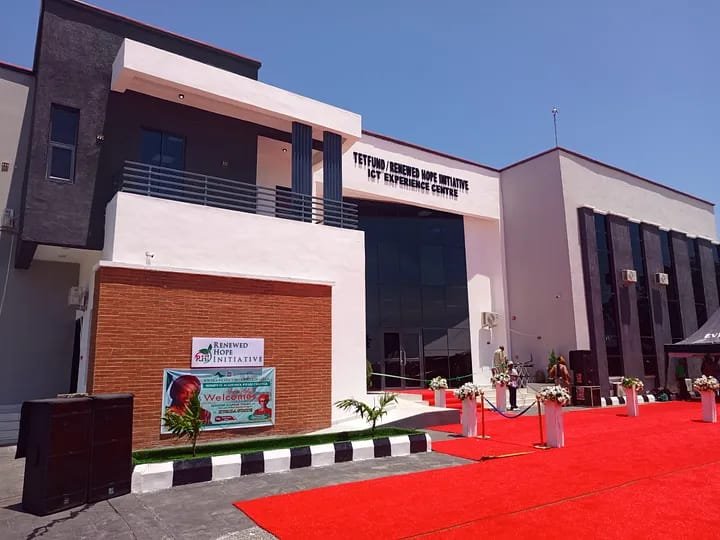

Kwara State University, Malete, has taken another step towards expanding practical technology education in Nigeria with the commissioning of a new ICT Experience Centre designed to give students and lecturers greater access to modern digital tools.
The facility, developed through a partnership between the Tertiary Education Trust Fund (TETFund) and the Renewed Hope Initiative (RHI), was commissioned on Tuesday, September 15, 2026. The event brought together government officials, university administrators and education stakeholders who described the centre as an investment in the digital future of young Nigerians.
The First Lady, Senator Oluremi Tinubu, was represented at the commissioning by the wife of the Vice President, Hajia Nana Shettima. According to reports by Vanguard and ThisDay, the initiative is intended to strengthen digital inclusion, youth empowerment, research and innovation within Nigeria’s tertiary institutions.
The KWASU ICT Experience Centre includes ICT laboratories, interactive digital displays, conference facilities and exhibition spaces. The aim is to create an environment where students can move beyond classroom theory and gain practical exposure to technologies increasingly shaping education, employment and business.
For students at KWASU, the significance of the project may ultimately depend less on the building itself and more on what happens inside it. Access to appropriate equipment, training and mentorship could give students an opportunity to develop skills that are useful beyond their academic programmes.
Also Read: Nigeria’s Titans of Tech Awards Celebrate Africa’s ICT Leaders Driving Digital Transformation
TETFund Targets AI, Cybersecurity, Robotics and Software Development
TETFund Executive Secretary, Arc. Sonny Echono, represented at the event by the Fund’s Director of Monitoring and Evaluation, Arc. Olajide Babatunde, said the ICT Experience Centre programme was created to prepare students and lecturers for emerging areas of technology.
The areas identified include artificial intelligence, cybersecurity, robotics and software development, alongside practical applications of technology in sectors such as agriculture, healthcare, security, media and mining. The Sun reported that TETFund had approved approximately N1 billion for each of the six centres established under the initial phase of the programme.
KWASU is one of six tertiary institutions selected to represent Nigeria’s six geopolitical zones in the pilot phase. Other institutions involved include Ekiti State University, the University of Cross River State, Anambra State Polytechnic, Kaduna State University and Taraba State University.
The intervention therefore goes beyond KWASU. It forms part of a broader attempt to place digital infrastructure closer to students who may otherwise have limited opportunities to access advanced technology and practical training.
KWASU Vice-Chancellor, Professor Shaykh-Luqman Jimoh, described the facility as an investment in human capital, innovation and entrepreneurship. He said it would support teaching, learning, research, community service and interdisciplinary engagement.
That broader use could be important. Technology skills are no longer confined to computer science departments. Students studying agriculture, engineering, education, sciences, business and the humanities increasingly encounter digital tools in their respective fields.
Back Story: Federal Government Expands the ICT Centre Programme
The commissioning at KWASU comes as the Federal Government moves to expand the TETFund and RHI ICT Experience Centre programme beyond the original six pilot institutions.
Senator Oluremi Tinubu announced that construction was ongoing at 15 additional tertiary institutions across Adamawa, Bayelsa, Borno, Delta, Edo, Enugu, Imo, Katsina, Nasarawa, Niger, Ondo, Osun, Rivers, Yobe and Zamfara states.
ThisDay’s report noted that the expansion is intended to give more young Nigerians access to digital learning and innovation opportunities, regardless of their location.
Several of the original centres have also moved forward. According to Vanguard, centres had already been commissioned at Ekiti State University, the University of Cross River State and Anambra State Polytechnic, while facilities at Kaduna State University and Taraba State University were expected to be commissioned subsequently.
The expansion comes at a time when Nigerian graduates are entering a labour market where digital competence is increasingly relevant. For universities, the challenge is not simply to produce graduates who understand concepts, but graduates who can apply knowledge to real problems.
Also Read: The Rise of Robotics Laboratories in African Universities Is Shaping the Continent’s Future
What the KWASU Centre Could Mean for Students
The immediate opportunity created by the KWASU ICT Experience Centre is access. Students and lecturers now have a dedicated environment where digital learning, experimentation and collaboration can take place with modern infrastructure.
But the long-term value of the project will depend on consistent use, maintenance and training. A technology centre can only deliver its intended impact when students regularly use its equipment, lecturers incorporate it into teaching and researchers find ways to build projects around the available resources.
The university has indicated that it intends to use the centre for research, entrepreneurship, innovation and community development. KWASU’s official account of the commissioning also emphasised the facility’s role in practical digital skills and engagement with contemporary technologies.
For students, this could mean an opportunity to develop skills that complement their degrees and potentially open doors to technology-driven careers, entrepreneurship and further research.
The wider programme also presents a test for Nigeria’s digital education strategy. Building ICT facilities is an important starting point, but ensuring that they remain functional, adequately equipped and accessible to students will determine how much value they create.