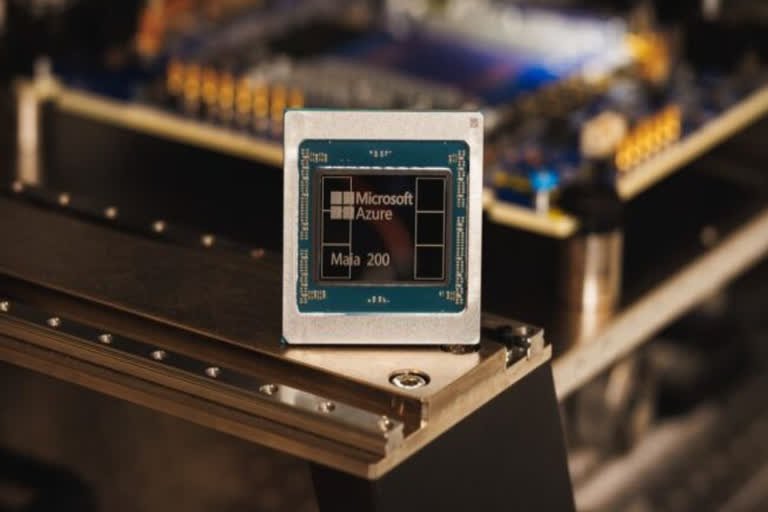

Microsoft has unveiled its third-generation artificial intelligence (AI) chip, Maia 300, as the technology company intensifies efforts to reduce the cost of running AI services and improve the efficiency of its data centres.
Announced on October 12, 2026, the new chip is designed to handle demanding AI workloads, including complex reasoning, conversational applications and tasks performed by AI agents. Microsoft plans to begin deploying Maia 300 in production environments in 2027, with the long-term goal of making its in-house Maia chips the primary infrastructure for running AI across its products and services.
According to Microsoft’s official announcement, the company intends to expand its Azure Maia infrastructure to multi-gigawatt deployments from next year. The move reflects growing demand for computing capacity as businesses and consumers increasingly rely on AI-powered tools.
Maia 300 Targets Lower AI Computing Costs
A central objective of Maia 300 is to deliver more AI computing performance without requiring a proportional increase in energy consumption and infrastructure spending.
Microsoft expects the chip to deliver approximately 40 per cent more tokens per megawatt than leading graphics processing unit (GPU) systems. Tokens are the units of text and other data that AI models process when generating responses. Higher token output for the same amount of electricity could help Microsoft serve more requests while improving its operating efficiency.
The company has also designed Maia 300 to support larger and more demanding AI workloads. Its architecture separates computing, memory control and input/output functions into different chiplets, allowing each component to use technology suited to its particular role.
Microsoft says this approach can improve performance, scalability and cost efficiency. The chip uses TSMC’s N2P manufacturing process for its computing chiplets, while its wider architecture is designed to reduce memory and data-transfer requirements.
As reported by The Verge, Maia 300 is expected to deliver up to seven times the rack-scale token throughput of its predecessor, Maia 200, in a full configuration of 96 accelerators.
Microsoft Expands Its AI Infrastructure Strategy
Beyond the chip itself, Microsoft’s announcement highlights the importance of controlling more of the infrastructure behind its AI services.
The company has relied on processors from external suppliers, including Nvidia and AMD, to support its growing computing needs. Developing its own accelerators gives Microsoft greater flexibility to design hardware around its AI models, cloud services and software requirements.
The Maia 200 chip is already running production workloads, including Microsoft Copilot. Microsoft also plans to extend its use across additional services, including GitHub Copilot and Microsoft Foundry.
Maia 300 will build on that foundation, supporting Microsoft’s efforts to improve the performance of its own AI models while expanding the capacity available through Azure.
The company’s strategy is not simply to replace every third-party processor. Instead, it is seeking to combine in-house chips with other hardware and software improvements to make its overall infrastructure more efficient.
This matters because operating advanced AI systems requires substantial computing power, electricity, cooling equipment and data centre capacity. Improvements at the chip level can therefore influence the wider cost of delivering AI services.
Back Story: Why AI Chip Efficiency Matters
The race to develop more efficient AI hardware has intensified as technology companies invest heavily in data centres to meet rising demand for generative AI.
AI models require powerful processors to train, respond to user requests and perform increasingly complex tasks. As adoption grows, the cost of providing these services becomes a major consideration for cloud providers.
Microsoft has been expanding its infrastructure while developing proprietary hardware to improve performance across its technology stack. Its previous financial updates have highlighted investments in data centre capacity and custom silicon as part of this broader strategy.
Maia 300 represents another step towards integrating hardware design with AI software development. However, its expected efficiency gains will need to be assessed as the chip enters production and operates under real-world workloads.
For businesses, developers and cloud customers, the potential benefits include more computing capacity and improved efficiency. Whether those improvements translate into lower prices will depend on Microsoft’s deployment costs, demand and pricing decisions.
The planned rollout in 2027 will provide a clearer picture of how much the new chip changes the economics of delivering AI at scale.