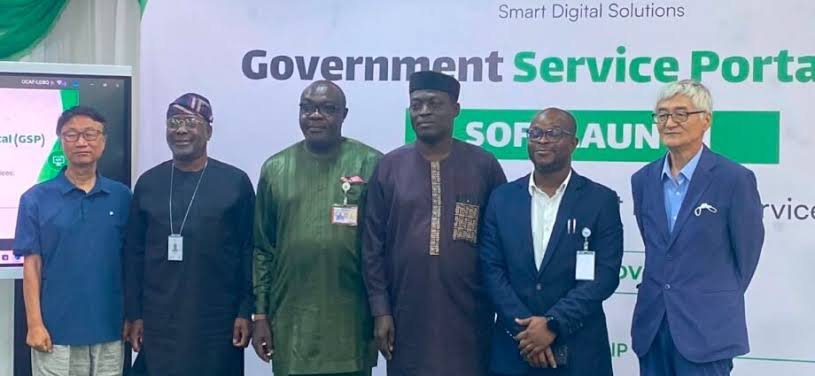

Nigeria has taken another major step towards digitalising public services with the launch of the Government Service Portal, a centralised online platform designed to give citizens and businesses easier access to services provided by government institutions.
The platform, which was soft-launched in Abuja in July 2026, is intended to address one of the familiar frustrations of dealing with government in Nigeria: having to search through several agency websites, visit different offices and provide similar information repeatedly before completing a single process.
Developed by Galaxy Backbone in partnership with the Federal Ministry of Communications, Innovation and Digital Economy and the Korea International Cooperation Agency, the Government Service Portal brings government services together through a single digital gateway.
The official platform, services.gov.ng, describes itself as a digital gateway intended to make government services more accessible, efficient and secure for Nigerians.
For ordinary citizens, the significance of the development may be less about the technology itself and more about what it could mean when someone needs a government service and does not know which agency to approach.

How Nigeria’s Government Service Portal Works
The new Government Service Portal is designed as a one-stop digital access point where Nigerians and businesses can discover and access services provided by different government institutions.
Rather than starting with the name of a ministry or agency, users can search for the service they need and navigate from the central platform.
The Federal Government said the approach is aimed at reducing fragmentation in public service delivery. According to officials at the launch, citizens have for years had to move between multiple government websites, offices and service channels, while businesses have often spent significant time identifying the appropriate institution and understanding different administrative procedures.
One of the features highlighted for the platform is a single secure sign-in. The government says this should reduce the need for citizens to repeatedly submit the same information when accessing different services.
The portal also provides online service tracking and support features. Its frequently asked questions section states that users can track the status of applications online, while some services can be processed within defined timelines depending on the particular government agency and service involved.
The platform is therefore expected to become more than simply another government website. Its wider objective is to create a more connected digital experience between Nigerians, businesses and public institutions.
Why the Centralised Government Portal Matters to Nigerians
For a country with a large and increasingly connected population, moving public services online could have practical benefits.
A properly integrated government portal can reduce unnecessary physical visits to government offices, make information easier to find and give citizens greater visibility into the progress of applications.
For businesses, particularly small businesses that may not have the resources to dedicate staff to government paperwork, easier access to official services could also reduce administrative costs and wasted time.
The initiative also fits into Nigeria’s broader digital transformation programme. The Federal Ministry of Communications, Innovation and Digital Economy says its e-government department is responsible for supporting the development and deployment of technology-driven government solutions, including the digitisation of government services and the development of a national e-government strategy.
Nigeria has also been developing other digital infrastructure to support this transition. In June 2026, government officials trained Ministries, Departments and Agencies on the use of 1Gov Cloud, a shared digital infrastructure intended to improve efficiency, collaboration, security and service delivery across the public sector.
Another development came in May when the Federal Ministry of Communications, Innovation and Digital Economy, Meta, the National Centre for Artificial Intelligence and Robotics and Publica AI launched GovGuide Nigeria. The AI-powered chatbot was designed to help Nigerians obtain information about government services through web-based voice and text interactions, including support for English, Hausa, Igbo and Yoruba.
Together, these initiatives suggest that Nigeria’s digital government strategy is gradually moving beyond individual agency websites towards interconnected platforms and digital tools.
Back Story: Nigeria’s Long Push Towards Digital Government
The idea of providing government services through a central online platform is not entirely new in Nigeria.
The country’s National Digital Economy Policy and Strategy had already identified the need to strengthen e-government and promote services.gov.ng as a one-stop online platform for accessing government services. It also called for stronger interoperability between government institutions and greater digitisation of public services.
The newly launched Government Service Portal can therefore be viewed as part of a longer-running effort to make public administration more digital.
The Federal Government has also introduced digital tools for monitoring public sector reforms. In July 2026, it launched a Reform Tracker, Knowledge Repository and National Strategy for Public Service Reforms Dashboard to improve transparency, performance monitoring, accountability and knowledge management across federal institutions.
The bigger challenge now will be implementation.
Putting services on a central website is only the first step. For the portal to genuinely change how Nigerians interact with government, agencies will need to keep their services updated, integrate their systems properly, protect citizens’ personal information and ensure that online processes work reliably.
Digital inclusion will also matter. Millions of Nigerians still face challenges involving internet access, affordability, digital literacy and reliable electricity. A government service that exists online but is difficult to use will not automatically become accessible to everyone.
Still, the Government Service Portal represents an important direction for Nigeria. If the system continues to expand and government agencies integrate their services effectively, Nigerians could gradually spend less time searching for the right office and more time completing public services through a single, familiar digital gateway.