
Artificial intelligence is moving from the technology industry into the classroom, and Singapore is showing what a deliberate response can look like. For Nigeria, where millions of learners and teachers are entering an increasingly digital world, the lesson is not simply that teachers should learn how to use AI. It is that teacher training must evolve alongside the technology.
Singapore has spent several years preparing educators for the growing role of artificial intelligence in education. Its National Institute of Education launched the AI@NIE initiative to strengthen research, innovation and teacher training around AI, with plans for AI-related education topics to be offered to trainee and in-service teachers.
The country’s Ministry of Education has also continued to expand AI literacy among students, including integrating AI-related learning into the curriculum, co-curriculum and self-directed learning resources. Its plans include strengthening AI skills through the Code for Fun programme and teaching students how to identify deepfakes and verify information generated by AI.
This is where the Nigerian conversation should become more serious. The question is no longer whether artificial intelligence will enter Nigerian classrooms. It already has. The question is whether teachers will be prepared to guide students through a world where AI can generate information, write essays, create images, explain difficult concepts and increasingly influence how people learn and work.
Also Read: Nigeria Must Learn From America’s Chromebook Experience Before Expanding Digital Classrooms
Singapore’s approach goes beyond simply teaching teachers to use AI
One of the most important lessons from Singapore is that AI training cannot be reduced to showing teachers how to write better prompts.
Teachers need to understand what AI can do, where it can fail and when it should not be trusted. They also need to know how to evaluate AI-generated information, protect students’ data and use technology without weakening the human relationship at the heart of education.
Singapore has been developing this capability through its teacher education system. The National Institute of Education’s AI@NIE initiative was designed to build capacity among educators while also supporting research and innovation in AI-enabled education. By 2026, AI in education was expected to form part of the training available to trainee and in-service teachers.
The approach matters because teachers are not simply technology users. They are the people expected to help young people understand technology responsibly.
Singapore’s wider education strategy reflects this thinking. The Ministry of Education says AI literacy is being developed throughout students’ education journey, with defined milestones for digital and technological skills. The country is also updating cybersecurity and citizenship education so students can better validate information produced by generative AI and recognise deepfakes.
For Nigeria, this provides a useful blueprint. AI education should not exist as an isolated computer studies topic. It should become part of the wider digital literacy conversation.
Nigeria has started, but teacher preparation must go further
Nigeria is not starting from zero.
The Federal Ministry of Education already operates digital learning and teacher development platforms, while its AWS Academy project is designed to build digital competencies among students and educators, including areas such as cloud computing and machine learning.
There are also more direct AI initiatives. The National Senior Secondary Education Commission says it is partnering with Google to train 6,000 teachers nationwide in artificial intelligence. The programme covers AI concepts, ethical considerations and classroom applications, while also supporting robotics and technology-based learning in schools.
These efforts are encouraging, but Nigeria’s scale makes the challenge considerably bigger.
The country’s Federal Ministry of Education says its new eLearn platform provides teachers with curriculum-aligned resources and professional development opportunities. The platform also includes mandatory government continuing professional development and supplementary courses.
The opportunity is therefore to build AI training into systems that already exist rather than creating disconnected programmes that reach only a small percentage of educators.
Nigeria does not necessarily need to copy Singapore’s model. Its education system has different realities, particularly around internet access, electricity, device availability, teacher workload and funding.
But Nigeria can adopt the principle behind the Singaporean approach: prepare teachers before expecting them to prepare students.
Also Read: Can Artificial Intelligence Help Nigeria Address Its Teacher Shortage?
Back story: Why AI teacher training is becoming urgent
The rapid growth of generative AI has changed the classroom conversation considerably.
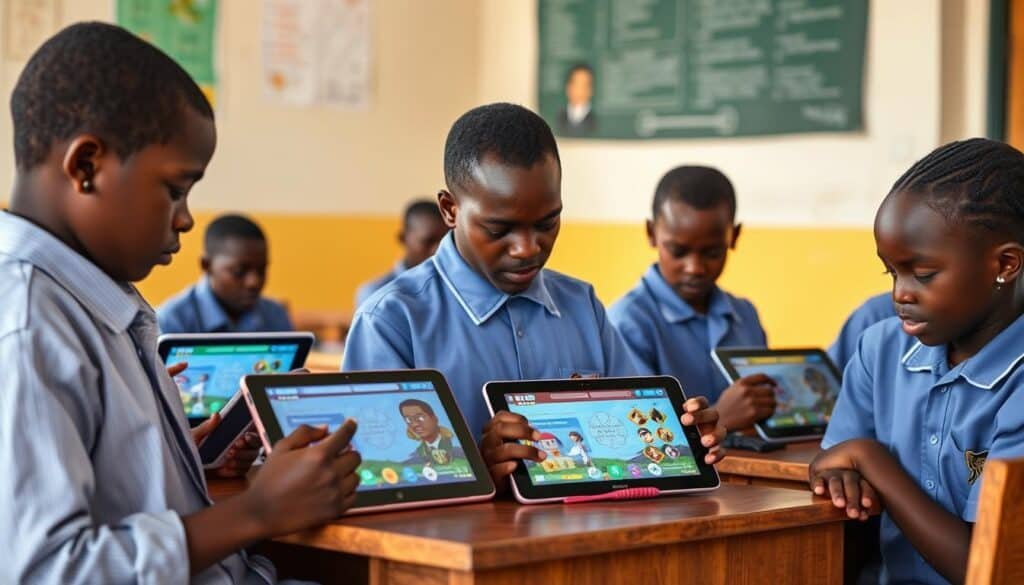
Students can now access tools capable of producing explanations, summaries, essays, computer code and other learning materials within seconds. Teachers are consequently facing a new responsibility. They must teach students not only how to find information, but how to question information generated by machines.
That requires a different kind of digital literacy.
Singapore’s education policy is already moving in that direction. Its Ministry of Education has identified AI literacy as an important part of preparing students for an AI-transformed future, while teacher education has been developing the capacity required to support that transformation.
Nigeria is facing the same technological shift, but with an additional responsibility. Any national AI-in-education policy must work for both well-connected urban schools and classrooms where basic digital infrastructure remains limited.
The recently launched HOPE-EDU programme, backed by the World Bank and Global Partnership for Education, is expected to reach about 29 million children, more than 500,000 teachers and 65,000 public schools. That scale presents a significant opportunity to incorporate practical digital and AI competencies into teacher development as Nigeria strengthens its education system.
The goal should not be to turn every Nigerian teacher into an AI engineer.
It should be to ensure that every teacher understands enough about artificial intelligence to use it responsibly, question its answers, protect students and help learners develop skills that machines cannot simply provide on demand.
Singapore’s experience offers Nigeria a straightforward lesson: technology moves quickly, but education systems cannot afford to wait until the technology becomes unavoidable before preparing the people who will use it.
If Nigeria gets teacher training right, AI can become more than another technology initiative. It can become a tool for helping teachers save time, personalise learning, improve access to educational resources and prepare Nigerian students for the realities of the modern economy.
The real investment, however, should remain in people. AI may transform the classroom, but the teacher still determines how that transformation affects the learner.