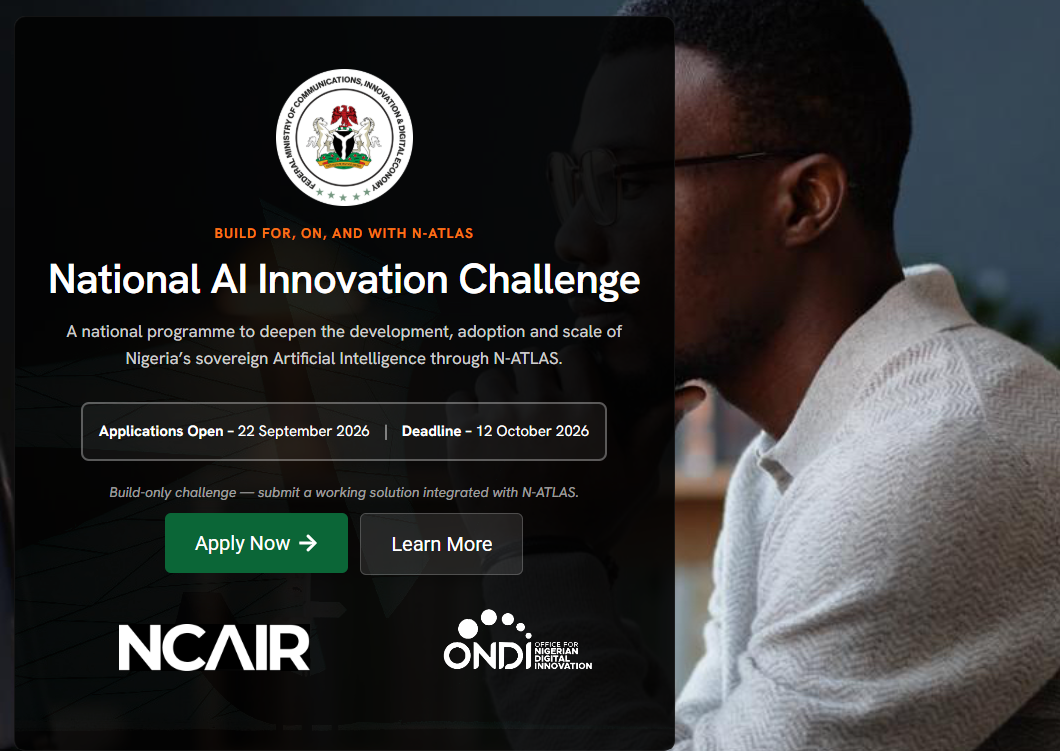

Nigeria has opened applications for the 2026 National AI Innovation Challenge, a programme focused on moving the country’s artificial intelligence capabilities from a promising model into practical tools and services.
The challenge places N-ATLAS, the Nigerian Atlas for Languages and AI at Scale, at the centre of the programme. The official NCAIR challenge page says applications opened on September 22, 2026 and will close on October 12, 2026 at 11:59pm WAT. The programme is implemented through the Office for Nigerian Digital Innovation and NCAIR, with Awarri Technologies as a partner.
For Nigerian developers, researchers, startups and technology teams, this is not an idea pitching exercise. Applicants must build something functional and demonstrate that it works with N-ATLAS.
What NITDA is asking Nigerian innovators to build
The challenge is organised around three problem statements. The first is developer infrastructure, which covers tools that can make N-ATLAS easier to integrate, test, adapt and deploy. Possible solutions include software development kits, browser testing environments, fine-tuning starter kits and improved technical documentation.
The second area is voice-first access. This is aimed at services that can help Nigerians who may prefer speaking to typing, through channels such as WhatsApp voice notes, interactive voice response systems, USSD-linked services and low-bandwidth mobile applications.
The third area is sectoral fine-tuning. Participants can adapt N-ATLAS for Nigerian contexts, with target areas including education, primary healthcare, agriculture, legal rights and civic literacy, and basic financial literacy.
NCAIR guidelines stress that every project must use N-ATLAS directly. Simply connecting another general-purpose AI model to a proposed product does not meet the core requirement. Applicants are also expected to provide evidence from real users, real data or live benchmarks.
Also Read: World Bank Opens 2027 Africa Fellowship Applications for Nigerian Scholars
Who can apply and what successful entries must show
The programme accepts Nigerian universities, research institutions, startups, technology companies, social enterprises, innovation hubs and independent developers, subject to the selected track.
Academic and research teams must have a team lead connected to an accredited Nigerian university or research institution and provide institutional endorsement. Innovation and enterprise applicants must meet the relevant individual or company requirements, including valid identification for individuals and Corporate Affairs Commission registration for registered organisations. Diaspora teams must have at least half of their members based in Nigeria.
Teams are expected to submit more than a proposal. A valid entry must include a functioning technical artefact, proof of N-ATLAS integration, evidence of real-world validation, technical documentation, a three- to five-minute demonstration video and a profile of team members.
Depending on the problem statement, validation requirements also apply. Developer infrastructure entries need at least two external beta testers, voice-first entries require at least 50 documented real user interactions, while sectoral fine-tuning projects need a benchmark of at least 500 examples against the base N-ATLAS model.
The schedule gives applicants a narrow window to move from building to verification. After submissions close on October 12, N-ATLAS integration checks are scheduled for October 15 to 17, followed by shortlisting between October 16 and 20. A mentorship phase is planned for October 25 to November 4, ahead of the Digital Nigeria Showcase, November 8 to 10.
Backstory: why N-ATLAS matters to Nigeria
N-ATLAS is part of Nigeria’s wider effort to develop AI systems that better reflect the country’s languages and digital realities. The Federal Ministry of Communications, Innovation and Digital Economy announced the launch of the open-source multilingual model on September 21, 2025. The ministry said the initiative was designed to support Nigerian voices and create opportunities for applications in areas such as education, health, commerce and governance.
NCAIR describes N-ATLAS as an open-source multilingual large language model supporting Yoruba, Hausa, Igbo and Nigerian-accented English, with automatic speech recognition capabilities for voice applications. The model is fine-tuned from Llama-3 8B.
That explains the direction of the 2026 challenge. Rather than stopping at the release of an AI model, the programme is asking Nigerian builders to develop practical products around it. For applicants, the immediate task is clear: choose one problem statement, build a working solution, test it properly and submit before the October 12 deadline.
The official application portal and eligibility requirements are available on the NCAIR challenge page. Apply through the official NCAIR portal
Also Read: Nigerian Telcos Support NCC Zero-Rated Education Plan for Students