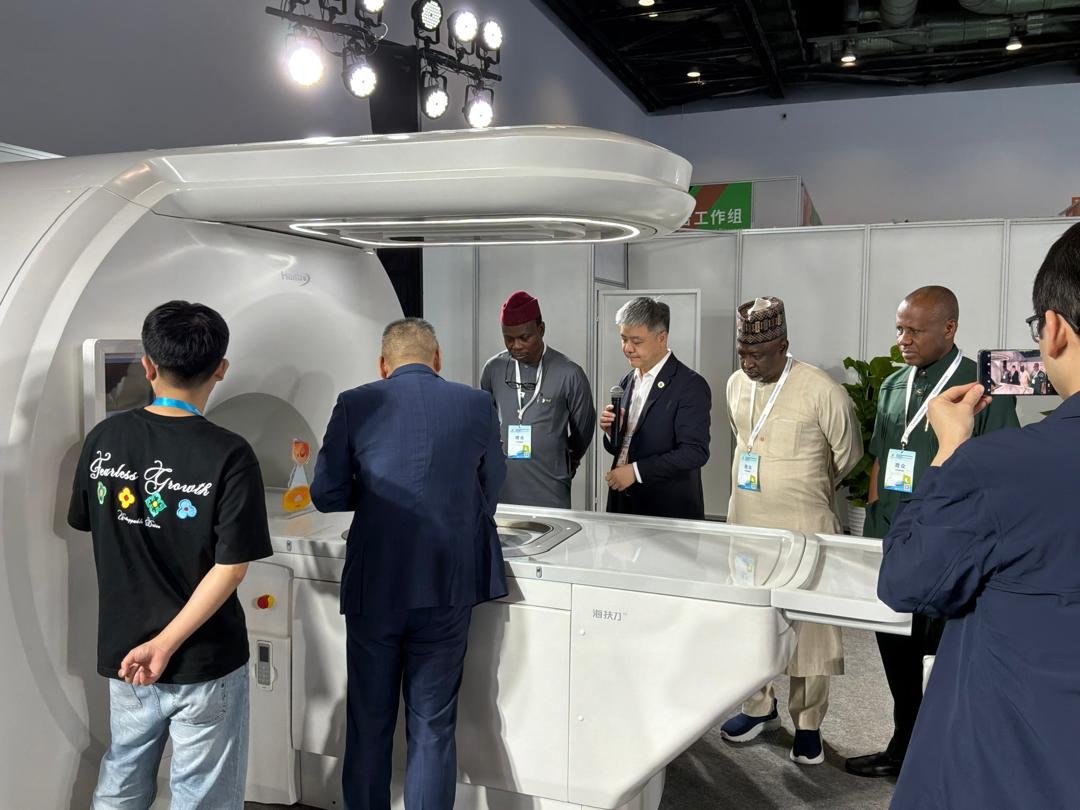

Nigeria and China are steadily expanding cooperation in artificial intelligence, medical research and health technology, creating new possibilities for how healthcare could be delivered, diagnosed and managed in Nigeria.
The relationship is developing through several connected initiatives rather than one single agreement. Recent engagements have covered artificial intelligence, infectious disease research, vaccines, diagnostic technology, traditional medicine, health data and technology transfer.
For Nigeria, the significance goes beyond acquiring new machines or importing software. The bigger opportunity is whether the country can use these partnerships to strengthen local expertise and build healthcare technologies that respond to its own challenges.
In July, China reaffirmed its willingness to expand cooperation with Nigeria in artificial intelligence as part of the two countries’ broader strategic partnership. The Chinese Embassy said both sides were looking to deepen practical cooperation, including AI, while maintaining wider economic and diplomatic ties.
The health side of the relationship is also gaining momentum. In March, Nigerian and Chinese experts met in Abuja for a health security dialogue focused on pandemic preparedness, disease surveillance, laboratory systems and emergency response. The discussions included plans for stronger research partnerships, technology transfer and local vaccine manufacturing.
For ordinary Nigerians, the real question is what these high-level discussions could eventually mean inside hospitals and clinics.
Also Read: Sino-African Tech-Creative Corridor Targets New Digital Opportunities for Africa

AI Could Strengthen Diagnosis and Early Detection
One of the most immediate opportunities is medical diagnosis.
In February, Afe Babalola University, Ado-Ekiti, announced a partnership with Chinese firm Cherami-PV Group to deploy AI-powered solutions for breast cancer detection and treatment. The initiative is intended to support earlier diagnosis and improve access to quality screening, while keeping medical professionals at the centre of clinical decisions.
This is particularly important in Nigeria, where access to specialist healthcare remains uneven. AI-supported diagnostic systems could help health workers analyse medical images, identify warning signs and determine which patients require further specialist attention.
The potential is not limited to cancer. Chinese scientists who visited the Nigerian Institute of Medical Research in March also discussed infectious disease research, vaccine development, genomic surveillance and clinical trials. The delegation included researchers from the Chinese Academy of Sciences, China CDC, Peking University and Shanghai Junshi Biosciences.
There is also evidence that Chinese medical AI technology is already being tested in Nigeria. A March report described the use of an ultra-portable X-ray system supported by AI for tuberculosis screening in a remote Nigerian mining community. Such technology could be particularly useful in locations where access to conventional diagnostic facilities is limited.
What the Partnership Could Mean for Nigerian Healthcare
If properly implemented, the cooperation could produce benefits beyond the introduction of artificial intelligence tools.
Technology transfer could help Nigerian researchers and health professionals develop stronger technical skills instead of remaining dependent on foreign specialists. Joint research could also make it easier to study diseases that disproportionately affect African populations and ensure that new diagnostics and treatments are tested in environments that reflect local realities.
The Nigerian government is already creating structures to support this transition. In June, President Bola Tinubu approved the National Health Technology and Data Analytics Office, designed to coordinate Nigeria’s digital health agenda and strengthen the implementation of the country’s National Digital Health Architecture.
However, technology alone will not solve Nigeria’s healthcare challenges. Reliable electricity, internet connectivity, data protection, trained personnel, equipment maintenance and sustainable funding remain essential.
There are also questions around patient privacy and the use of health data. As AI becomes more involved in diagnosis and healthcare decision support, Nigeria will need clear rules governing how patient information is collected, stored and used.
The most valuable outcome of the Nigeria-China relationship may therefore not be the number of AI systems installed in Nigerian hospitals. It could be the development of a stronger Nigerian ecosystem of researchers, engineers, doctors, laboratories and technology companies capable of building and maintaining these systems locally.
Also Read: AI and Telepathology Could Reshape Nigeria’s Healthcare System Over the Next Decade
Back Story: A Broader Nigeria-China Health Relationship
Nigeria and China have maintained diplomatic relations for more than five decades, but health cooperation has increasingly become part of the broader strategic relationship.
In April, a Chinese scientific delegation led by Professor George Gao visited the Nigerian Institute of Medical Research to explore cooperation in infectious disease research, vaccine development and capacity building. Discussions included Mpox vaccines, genomic surveillance, clinical trials and training for Nigerian scientists.
In June, Nigeria also sent a multidisciplinary delegation to China for a bilateral programme focused on traditional medicine, medicinal materials, scientific knowledge exchange and capacity building.
These developments suggest that Nigeria-China healthcare cooperation is moving towards a wider model involving research, technology, training and production.
For Nigeria, the opportunity is significant, but the measure of success will ultimately be simple: whether these partnerships translate into faster diagnosis, better treatment, stronger local research capacity and more affordable healthcare for Nigerians.