MTN Group has released fresh financial details tied to its proposed acquisition of the remaining stake in IHS Towers, giving shareholders and market watchers a clearer picture of how the landmark telecom infrastructure deal could reshape the company’s balance sheet and future earnings.
The update, published through the Johannesburg Stock Exchange’s Stock Exchange News Service, outlines the projected financial effects of MTN taking full ownership of IHS Towers if the transaction is completed. According to the telecom giant, the figures are intended to provide illustrative guidance only and should not be interpreted as final or guaranteed outcomes.
The latest disclosure arrives at a time when investors across Africa’s telecom sector are paying close attention to infrastructure ownership, operating costs, and long-term profitability. MTN believes bringing IHS fully under its control could strengthen its digital infrastructure strategy and improve financial efficiency over time.
The transaction itself remains subject to shareholder approvals, regulatory clearances, and the fulfilment of several conditions before it can officially close.

MTN Projects Stronger Earnings Position After Acquisition
The newly released pro forma figures suggest the acquisition could positively affect several of MTN’s key financial metrics. Reports linked to the filing indicate that the transaction would have boosted MTN’s 2025 earnings performance if the companies had already been operating as one entity during the financial year.
Data attached to the financial presentation showed projected revenue growth, stronger EBITDA performance, and improved profitability after integrating IHS Towers into MTN’s operations. Analysts say that is significant because tower infrastructure has become one of the most strategic assets in Africa’s telecom industry.
For years, mobile operators across the continent sold off tower assets to specialist infrastructure firms in order to unlock capital and reduce operating pressure. Now, some operators appear to be reconsidering that model as data demand, AI-driven services, cloud infrastructure, and digital payments continue to expand rapidly.
MTN appears to be positioning itself for that future.
The company said the transaction would help it internalise margins currently paid to IHS, benefit from third-party revenue opportunities, and improve long-term cost predictability across its network operations.
Industry observers say the move could give MTN more direct control over network expansion plans in some of its biggest African markets, including Nigeria, South Africa, Ghana, Rwanda, and Zambia, where IHS Towers already maintains significant infrastructure presence.
The group also stressed that the financial information released has not yet been reviewed or audited externally, making it preliminary in nature.
Why the IHS Towers Deal Matters Across Africa’s Telecom Industry
The proposed takeover is not just another corporate acquisition. It represents one of the biggest infrastructure moves in Africa’s telecom market in recent years.
IHS Towers is widely recognised as one of the continent’s largest telecom infrastructure companies, with tens of thousands of towers spread across Africa and parts of Latin America. The company has historically worked with several leading mobile network operators, including MTN itself.
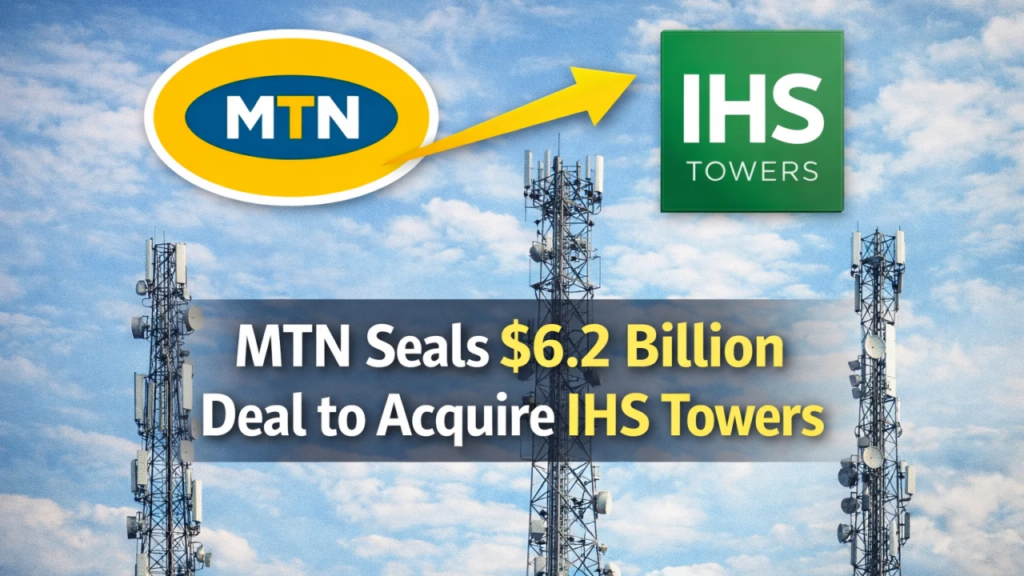
Under the proposed arrangement announced earlier this year, MTN would acquire the shares in IHS that it does not already own in a transaction valued at roughly $6.2 billion. MTN already holds about 24.7 per cent of the tower company.
The acquisition would effectively take IHS private and deepen MTN’s ownership of critical telecom infrastructure across Africa.
For telecom operators, tower ownership has become increasingly strategic because mobile connectivity demand is rising sharply across the continent. The growth of streaming, fintech services, remote work, digital education, and artificial intelligence tools has increased pressure on network operators to expand capacity while maintaining profitability.
Owning infrastructure directly can potentially help operators reduce leasing expenses and gain greater flexibility in network investments.
Still, the transaction also comes with risks.
Some market analysts have warned that the acquisition could increase MTN’s debt exposure in the short term, especially considering the scale of financing required to complete the transaction.
However, MTN executives have maintained that the deal aligns with the company’s long-term growth ambitions and disciplined capital allocation strategy. The group has repeatedly argued that stronger infrastructure ownership could create more sustainable value for shareholders over time.
Back Story: From Tower Sales to Strategic Reacquisition
The MTN and IHS relationship stretches back more than a decade and reflects a wider trend that reshaped the telecom industry across Africa.
During the 2010s, many African telecom operators began selling tower assets to independent infrastructure firms as a way to raise cash, improve efficiency, and focus more heavily on customer services and digital products.
IHS Towers became one of the biggest beneficiaries of that trend.
The company expanded aggressively across the continent, acquiring tower portfolios from major telecom operators in countries including Nigeria, Rwanda, Zambia, Cameroon, and Côte d’Ivoire.
MTN itself transferred several tower assets into the IHS ecosystem over the years while increasing its shareholding in the infrastructure company.
At the time, the strategy made financial sense for operators seeking leaner balance sheets and lower maintenance responsibilities.
But the market has evolved significantly.
Infrastructure has now become central to Africa’s digital economy ambitions. Telecom companies are no longer just providing voice calls and mobile data. They are increasingly positioning themselves as technology platforms powering fintech, enterprise connectivity, cloud services, streaming, and AI-driven applications.
That shift appears to be influencing MTN’s current strategy.
When MTN announced the proposed acquisition in February, Group President and Chief Executive Officer Ralph Mupita described the move as an opportunity to strengthen MTN’s role in Africa’s digital future and regain control of critical infrastructure assets.
The company also stated that no new equity issuance would be required at the group level to complete the transaction, although leverage could rise temporarily after the acquisition.

Investors Await Regulatory Approvals as MTN Pushes Ahead
Despite the release of the pro forma financial effects, the acquisition process is still ongoing, and several hurdles remain before completion can happen.
Regulatory approvals across multiple markets are expected to play a key role because of the scale of the combined infrastructure footprint. Shareholder approval processes are also continuing as investors assess the long-term implications of the transaction.
Still, early market reactions suggest many investors see strategic merit in the deal, particularly as competition intensifies across Africa’s telecom and digital services industry.
The transaction also reflects a broader shift happening globally, where telecom operators are increasingly reassessing the value of owning core infrastructure instead of relying entirely on third-party providers.
For MTN, the success of the deal could influence how aggressively the company expands into next-generation digital infrastructure over the coming years.
For Africa’s telecom market, it may signal the beginning of a new era where infrastructure ownership once again becomes central to long-term competitive advantage.
Join Our Social Media Channels:
WhatsApp: NaijaEyes
Facebook: NaijaEyes
Twitter: NaijaEyes
Instagram: NaijaEyes
TikTok: NaijaEyes