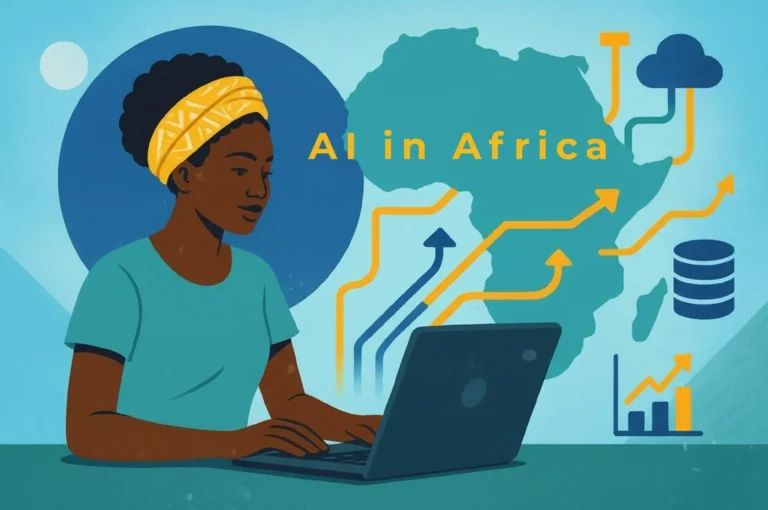
Artificial intelligence has moved far beyond being a trendy buzzword in Africa. Across major cities such as Lagos, Nairobi, Johannesburg and Cairo, AI tools are now becoming part of daily life for students, entrepreneurs, remote workers, content creators and corporate professionals. What once felt experimental has become practical, accessible and increasingly necessary.
In 2026, Africa’s AI adoption story is being driven by necessity as much as innovation. Young people are using AI to study smarter, small businesses are automating customer engagement, startups are reducing operating costs, and companies are streamlining workflows in ways that were previously impossible without large teams and expensive infrastructure.
The continent’s growing internet penetration, improved smartphone access and expanding digital economy are accelerating this shift. Experts say Africa is no longer simply observing the global AI race from the sidelines. Instead, the continent is gradually carving out its own role as both a consumer and future creator of AI technologies.
Recent industry reports and adoption trends show that a handful of AI platforms have emerged as clear leaders across Africa in 2026. These tools are shaping how millions of Africans work, communicate, learn and build businesses.

ChatGPT Leads Africa’s AI Revolution
At the top of the list is ChatGPT, which continues to dominate AI usage across Africa. From Nigerian freelancers writing proposals to Kenyan students preparing for exams, ChatGPT has become the go-to digital assistant for millions of users.
Its popularity comes from versatility. Unlike specialised tools that focus on a single task, ChatGPT allows users to write emails, summarise documents, generate ideas, solve coding problems, explain difficult concepts, and even assist with business planning within one platform.
In countries where affordability matters, an all-in-one AI assistant naturally becomes attractive. For many Africans, ChatGPT represents their first practical experience with artificial intelligence.
The tool has become especially valuable among young Africans navigating remote work and the global digital economy. Freelancers now rely on it to create client pitches and marketing content. Journalists use it to organise research. Developers use it to debug code faster. Students use it to simplify difficult academic topics.
In Nigeria, particularly, AI adoption has surged among young professionals and entrepreneurs searching for ways to remain competitive in a challenging economy. Reports suggest Nigerians rank among the highest AI users globally for work and educational purposes.
Beyond productivity, ChatGPT is also influencing how Africans learn independently. Many users now treat AI assistants almost like personal tutors available twenty-four hours a day. This has become increasingly important in regions where access to educational resources and mentorship opportunities can still be uneven.

Canva, Copilot and Grammarly Reshape Everyday Productivity
While ChatGPT dominates overall AI usage, other platforms are rapidly transforming specific sectors across Africa.
Canva and its AI-powered Magic Studio tools have become essential for small businesses, digital marketers and content creators. Entrepreneurs with little or no graphic design experience can now create professional flyers, presentations, advertisements and social media posts in minutes.
This has been particularly important for Africa’s SME sector, where businesses often operate with lean budgets and limited staff. Instead of hiring expensive design agencies, many small business owners now depend on Canva AI to maintain a polished online presence.
Across platforms such as Instagram, Facebook and WhatsApp Business, African entrepreneurs are increasingly using AI-generated visuals to promote products and services. The ease of use has made Canva one of the continent’s most practical business tools.
Another major player is Microsoft Copilot, which has gained strong traction in corporate environments. Companies already using Microsoft 365 are integrating Copilot into their daily operations for meeting summaries, report drafting, spreadsheet analysis and workplace automation.
Corporate adoption has accelerated because businesses are under pressure to improve efficiency while reducing operational costs. Many organisations now see AI integration not as an optional experiment but as a competitive necessity.
Meanwhile, Grammarly continues to thrive among students, job seekers and remote workers across Africa. The platform’s ability to improve grammar, tone and clarity has made it especially valuable for professionals communicating in international business settings.
For many Africans seeking global opportunities, strong written communication has become increasingly important. Grammarly helps users present themselves more professionally in emails, proposals, applications and reports.
Its appeal also reflects a broader trend. AI is no longer limited to highly technical users. Every day, people are now integrating these tools into ordinary tasks such as writing messages, creating presentations and preparing school assignments.
Google Gemini Gains Ground as AI Competition Intensifies
Another platform making significant progress across Africa is Gemini, formerly known through Google’s earlier AI systems.
Gemini’s growth has been powered largely by its integration with Google Workspace tools, including Gmail, Docs and Drive. Students, researchers and business teams are increasingly using it for multitasking, content generation and information analysis.
One of Gemini’s strongest advantages is its multimodal capability. Unlike earlier AI systems that focused mostly on text, Gemini can process images, documents and other forms of media more efficiently. This makes it particularly useful for content creators and research-based work.
Africa’s growing startup ecosystem is also contributing to AI adoption. Local innovators are increasingly building AI-driven solutions designed specifically for African realities. Companies such as CDIAL are developing AI systems focused on African languages and localisation, helping bridge the digital divide for non-English speaking communities.
Similarly, African startups in agriculture, education and finance are integrating AI into services tailored to local users. Platforms such as Zowasel use digital tools to improve agricultural access and farmer support, while education-focused companies like Afrilearn continue expanding AI-assisted learning opportunities.
Industry experts say Africa’s long-term success in AI will depend on moving beyond consumption into creation. While global platforms currently dominate usage, there is increasing conversation around building African AI infrastructure, local datasets and homegrown innovation ecosystems.
There are still challenges. Limited computing infrastructure, inconsistent internet access, energy constraints and funding gaps continue to slow deeper AI development in many African countries. Researchers also warn that unequal access to AI education and digital resources could widen existing inequalities if not addressed properly.
Even so, momentum continues to build. Across industries, businesses are already restructuring workflows around AI-assisted systems, while universities and technology hubs are increasingly incorporating AI into training and research.

Back Story: How Africa Became One of the Fastest-Growing AI Markets
Africa’s AI growth did not happen overnight. The foundation was laid over several years through the rapid expansion of mobile internet access, fintech innovation and digital entrepreneurship.
The continent’s youthful population has also played a major role. Africa has one of the world’s youngest populations, with millions of digitally savvy young people eager to adopt new technologies that can improve income opportunities and productivity.
The COVID-19 pandemic further accelerated digital adoption across the continent. Remote work, online learning and digital commerce became more common, pushing both individuals and businesses to embrace technology at a faster pace.
By 2026, AI tools will have become deeply integrated into sectors such as education, customer service, finance, media, healthcare and agriculture. Discussions are now shifting from whether Africa should adopt AI to how the continent can build sustainable AI ecosystems of its own.
Technology leaders across Africa increasingly argue that the continent must avoid becoming only a passive consumer of foreign AI systems. Instead, they say Africa must invest in local talent, policy frameworks and infrastructure capable of supporting indigenous AI innovation.
As AI adoption deepens, one thing is becoming increasingly clear. Artificial intelligence is no longer a future concept in Africa. It is already reshaping the continent’s economy, workforce and digital culture in real time.
Join Our Social Media Channels:
WhatsApp: NaijaEyes
Facebook: NaijaEyes
Twitter: NaijaEyes
Instagram: NaijaEyes
TikTok: NaijaEyes