The global technology hiring landscape is undergoing a quiet but powerful transformation. For decades, a university degree was considered the ultimate gateway into the tech industry. Today, that assumption is being steadily challenged by a new contender: micro-credentials.
These short, skill-focused certifications are increasingly influencing how employers identify, assess and recruit talent. From Silicon Valley startups to African tech hubs, the shift towards skills-based hiring is gaining momentum, signalling a broader rethink of what truly qualifies someone for a job in technology.
Micro-credentials are not just a passing trend. They represent a structural shift in how knowledge is acquired and validated. Defined as targeted learning programmes that focus on specific competencies, they can often be completed within weeks or months rather than years. This speed and precision have made them particularly attractive in an industry where technologies evolve faster than traditional academic curricula can keep up.
For many young professionals in Nigeria and across Africa, this shift offers a new kind of opportunity. It reduces the reliance on expensive, time-consuming university education and opens doors for those who are self-taught, resourceful and eager to learn practical skills.

Why Employers Are Prioritising Skills Over Degrees
At the heart of this transformation is a growing preference for skills-based hiring. Employers are no longer asking only “Where did you study?” but increasingly, “What can you do?”
Recent data shows that a significant majority of employers are either already adopting or considering a skills-first hiring approach. In practical terms, this means recruiters are focusing more on demonstrable abilities such as coding, data analysis, cybersecurity or UI design rather than academic qualifications alone.
This shift is particularly visible in the tech sector. Emerging fields like artificial intelligence, cloud computing and software engineering require highly specialised, constantly evolving skills. Traditional degree programmes, which often span four years, can struggle to keep pace with these rapid changes.
Micro-credentials fill this gap effectively. They are designed in collaboration with industry players and focus on real-world applications. As a result, they provide a more direct alignment with job requirements.
Surveys further reinforce this trend. A large proportion of hiring managers say they are open to candidates with micro-credentials, provided their skills match the role. In fact, many employers see these certifications as evidence of initiative, adaptability and continuous learning.
For employers, this approach also expands the talent pool. Instead of limiting recruitment to university graduates, companies can tap into a broader range of candidates, including those who have learned through online platforms, bootcamps or self-directed study.
The Appeal of Micro-Credentials for a New Generation
For job seekers, especially in developing economies, micro-credentials offer a compelling alternative to traditional education.
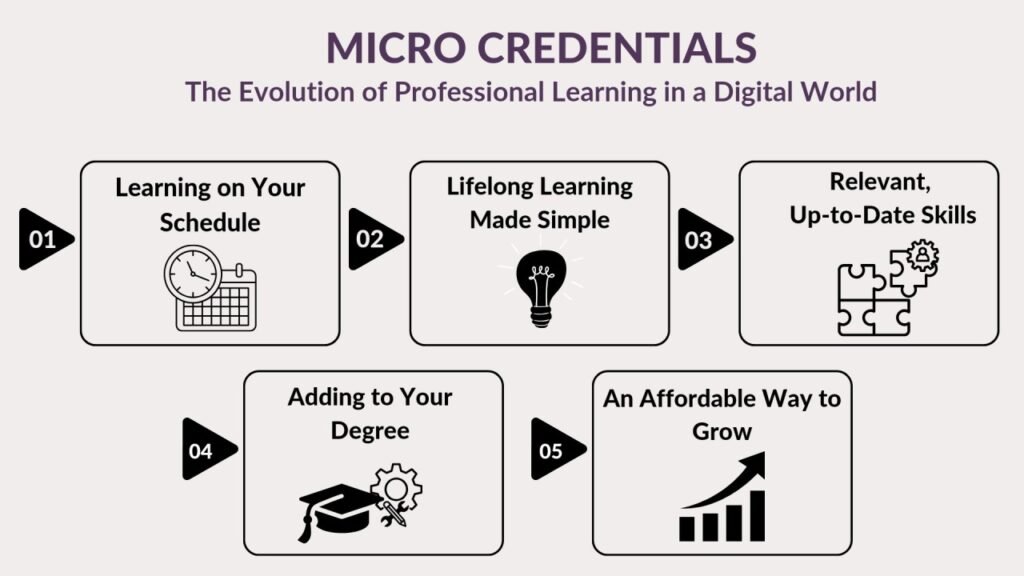
One of the biggest advantages is affordability. University education can be prohibitively expensive, often requiring significant financial investment over several years. In contrast, micro-credentials are generally more cost-effective, making them accessible to a wider audience.
Time is another critical factor. In a fast-paced digital economy, waiting four years to acquire a degree can feel like a disadvantage. Micro-credentials allow learners to gain relevant skills quickly and enter the workforce sooner.
Flexibility also plays a major role. Many micro-credential programmes are delivered online, enabling learners to study at their own pace while balancing work or other commitments. This is particularly relevant in Nigeria, where many young people combine learning with side hustles or freelance work.
Beyond accessibility, micro-credentials support lifelong learning. As industries evolve, professionals must continuously update their skills to remain competitive. Micro-credentials make it easier to reskill or upskill without returning to full-time education.
Importantly, these certifications are often highly practical. Unlike some traditional academic programmes that emphasise theory, micro-credentials focus on hands-on skills that can be immediately applied in the workplace. This practical orientation aligns closely with employer expectations.
Universities Are Adapting but Not Disappearing
Despite the growing popularity of micro-credentials, it would be inaccurate to suggest that university degrees are becoming irrelevant. Instead, the relationship between the two is evolving.
Many universities are already adapting by integrating micro-credentials into their offerings. More than half of higher education institutions globally have begun incorporating these programmes into their curricula, with even more planning to do so in the near future.
This hybrid approach allows students to combine the depth of a traditional degree with the specificity of micro-credentials. For example, a computer science student might supplement their degree with certifications in cloud computing or data science, making them more attractive to employers.
At the same time, degrees still hold significant value. They provide foundational knowledge, critical thinking skills and broader intellectual development. In many cases, employers still prefer candidates who combine formal education with practical skills.
However, the monopoly of degrees as the sole pathway into tech is clearly diminishing. The rise of micro-credentials signals a move towards a more flexible, inclusive and skills-driven education system.
What This Means for Nigeria and Emerging Tech Markets
For Nigeria and other emerging tech ecosystems, the rise of micro-credentials could be transformative.
The country has a large, youthful population with growing interest in technology. However, access to quality higher education remains uneven. Micro-credentials offer a scalable solution to bridge this gap, enabling more people to acquire in-demand skills without the barriers of cost and geography.
This trend also aligns with the rise of remote work. Nigerian developers, designers and tech professionals are increasingly working for global companies. In this context, what matters most is not where you studied, but what you can deliver.
Micro-credentials provide a way to showcase these capabilities. Digital badges and certificates can be easily shared online, making it simpler for employers to verify skills and assess candidates.
However, there are challenges to consider. Not all micro-credentials carry equal value, and the lack of standardisation can make it difficult for employers to assess their credibility. Some studies have also shown that not all certifications lead to immediate career advancement or salary increases.
This highlights the importance of choosing the right programmes. Learners must focus on credentials that align with market demand and are recognised by reputable organisations or industry leaders.
A Future Defined by Skills, Not Just Certificates
The rise of micro-credentials in tech hiring reflects a broader shift in how society defines education and competence.
We are moving from a system that prioritises formal qualifications to one that values demonstrable skills. This does not mean degrees will disappear, but it does mean they will no longer be the only measure of capability.
For individuals, the message is clear. Continuous learning is no longer optional. Whether through university education, micro-credentials or a combination of both, staying relevant requires constant adaptation.
For employers, the challenge is to refine hiring processes to accurately assess skills while maintaining standards of quality and credibility.
And for policymakers and educators, the task is to create frameworks that ensure micro-credentials are reliable, transferable and aligned with industry needs.
In the end, the question is no longer whether micro-credentials will overtake university degrees. The real question is how both can coexist to create a more dynamic, inclusive and effective system of education and employment.
As the tech industry continues to evolve, one thing is certain. The future belongs not just to those with certificates, but to those who can prove what they know and apply it where it matters most.
Join Our Social Media Channels:
WhatsApp: NaijaEyes
Facebook: NaijaEyes
Twitter: NaijaEyes
Instagram: NaijaEyes
TikTok: NaijaEyes