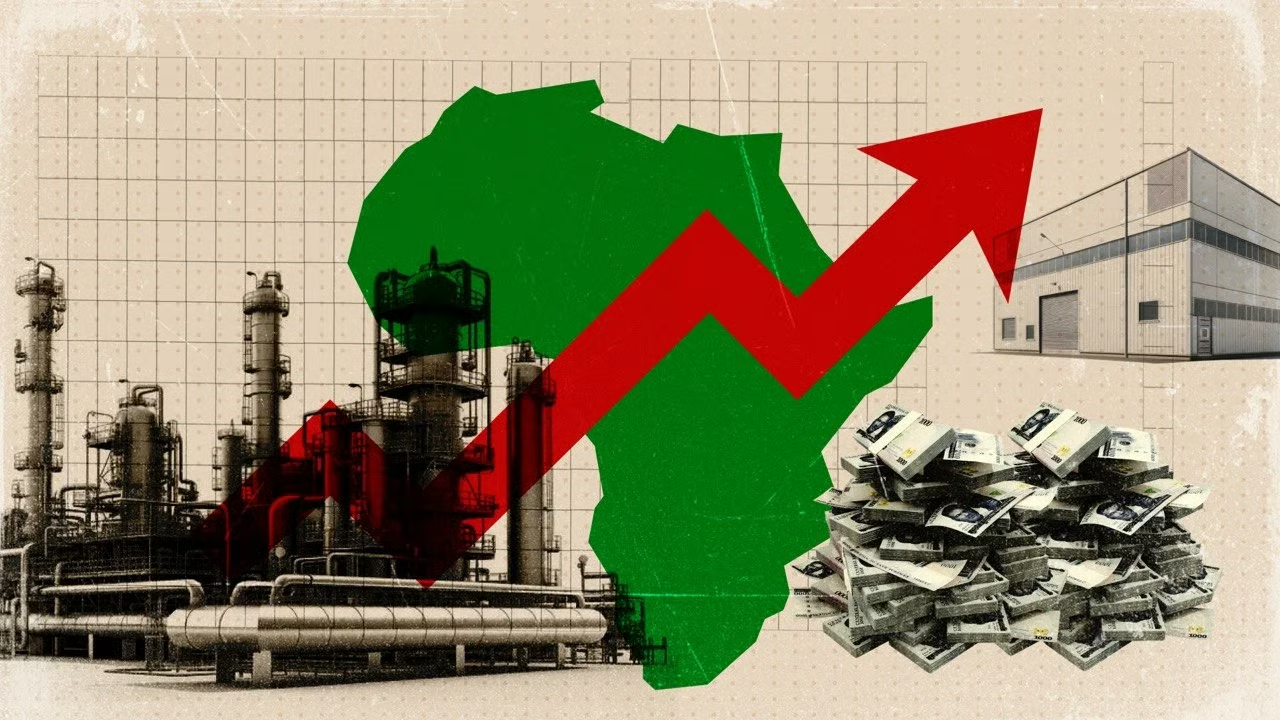

Africa’s startup ecosystem has kicked off 2026 with renewed momentum, recording more than $700 million in funding within the first quarter alone. While the headline figure signals resilience in the face of global economic tightening, a closer look reveals a deeper transformation in how capital flows across the continent.
From Lagos to Cairo and Nairobi, investors are not just writing cheques; they are rethinking risk, sector priorities, and the very structure of funding deals. For founders and stakeholders in Nigeria and across Africa, this shift could define the next phase of innovation on the continent.

A Strong Start to 2026 Masks a Changing Investment Playbook
Between January and March 2026, African startups raised approximately $705 million across 59 deals spanning at least 14 countries. This performance builds on a strong opening to the year, with over $575 million already secured within the first two months alone, signalling early investor confidence.
At first glance, the numbers suggest a healthy rebound for African tech after a turbulent global funding environment in recent years. However, beneath the surface lies a structural shift that is redefining how startups raise and deploy capital.
One of the most notable changes is the rise of debt financing. Traditionally viewed as a last resort for struggling companies, debt is now becoming a strategic tool for growth-stage startups. In Q1 2026, debt and hybrid funding instruments accounted for more than $490 million of total capital raised, significantly outweighing pure equity investments, which stood at roughly $212 million.
This signals a maturing ecosystem where startups are no longer solely reliant on venture capital. Instead, they are leveraging more sophisticated financial structures to scale sustainably while retaining ownership.
For many Nigerian founders, this evolution presents both an opportunity and a challenge. While access to alternative financing can reduce dilution, it also demands stronger financial discipline and predictable revenue streams.

Fintech Retains Dominance but New Sectors Gain Ground
Despite ongoing diversification, fintech remains the backbone of Africa’s startup funding landscape. In Q1 2026, the sector recorded the highest number of deals, accounting for 20 out of 59 transactions and attracting about $208 million in investment.
This dominance is hardly surprising. Financial technology continues to address critical gaps in payments, lending, and financial inclusion across the continent, particularly in markets like Nigeria, where digital transactions are rapidly expanding.
However, what stands out in 2026 is the growing competition from other sectors. Mobility and logistics startups collectively raised around $161 million, driven by increasing demand for transportation infrastructure and last-mile delivery solutions.
Clean energy is also emerging as a serious contender. With just a handful of deals, the sector still attracted over $100 million, largely due to large-scale project financing rounds.
Agritech, another critical sector for Africa’s future, pulled in nearly $60 million, reflecting investor interest in food security and climate-resilient farming solutions.
This diversification aligns with broader industry trends. Early 2026 data shows investors increasingly backing infrastructure-heavy and business-to-business startups, rather than purely consumer-focused platforms.
For Nigeria, this shift could open new funding pathways beyond fintech, particularly in sectors like energy, logistics, and agriculture where the country holds strong market potential.
Nigeria Leads in Deal Activity but Trails in Capital جذب
Nigeria continues to assert itself as one of Africa’s most active startup ecosystems. In Q1 2026, it recorded the highest number of deals on the continent, highlighting the country’s vibrant entrepreneurial pipeline.
However, when it comes to total funding value, Nigeria lags behind its peers. Egyptian startups led the continent with approximately $190 million in funding, followed by South Africa with $157 million. Nigeria, by comparison, attracted about $78 million.
This disparity points to a critical gap. While Nigeria excels at generating startup activity, it struggles to secure large-ticket investments compared to other major markets.
Several factors may explain this trend. Investors are increasingly favouring growth-stage companies with proven revenue models, and many of these are currently concentrated in markets like Egypt and South Africa. Additionally, macroeconomic concerns, including currency volatility, may be influencing investor sentiment towards Nigeria.
That said, Nigeria’s strong deal volume suggests a robust early-stage ecosystem. The challenge now is to nurture these startups into scalable businesses capable of attracting larger rounds.
What This Means for African Startups and the Road Ahead
The first quarter of 2026 offers a clear message. Africa’s startup ecosystem is not just growing, it is evolving.
The rise of debt financing signals a shift towards sustainability and capital efficiency. Startups are being forced to build stronger business models, prioritise profitability, and demonstrate clear paths to revenue.
At the same time, sector diversification shows that innovation is spreading beyond fintech into critical areas like energy, logistics, and agriculture. This could lead to more balanced economic growth across the continent.
For Nigerian entrepreneurs, the implications are significant. The opportunity to lead in deal volume must now translate into leadership in funding value. Achieving this will require stronger execution, better governance, and increased investor confidence.
Looking ahead, analysts expect consolidation, mergers, and strategic partnerships to shape the next phase of Africa’s tech ecosystem. Companies that can scale efficiently while adapting to new funding realities will be best positioned to thrive.
Ultimately, the $700 million milestone is more than just a number. It is a reflection of a continent in transition, where innovation is no longer just about growth, but about building resilient, sustainable businesses that can compete on a global stage.
Join Our Social Media Channels:
WhatsApp: NaijaEyes
Facebook: NaijaEyes
Twitter: NaijaEyes
Instagram: NaijaEyes
TikTok: NaijaEyes