Two African students have captured global attention with a bold innovation that challenges one of education’s biggest barriers in the developing world: lack of internet access. In a world increasingly driven by digital learning, millions of students remain excluded simply because they cannot get online.
That reality is what inspired Happy Niyorurema and Mame Niang, students at Texas Christian University, to build an artificial intelligence-powered education system that works entirely without internet connectivity. Their solution delivers lessons through ordinary phone calls, meaning users do not need smartphones, data, or even literacy in navigating apps.
At its core, the system uses voice-based AI to interact with learners, providing educational content in a simple, accessible format. A student can dial in, ask questions, and receive guided learning responses, effectively turning any basic mobile phone into a learning device.
This innovation is particularly significant for Africa, where access to digital infrastructure remains uneven. According to global estimates, a large percentage of learners across the continent still lack reliable internet or computers, making traditional e learning platforms inaccessible to many.
By removing the dependency on internet connectivity, the students’ solution does something powerful. It meets learners where they already are, using technology they already have.
Global Recognition at the World Stage
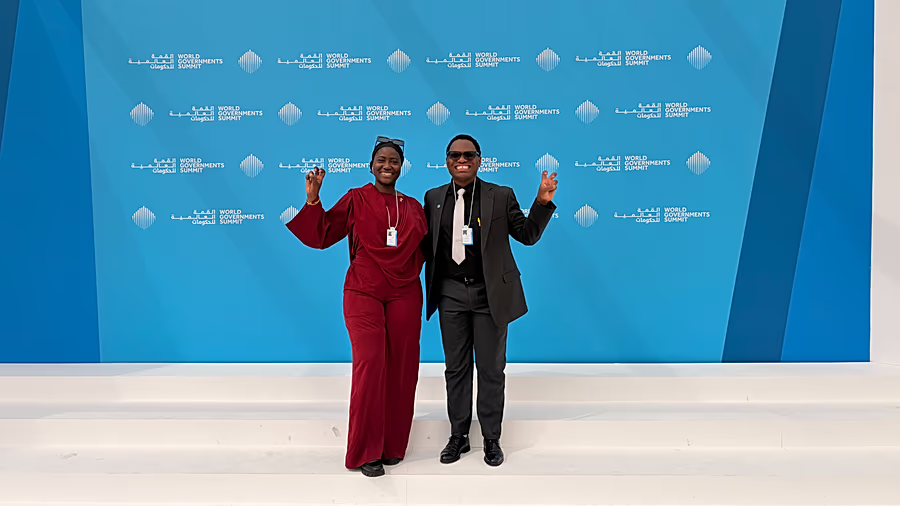
The impact of this idea did not go unnoticed. The project earned the prestigious Global Best M Gov Award at a major international gathering in Dubai, where governments and innovators from across the world convened to showcase solutions that improve public services.
The award highlights not just technical brilliance but also real-world relevance. In a space often dominated by high-end innovations requiring expensive infrastructure, this solution stands out for its simplicity and scalability.
The judges recognised the system’s potential to transform education delivery in underserved communities. Its ability to function without internet makes it especially valuable in rural and low-income regions, where connectivity challenges have long slowed educational progress.
Beyond the recognition, the innovation signals a broader shift in how African talent is contributing to global technology conversations. Rather than simply adopting imported solutions, young African innovators are now building context-driven technologies that directly address local challenges.
How the AI System Works and Why It Matters
The system operates through a voice-based interface that allows users to access lessons via phone calls. This approach removes several common barriers at once. There is no need for smartphones, no need for mobile data, and no need for complex digital skills.
In practical terms, a learner in a remote village can dial a number, interact with the AI, and receive structured educational content. The experience is designed to mimic a tutoring session, where questions can be asked and explanations provided in real time.
This model is especially relevant in regions where educational inequality is driven by infrastructure gaps. In many African countries, even where schools exist, there are shortages of teachers, learning materials, and digital tools.
Artificial intelligence has often been positioned as a high-tech solution requiring advanced systems, but this innovation flips that narrative. It demonstrates that AI can be lightweight, inclusive, and adaptable to low-resource environments.
There is also a deeper implication for language and accessibility. Voice-based systems can be adapted to local languages, making education more inclusive for learners who may not be fluent in English or other dominant languages used in formal schooling.
Early reports indicate that the system is already being piloted in parts of Africa, with plans to expand into more countries.
A Defining Moment for African EdTech and the Future of Learning
This achievement comes at a time when education systems across Africa are under pressure to evolve. Governments and institutions are increasingly turning to digital solutions to address gaps in access, quality, and scale.
However, many of these solutions still depend heavily on internet infrastructure, which remains inconsistent in several regions. That is why innovations like this stand out. They do not wait for infrastructure to catch up. Instead, they work around existing limitations.
The success of Niyorurema and Niang also reflects a growing movement among African innovators who are building technology with a clear social purpose. Their work aligns with broader continental efforts to expand digital education and improve learning outcomes through technology-driven approaches.
More importantly, it challenges assumptions about what innovation should look like. In many cases, the most impactful solutions are not the most complex but the most practical.
For Nigeria and other African countries, the implications are significant. With millions of students facing similar connectivity challenges, adopting or adapting such solutions could help bridge longstanding educational gaps. It also opens up opportunities for local developers, policymakers, and investors to rethink how technology is deployed in the education sector.
As the global education landscape continues to evolve, one thing is clear. The future of learning will not be defined solely by high-speed internet and advanced devices. It will also be shaped by inclusive innovations that ensure no learner is left behind.
And in that future, ideas like this one, simple, scalable, and deeply human-centred, may well lead the way.
Join Our Social Media Channels:
WhatsApp: NaijaEyes
Facebook: NaijaEyes
Twitter: NaijaEyes
Instagram: NaijaEyes
TikTok: NaijaEyes